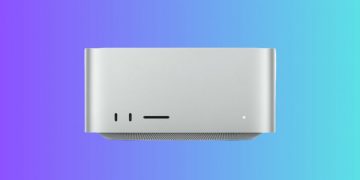



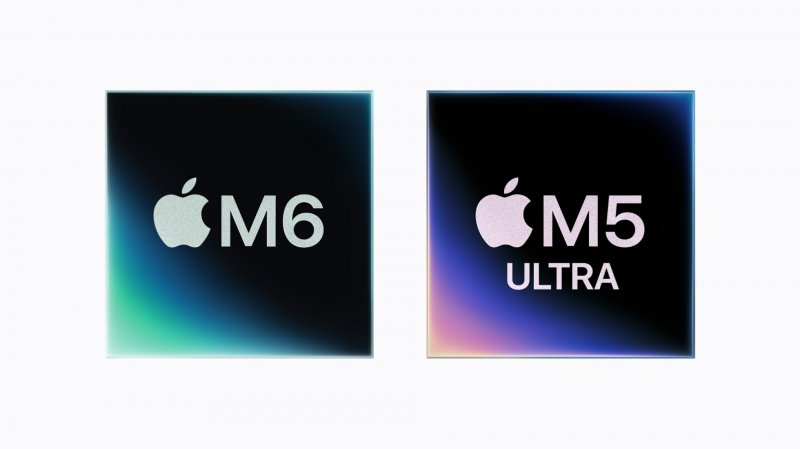
apple display M6 and M5 Ultra, two new chips designed to dramatically improve desktop Mac performance. The M6, which debuted in the new Mac mini, is the company’s first SoC built using a 2nm production process, while the M5 Ultra apparently represents the most powerful chip Apple has ever produced and will be used in the new Mac Studio.
The two platforms follow different approaches. M6 focuses first on efficiency and effectiveness Ideal for everyday tasks, software development and locally run AI, M5 Ultra is designed for professional workstations, rendering, video and large-scale AI models.
M6 is Apple’s first 2nm chip
The new M6 uses 2nm manufacturing technology, which allows Apple to increase transistor density while improving performance and efficiency. The chip integrates 12 core CPUwith two super cores, four performance cores and six efficiency cores. Compared with M5, Apple claims that single-thread performance is superior, multi-thread performance is improved by up to 1.2 times, and the advantage is up to 2.4 times compared with M1. As a result, the new CPUs should deliver advantages, especially in the most demanding workloads, from coding to photo editing to artificial intelligence-related activities.
However, the most important news in the field of artificial intelligence is Dual Neural Engine a 16 core. Both engines can be used by the system framework at the same time, and the peak computing power can reach twice that of the previous generation products. The M6’s GPU has also been increased, reaching 12 cores, two more than the M5. Each core also incorporates a neural accelerator, a solution that boosts specialized processing power for artificial intelligence.
Apple launches new Mac mini equipped with M5 Pro and M6 chips: more powerful

Apple reports that peak AI performance is nearly 30% higher than the M5 and more than eight times higher than the M1. The new chip also incorporates an updated shader architecture, dynamic caching and hardware-accelerated ray tracing. The GPU also increases the geometry rate by 50%, aiming to improve the performance of more complex graphics workloads and games.
M6 supports up to 32GB of unified memory, with a bandwidth of 170GB/s, which is about 10% higher than M5 and 2.5 times that of M1. The combination of more memory and more bandwidth will also allow larger language models to be run natively.
M5 Ultra is power
For Mac Studio, Apple showed off the M5 Ultra, the company’s “most powerful chip ever.” This SoC uses Next generation UltraFusion technologywhich connects two dual-die M5 Max dies, creating a four-die architecture for the first time in an M-series SoC.
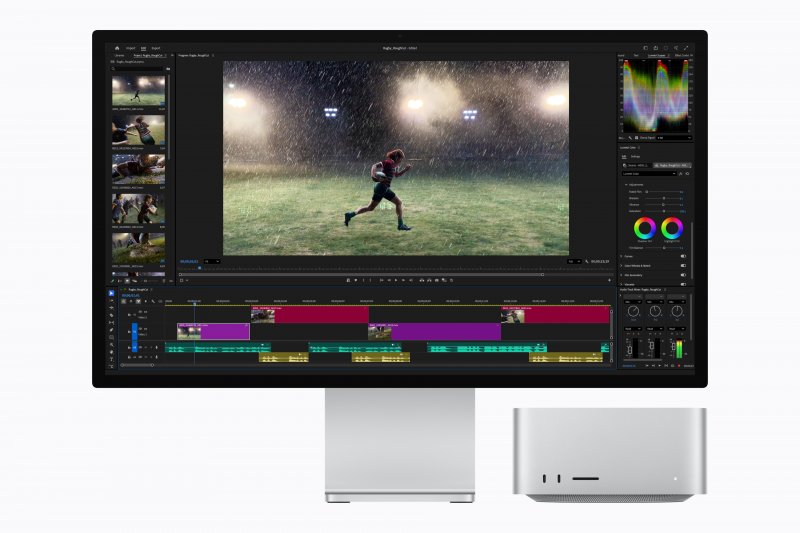
The connection between the four dies enables over 4.4 TB/s of inter-die bandwidth while increasing connection density by more than six times. The goal is to have four dies working as a single processor, minimizing losses due to communication between different components.
M5 Ultra is available at 36 core CPUconsisting of 12 super cores and 24 performance cores. According to Apple, single-thread performance is 1.25 times faster than the M3 Ultra, while multi-thread performance is 1.3 times faster.
However, the most important leap involves GPU, offering up to 80 coreseach equipped with a neural accelerator. Apple claims that peak AI performance is up to 4.5 times that of the M3 Ultra and more than six times that of the M1 Ultra. The GPU also uses Apple’s new shader cores, second-generation dynamic cache, hardware-accelerated mesh shading, and third-generation ray tracing. Overall, graphics performance is 40% better than the M3 Ultra.
The M5 Ultra also has a 32-core neural engine and, most importantly, a unified memory capacity of up to 512 GB. On the contrary, the bandwidth reaches 1.2 TB/s, which is 50% higher than M3 Ultra. Such devices can also run large artificial intelligence models with hundreds of billions of parameters locally without the need to constantly transfer data to the cloud. For professionals, this means the ability to keep entire data sets in system memory and increase the number of tokens processed per second.
In short, Apple is focused on doing artificial intelligence processing directly on the device. The M6 combines dual neural engines with neural accelerators in the GPU, while the M5 Ultra has enough memory and computing power to handle larger models. Hardware support includes Core ML, Metal, Core AI and Xcode, as well as the Apple Foundation Models framework and tools related to Apple Intelligence. The goal is to enable developers to run and optimize AI models directly on the Mac, automatically leveraging the CPU, GPU, and Neural Engine.
So the difference between the two chips is clear: the M6 is focused on efficiency and next-generation general-purpose performance, thanks first to the transition to 2 nm, while the M5 Ultra brings Apple Silicon architecture to a configuration designed for workstations and very intense AI, with four dies, 80 GPU cores, and up to 0.5TB of unified memory.