

In classical physics, heat spreads uniformly in all directions, which is the basis of all cooling. In the quantum world, everything is not that simple, heat can travel in the form of focused waves in strictly specified directions. This is observed during cryogenic cooling of substances, but is difficult to apply in practice. Now scientists first Observing focused quantum propagation of heat at room temperature gives a completely different perspective.
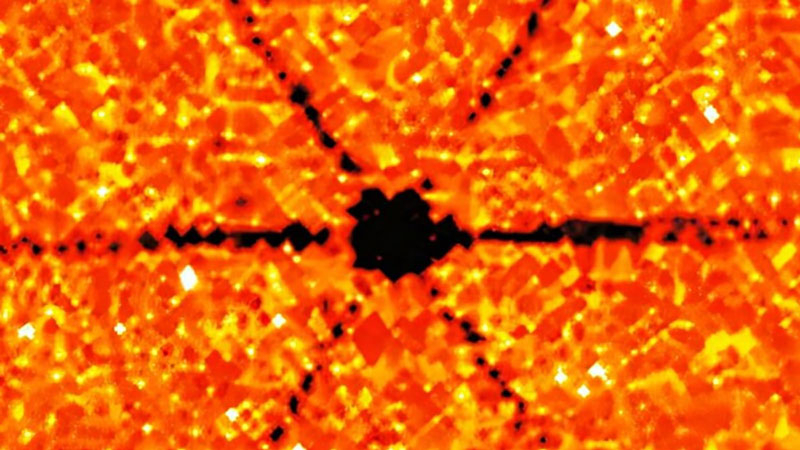
Image source: Nature Physics 2026
In modern physics, quasiparticles are responsible for heat transfer phonon. These are the lattice vibration quanta that transfer thermal energy. In ordinary materials at 300 K they are constantly scattered by other phonons, defects and crystal boundaries, so the heat from the classical waves is rapidly transferred to the usual diffusive propagation – chaotic and omnidirectional. In order to observe the wave characteristics of heat propagation, the researchers used boron arsenide as a sample. The scattering of boron arsenide is extremely weak, so the phonons in it can retain the wave characteristics over a longer distance.
To detect this effect, scientists developed a nanoscale temperature mapping method. In ordinary materials, a heat source produces a roughly circular propagation pattern. In contrast, distinct ray-like structures appear in boron arsenide crystals. Furthermore, their geometry depends on the orientation of the crystal lattice: four-, six- and eight-ray patterns are observed on different crystal planes. What is important is that the experimental results agree with the theoretical calculations. To obtain clear images of thermal wave propagation, a gold nanowire heater was introduced into the material, which also acted as a detector.

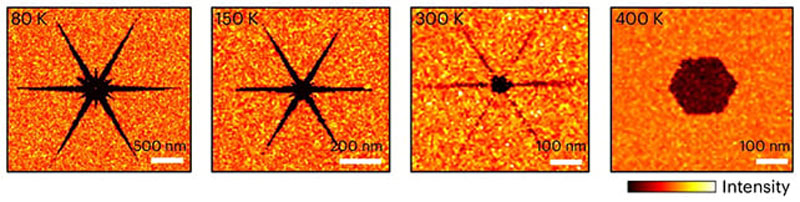
Scientists first observed the phenomenon of wave focusing heat transfer at an ambient temperature of 27°C. This is still advanced science, but it shows that heat transfer can be precisely controlled under normal conditions. The researchers did not hide the fact that the practical implications of this finding mainly relate to thermal management of electronics. If we learn to orient phonon motion through the structure of a material, heat can not only be dissipated but directed to specific areas or removed from the most important components. This ability is critical for cooling powerful chips, artificial intelligence accelerators and future quantum computers.
If you find an error, select it with your mouse and press CTRL+ENTER.