
Scientists may have made a breakthrough in their search for dark matter, discovering signs of it in an experiment about a kilometer and a half underground in South Dakota, USA, Reuters reported. However, they are yet to claim that they have finally discovered this elusive component of the universe.
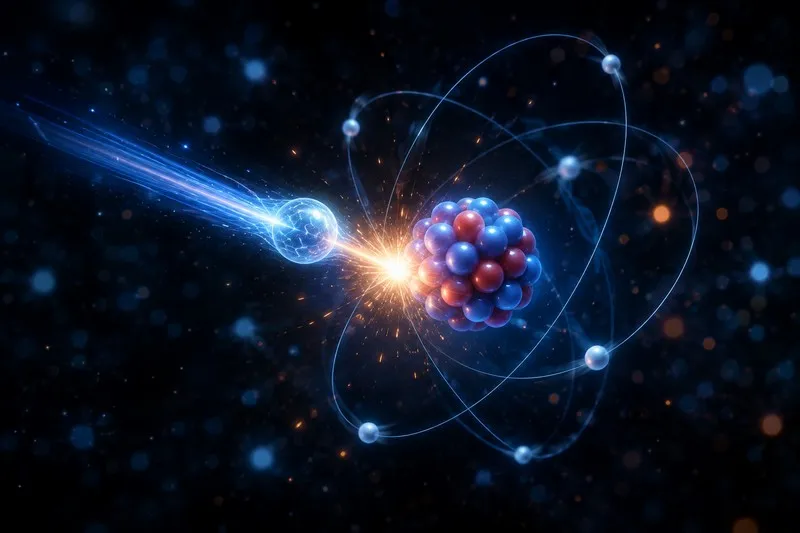
Image source: ChatGPT/3DNews
Researchers describe particle interactions recorded at the Sanford Underground Research Facility, built on the site of a former gold mine in the Black Hills of South Dakota. Scientists speculate that this interaction may involve a hypothetical particle called WIMP, short for WIMP “Weakly interacting massive particles”. This is one of the putative candidates for the role of dark matter particles.
Ordinary matter forms stars, planets, humans, and everything else we can see. But it only accounts for about 15% of all matter in the universe. The rest is considered dark matter, which neither emits nor reflects light, making it invisible to the human eye and elusive to telescopes. But due to its gravitational influence on the scale of the Milky Way, scientists are confident in the existence of dark matter.
Sam Eriksen, a particle physicist at the University of Bristol and lead author of the study describing the work, said: “Possibly the first sign of dark matter observed”. Dark matter is believed to rarely interact with ordinary matter. The discovery was made by the ongoing LUX-ZEPLIN or LZ experiment, designed to document such interactions and optimized for the search for WIMP particles.
The experiment used 10 tons of liquid xenon pumped into a large cylindrical container detector operated by the U.S. Department of Energy’s Lawrence Berkeley National Laboratory. Researchers are looking for dark matter that scatters off xenon atoms. When the particles scatter, a flash of light occurs, the characteristics of which can be used to determine the type of particle interacting with the xenon.
A statement from a scientific conference in Japan on Tuesday, along with a study published in the journal Physical Review Letters, reported the discovery of an interaction between xenon atoms and another particle that appeared to follow a scenario typical of WIMP particles. According to the scientists, they may have observed WIMP particles colliding with xenon nuclei, which released a small amount of energy, leading to the faint flashes of ultraviolet radiation recorded during the experiment. The result of the collision is that the xenon nuclei move forward, called nuclear recoil.
While the researchers said the interactions that occurred when colliding with WIMP particles were as expected, they noted that the data obtained did not yet reach the statistical threshold needed to declare the discovery of dark matter. “It’s worth noting that since this is an isolated case, we’re not saying it’s dark matter.”Erikson said.
Researchers are now working to rule out other possible explanations. “We may have encountered something unusual, but we would have to conduct an extremely thorough analysis to come to a conclusion.”said astrophysicist Alvin Kamaha, co-author of the study.
Scientists still don’t know what the nature of dark matter is, just like they don’t know the nature of the mysterious cosmic force called dark energy. “There may be millions of dark matter particles flying through our bodies every second, but almost none of them interact with the atoms in our bodies.”Kamaha said.
The main hypothesis is that dark matter consists of particles that formed in the early universe and exist today.
“When we look at galaxies and galaxy clusters, we find that they appear to have much more mass than the matter we see. So, while we can’t see dark matter itself, we can observe its gravitational effects. Dark matter can be compared to the cosmic glue that helped form galaxies like the Milky Way. Without dark matter, the evolution of the universe would have been very different, and ultimately the structure of our solar system might have formed differently.”Kamaha said.
Scientists are looking for dark matter in different ways.
“We are studying its gravitational effects on galaxies and the universe. We are trying to create dark matter particles in particle accelerators. We are using experiments like the LZ deep underground for direct detection to protect them from cosmic rays and other background radiation sources, while we look for extremely rare instances of dark matter particles interacting with ordinary matter.” – Kamaha added.
If you find an error, select it with your mouse and press CTRL+ENTER.