


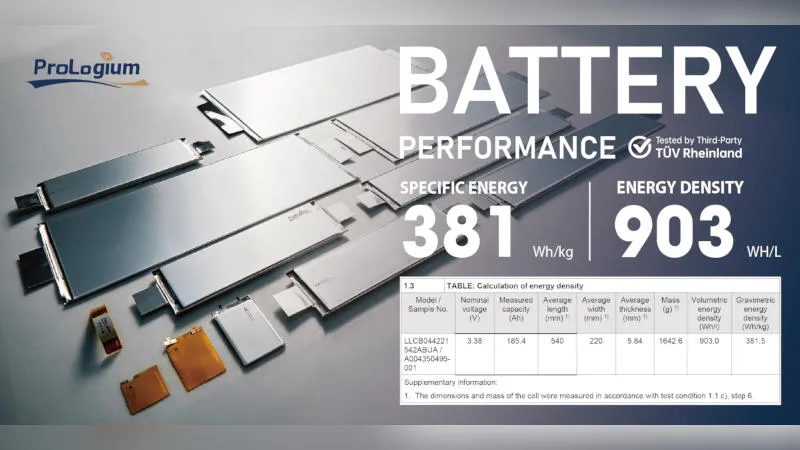
Taiwanese company Huineng announced the start of mass production of its 3.5th generation solid-state lithium ceramic batteries (LCB). As a result, the development of high-density energy storage solid-state batteries has moved beyond laboratory testing and pilot production.
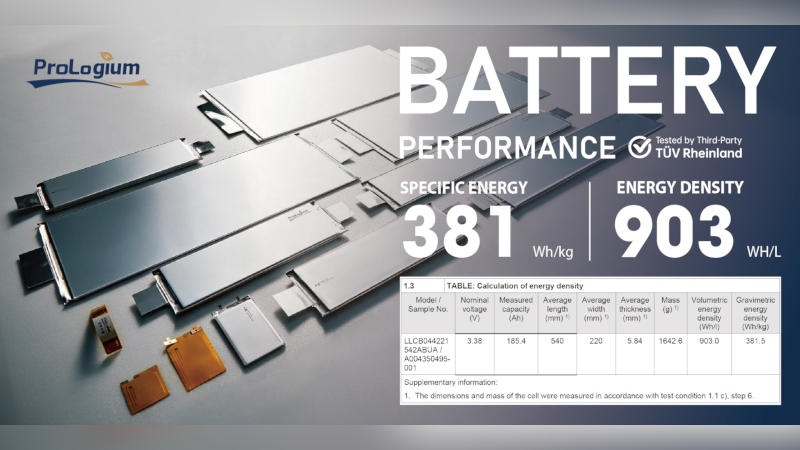
Image source: Huineng
Independent TÜV testing confirmed that the large 185.4 Ah ProLogium battery has a specific energy storage density of 381 Wh/kg and a volumetric energy density of 903 Wh/L. These indicators correspond to the declared characteristics of the 3.5 generation elements. Compared to previous solutions, Huineng has been able to reduce the weight and size of the battery while maintaining the same energy reserve, while delivering high power output and supporting fast charging.
Another independent test was conducted by UL Solutions. The battery was tested according to Chinese standard GB/T 43568-2026, which also defines the classification criteria for solid-state batteries. After 6 hours in a vacuum at 120 °C, the component lost less than 0.05% of its mass. This is ten times lower than the 0.5% limit that allows cells to be classified as all-solid-state.
ProLogium lithium ceramic batteries are built on Logithium’s proprietary architecture. Ceramic separators sit between the electrodes and provide a protective frame along the edges of the element. It prevents stray burrs at the electrode edges from damaging adjacent layers while providing sealing and electrical insulation. Through this design, Huineng can change the chemical composition of the battery and electrode materials while maintaining the principles of battery assembly. Therefore, the transition to next-generation batteries does not require a complete reorganization of production lines.
The Logithium architecture will also form the basis for fourth-generation batteries. Their fundamental difference is the complete rejection of organic materials. Huineng estimates that only about 10% of existing production lines and equipment need to be modified to produce such components. The new generation of products should further increase energy storage density, power and charging speed, as well as additional high-temperature operation ASM (anti-short circuit mechanism) protection mechanisms.
In addition, fourth-generation batteries should perform better at low temperatures and be cheaper to manufacture due to lower material and process costs. Huineng expects that such components will be needed not only in electric vehicles, but also in power supply systems for artificial intelligence data centers and in the marine and aerospace industries.
In order to expand the scale of production, Huineng plans to create an international corporate network. Taiwan will remain a center for technology development and production process development, with plans for large-scale production in France and the gradual establishment of local battery production and supply capabilities in North America. Huineng may further implement a similar model in the Asia-Pacific region.
If you find an error, select it with your mouse and press CTRL+ENTER.