


A group of scientists from Asia have built a robot that borrows the locomotion principles of the insect, the stick insect. The machine achieved this result on its own without setting itself the main goal of imitating natural prototypes.
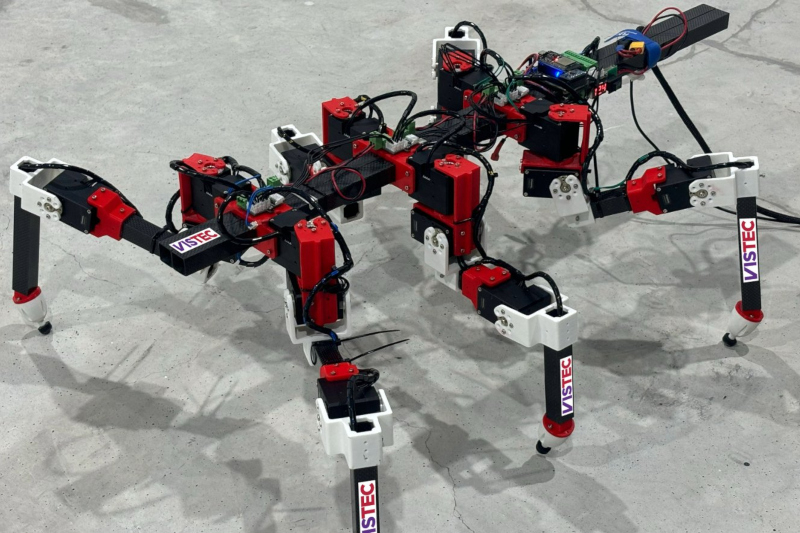
Image source: tohoku.ac.jp
author: project Engineers from Tohoku University (Japan) and the Vidyasirimedi Thailand Institute of Science and Technology (VISTEC) turned engineers – they built insect-like robots that can move across a variety of surfaces, partially mimicking the movements of stick insects. The study authors say just a few steps are enough for the stick insect to enable a machine five times its size to repeat the same principle.
Scientists point out that insects have a relatively simple central nervous system, but so far they have not been able to accurately restore the coordination principles of insect movement. To overcome this problem, they decided not to give the robot direct instructions on how to move, but to give it a goal and it would try to achieve it. This problem was solved using an artificial intelligence model trained on adversarial reinforcement learning – which was rewarded for the safe position of the legs.
As a result, the system only required brief interactions with stick insects moving on a flat surface—the robot, controlled by the AI model, independently learned to navigate various types of terrain in less than an hour. The model is very reliable and can be used with robots with different structures. In fact, such machines can be used to eliminate the consequences of disaster areas where there are no flat surfaces at all. They will be able to move, even if they lose some limbs in the process – with artificial intelligence able to adapt to new conditions.
If you find an error, select it with your mouse and press CTRL+ENTER.