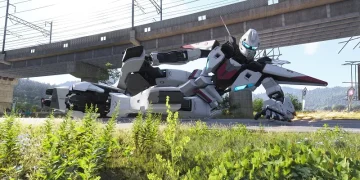


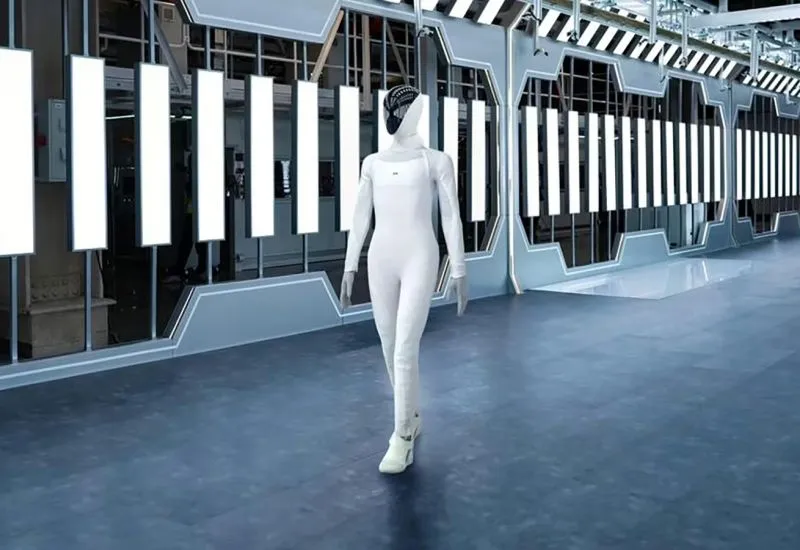
Chinese company Xpeng Motors has unveiled a range of ambitions, trying to produce not only electric cars but also flying taxis and humanoid steel robots. Their mass production should begin before the end of this year, and the company this month showed off the factory where such activity will take place. The first locally assembled robot prototype is presented to the public.
Image source: Xpeng Motors
essentially a ritual Very focused Xpeng Motors, a company dedicated to assembling humanoid robots, has completed construction, but its mass production itself has not yet started. After completing all stages of the process, the company hopes to begin mass assembly of Iron robots by the end of this year. The first batch of robots will be used within the company and in the company’s car dealerships, with sales of Iron to external customers, including foreign ones, expected to begin in 2027.
More than 80% of operations at the assembly plant are automated, but its production capacity and the price of the Iron robot itself have not yet been revealed. As part of the opening ceremony of the new enterprise, the first feminine robot assembled there was elegantly presented to an audience of delegates in the workshop, and was personally greeted by He Xiaopeng, the head of Xpeng Motors, who hung a commemorative badge around the robot’s neck and even hugged him in the subsequent group photo. Company representatives have spoken out about the prospect of introducing robots into all areas of society and even turning them into family members. However, Xpeng Motors said this transformation will last ten to fifty years.
Iron will have to develop a humanoid robot assembly line from scratch; assembly speed and scale will be priorities for Xpeng Motors in production development. The robots are launching in November 2025; their “brains” are three proprietary Turing AI processors, which allow them to handle AI tasks locally even without communicating with remote servers. The robot’s kinematics allow 76 degrees of freedom for the entire body and 21 degrees of freedom for each arm. The flexible shell has a mesh structure, allowing you to combine the safety of human-computer interaction with the familiar perceptual beauty.
According to Xpeng Motors’ predictions, producing robots will be more profitable than producing electric cars — at least per car sold. As mentioned above, Iron’s humanoid robots won’t hit the market in China and other countries until next year, but by showing that factories are ready to assemble the robots, the company is proving that it has the ability to begin mass production by the end of this year as planned.
If you find an error, select it with your mouse and press CTRL+ENTER.