
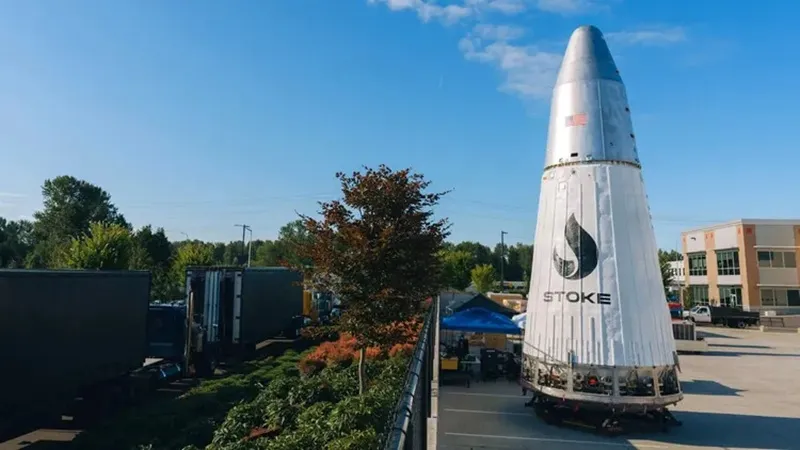
American aerospace company Stoke Space has completed US$1 billion in Series E financing, with an investment of US$2.3 billion in Stoke. The company is developing fully reusable Nova Pathfinder and Nova Block 2 rockets, the first of which is scheduled to launch in 2027.
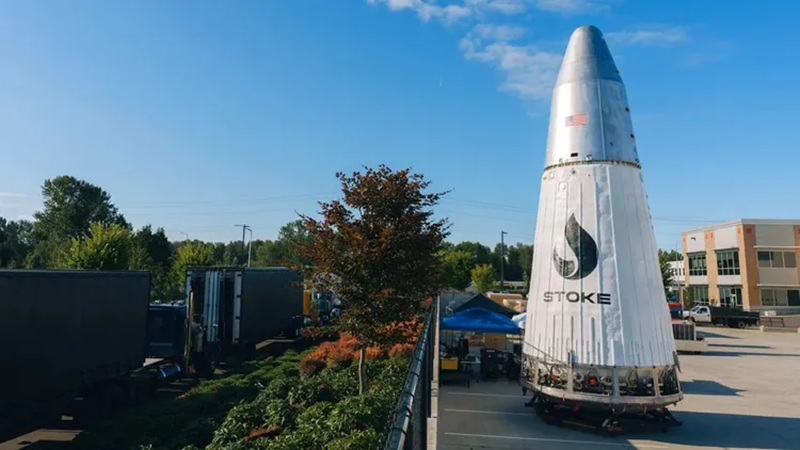
Image source: Stoke Space
According to Stock, Nova Pathfinder is the largest rocket ever launched by a U.S. company. The two-stage Pathfinder’s first stage is equipped with seven proprietary Zenith full-flow staged combustion (FFSC) rocket engines powered by liquid oxygen and liquefied natural gas (LNG). There are many advantages to using this type of engine, including reducing the amount of maintenance required between flights.
Like the Block 2, the Nova Pathfinder’s upper design is different from other missiles. Instead of the tiles typically used for spacecraft heat shields, Nova’s dome structure is made of metal and is cooled by the liquid hydrogen that powers Andromeda’s propulsion system.
In addition, the Nova upper stage is not equipped with a large central engine hood, but is equipped with 12 small twin thrust chambers arranged in a circle. In 2023, Stork used the “funnel” to test the Pathfinder upper-stage engine system, flying about 10 meters and landing safely.
Stoke plans to launch Pathfinder into orbit for the first time in early 2027 carrying customer payloads. If successful, additional Pathfinder missions will be carried out during 2027 and 2028.
Simultaneously, development will also take place on Nova Block 2, a more powerful system designed to deliver up to 15 tons of payload to low Earth orbit (LEO). Its upper stage will be equipped with independent systems for 12 engines, and the thrust will be increased by more than five times. Unlike Pathfinder’s conical design, the Block 2 upper stage will be cylindrical, which will increase fuel volume and payload. The first launch of Block 2 is planned for 2029. Its closest competitors are SpaceX’s Falcon 9 rocket and Rocket Lab’s Neutron launch vehicle, the latter of which is still under development.
The company will use the funds raised to develop the rocket and build the infrastructure Stoke needs to build, test and eventually operate both rockets. The company plans to expand its 30-hectare Moses Lake test site in Washington by 192 hectares to test propulsion systems and the missile itself.
The U.S. Space Force’s CCSFS Space Launch Complex 14 base in Cape Canaveral, Florida, is also under construction and is designed to accommodate two spacecraft. Additionally, the company is developing an offshore platform for landing them in the ocean.
If you find an error, select it with your mouse and press CTRL+ENTER.