


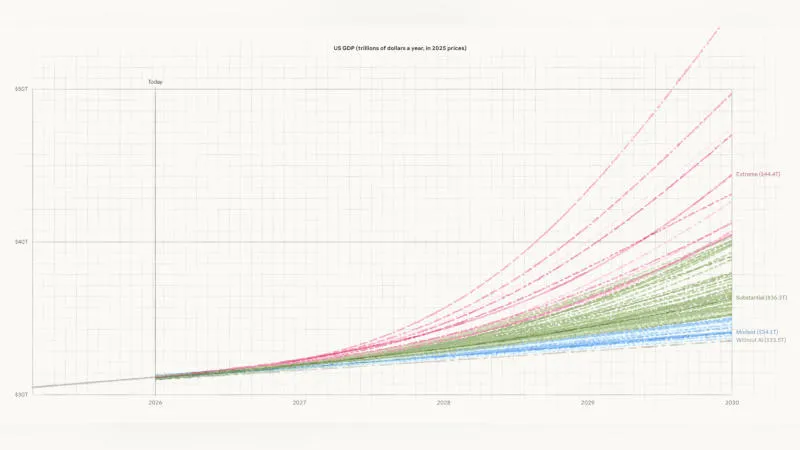
Proposed by Anthropic, an American artificial intelligence laboratory Three models By 2030, the impact of artificial intelligence technology on the U.S. economy: “moderate,” “significant,” and “extreme.” In the latter case, the economy and labor market will face fundamental changes.

Image source: anthropoic.com
The implementation of any scenario in practice will depend on the development of artificial intelligence capabilities and implementation mechanisms. In a “restricted” growth scenario, the impact of artificial intelligence on the economy is roughly the same as that of the Internet: it provides real economic benefits, creates new products and services, and changes some industries, but has no fundamental impact on the economy. Innovation is being rolled out at the historic pace of all new technology developments.
The “real” scenario assumes that by 2030, artificial intelligence will take over more than half of all human mental work. It is not implemented everywhere yet, but mostly operates autonomously. Most work tasks are performed the old-fashioned way, without the involvement of artificial intelligence. As a result, US GDP growth doubled from 2-2.5% to 4-5% per year.
The “extreme” model assumes that artificial intelligence surpasses and replaces humans in the vast majority of mental tasks, acting autonomously while humans face few new tasks. The U.S. GDP began to grow at an annual rate of 15%, or doubled in 4.5 years. In this scenario, Americans as a whole would become richer, but the number of knowledge workers would decline and unemployment would reach unprecedented levels as programmers and other professionals would be forced to change careers and new jobs would become harder to find.
In August, Anthropic conducted a survey, in which the majority of respondents predicted a “substantial” development pattern by 2030: By 2030, GDP will be 10% higher than without artificial intelligence, and the unemployment rate will reach about 5%. Another 10% of respondents preferred “extreme” scenarios.
If you find an error, select it with your mouse and press CTRL+ENTER.