



IL Cheating is becoming an increasingly important issue for developers Multiplayer competitive gamesnot only from the perspective of user experience, but also from an economic perspective. This is the conclusion of the report “The Rise of Cheating as a Service” created by Anybrain based on a survey of 250 developers in the US and UK.
According to research, 51% of studios surveyed reported a significant decrease in player retention or revenue due to cheatingwhile 69% believe cheating is a serious or very serious problem. 76% of developers have implemented at least one anti-cheat system.
a big deal
The report describes the phenomenon as an increasingly structured and professionalized ecosystem that includes cheating subscriptions, boosting services and manipulating internal gaming economies. Anybrain estimates that the market has reached Global value $8.5 billionalso cited the case of a cheating developer in 2021 who allegedly made approximately $77 million through services targeting a single game.
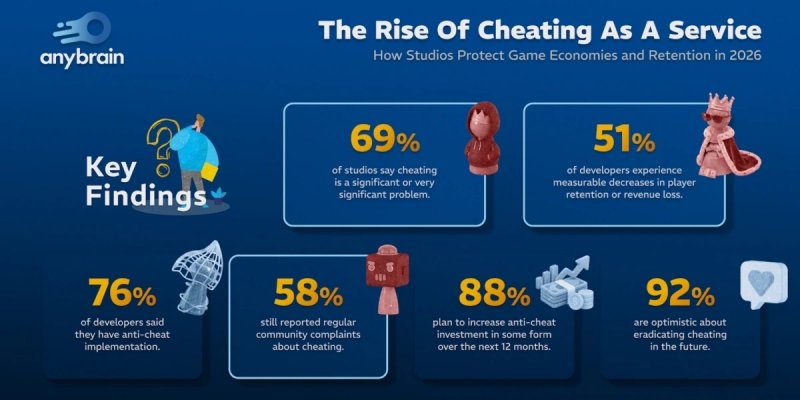
However, developers still encounter various difficulties in dealing with this phenomenon. 45% of respondents said Cheaters try to evade anti-cheat systemswhile 58% said their community frequently complained.
Call of Duty: Modern Warfare 2 Activision fixes bug used by cheaters in PC version

The solutions adopted can also create problems. 55% of research reports Technical difficulties caused by anti-cheat software 31% reported false positives, which could lead to innocent players being banned. A further 37% felt negative community reaction to the measures taken.
The most commonly used technology is client-side anti-cheat systems, accounting for 50% of studies, followed by artificial intelligence-based solutions at 48%, and third-party systems at 42%. Percentages may overlap given Developers can use multiple systems simultaneously.
Combating cheating seems destined to require increasing investment. 93% of studios surveyed have dedicated anti-cheat teams, and 88% plan to increase investment in this area in the next 12 months. Among the technologies developers are evaluating for next steps in intervention, 44% of respondents cited AI-based solutions, followed by third-party systems (42%) and proprietary core-level solutions (33%).
but it still exists Some studios do not yet use any anti-cheat system: This is 24% of the sample. Key reasons include difficulty finding effective solutions (25%), concerns about community reaction (22%), and belief that they do not have a serious cheating problem (22%). Another 15% do not have a dedicated team, while 12% believe the costs are too high, which is a real problem for the industry as a whole.
Despite these challenges, 73% of developers who do not currently use anti-cheat systems are considering introducing them within the next year. Overall, 92% of respondents also believe that cheating can be eliminated from games in the future.