



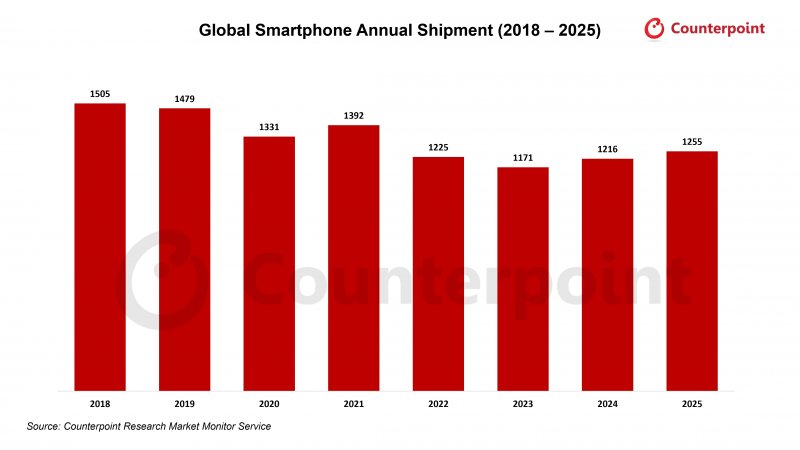
After several years of sharply shrinking shipments, the smartphone market is ending 2025 on a positive note. According to data compiled by Counterpoint Research from 2018 to 2025, the annual distribution 1 billion and 255 million smartphonescompared with 1 billion and 216 million in 2024. The 3% growth interrupted a negative sequence that took the market from record levels in 2018 into a tapering phase. However, the recovery is still not enough to bring shipments back to the levels of a few years ago, and now, due to the memory crisis, things are not the best, especially for manufacturers that rely on mid-range devices.
Samsung and Apple increase weight in smartphone market
Global shipments reached 1.5 billion units in 2018. In 2019, this number dropped to 1 billion and 479 million, The contraction will be more obvious in 2020shipments stopped at 1 billion and 331 million at that time. After a partial recovery of 1 billion units and 392 million units in 2021, the market begins to decline again in 2022 and 2023.
Growth in 2025 is also supported by last quarter’s performance, with an annual increase of 4%. Apple ranks first this quarter, with shipments growing 14%supported by demand for the iPhone 17 series. Samsung instead recorded a growth of 17%, the best result among the top five manufacturers.
Samsung Galaxy S26 “copies” Apple: Price increase as early as October?

The annual ranking shows that Apple’s market share in 2025 is 19.7%, only ahead of Samsung’s 19.2%. Xiaomi maintained third place with 13.2%, OPPO and vivo reached 11.5% and 8.5% respectively. Overall, the five largest manufacturers thus concentrate an increasing share of global shipments.
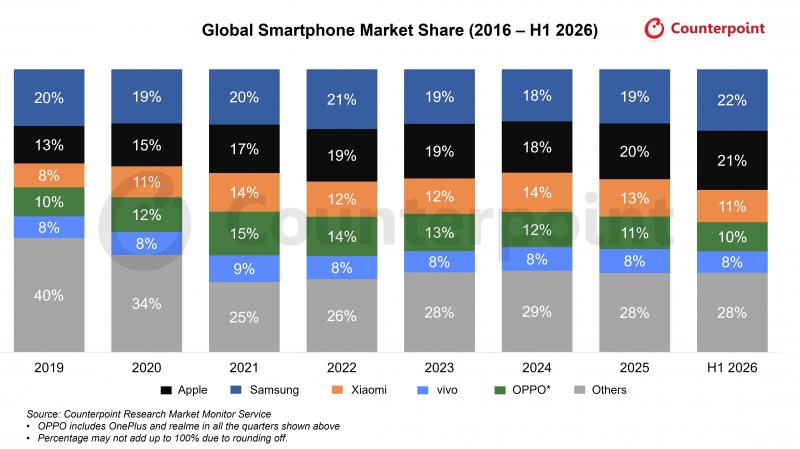
In the first six months of 2026, things changed again. Samsung regained the top spot with a market share of 21.8%while Apple reached 20.9%. Xiaomi fell to 11.4%, OPPO fell to 10.3%, and vivo fell to 7.6%.
However, the second quarter of 2026 highlights new difficulties. Global shipments fell 7% from the same period in 2025, mainly due to memory shortages and rising component prices. Some manufacturers have brought forward some shipments, at least partially mitigating the impact on the current season.
Developed markets are showing greater resilience due to an increase in quality equipment. North America grew by 6%, while Western Europe’s decline was limited to 1%. Apple grew by 13% in the second quarter, with a quarterly market share of 21%, becoming the only major manufacturer not to raise prices.
For Xiaomi, the situation is still more complicated, Second-quarter shipments fell 26%. In fact, greater exposure to the economy and intermediate segments makes manufacturers more sensitive to rising memory costs and declining purchasing power.
The data therefore describes a market that begins to recover in 2025 but faces new cost pressures in 2026. Trends in the coming quarters will be critical to understanding whether last year’s recovery represents the beginning of a more stable phase or is just an episode in a longer period of shrinking shipments.