
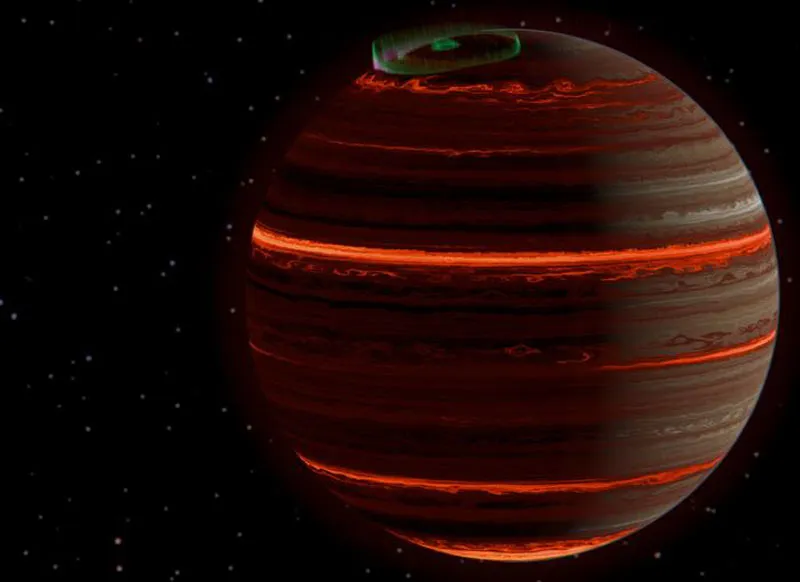
Scientist at Trinity College Dublin developed A method to understand changes in the weather of brown dwarfs by analyzing subtle changes in their brightness. The method was tested on SIMP 0136, an object about 20 light-years from Earth that is between a giant planet and a star in size and temperature. The technique is necessary to select potentially habitable worlds for further research, which will save time.
Image source: Trinity College Dublin
Brown dwarfs are not massive enough to sustain hydrogen fusion combustion—they do not become true stars—but their atmospheres can exhibit large and rapidly changing cloud structures. Importantly, the intense heating of the atmospheres of such objects allows the latest instruments, including the James Webb Space Telescope, to obtain quite rich data on the state of brown dwarf gas masses. It was Webb’s observations that made it possible to track changes in SIMP 0136’s atmosphere as the object rotates, and to actually study its atmosphere through changes in the light entering the telescope lens from what Webb believed was a brown dwarf.
Instead of immediately building a complex physical model of the atmosphere, the researchers used a principal component analysis (PCA) method. He used statistical methods to mathematically decompose a large number of observations into independent parts that accounted for most of the observed variability. It turns out that the vast majority of changes in SIMP 0136’s brightness can be described by just two principal components. The first corresponds to changes in temperature and the second to changes in the vertical structure of the cloud. As a result, the incredibly complex atmospheric processes on distant “daughter stars” are reduced to a simple and stable set of data that can be identified even at distances of tens of light-years.
Based on these two components, the scientists identified three repeating states of the atmosphere that replace each other as the brown dwarf rotates. The view alternates between hotter areas with lower cloud density and cooler areas with thick vertical clouds. What’s particularly important is that, although the specific types of atmospheric structures gradually changed, these atmospheric states were tracked, identified, and partially preserved over the course of the object’s dozen or so rotations.
Principal component methods can therefore separate stable atmospheric processes from less significant fluctuations and instrumental or statistical noise without having to pre-specify a large number of assumptions about the atmospheric structure and deeply model its state.
This method is not only meaningful for studying SIMP 0136 itself. Brown dwarfs are convenient natural laboratories for testing models of giant planet atmospheres because they can be observed directly, while most exoplanets are studied through indirect methods. Fast principal component analysis can be used as a first step in processing Weber data: it first identifies the main physical processes, and then more complex models of air movement, cloud formation, heat transfer and chemical composition can be built.
The authors of this work hope to extend this method to other brown dwarfs and giant exoplanets in order to compare their atmospheric dynamics and find out the diversity of weather systems in other planetary systems, and eventually learn to select the most habitable worlds based on this principle, which will save a lot of energy and money in the search for truly “life” worlds.
If you find an error, select it with your mouse and press CTRL+ENTER.