

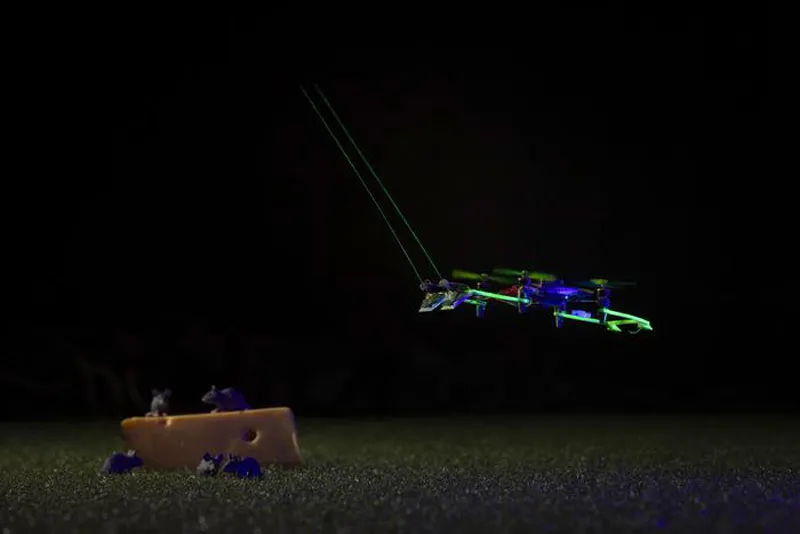
Scientist at Delft University of Technology (Netherlands) developed Tiny tactile navigation system for drones weighing less than 100 grams. Cameras and lidars are bulky and don’t work well in smoke, dust and complete darkness, and are replaced by a pair of artificial “whiskers” that resemble rodent whiskers. This enables small drones to explore small spaces—from cluttered buildings to underground tunnels—using only touch as a guide.
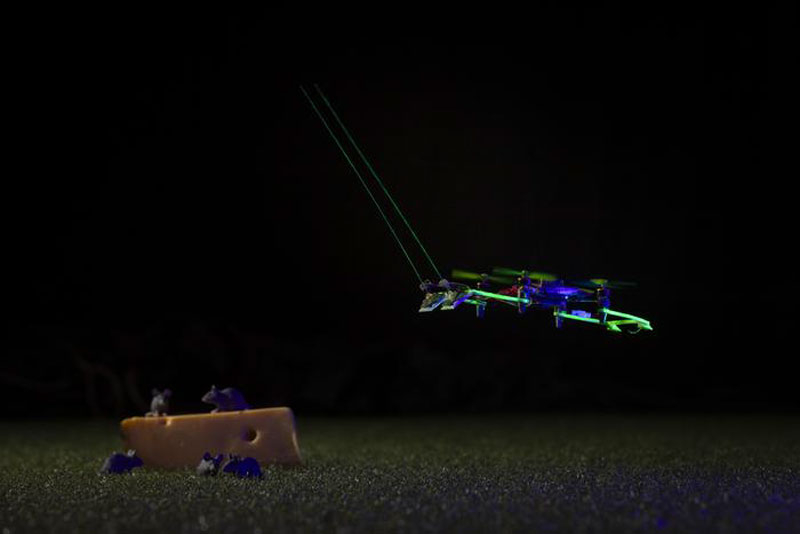
Image source: TU Delft
The tactile sensor consists of two flexible artificial “whiskers” mounted on the front of the drone. The base of each one is equipped with three tiny pressure sensors. As the whiskers contact the surface and bend, changes in pressure in the sensor allow you to determine the direction of contact, the proximity of the contact point, and the location of obstacles in space.
A major technology development challenge was to separate the touch signals from the vibrations of the drone components and the airflow generated by the propellers. To compensate for the disturbance, the scientists developed a compact controller and a special data-processing algorithm that mitigates the effects of turbulence and calculates the distance to obstacles with millimeter accuracy. At the same time, the entire computing pipeline runs directly on the onboard microcontroller, using only 34 KB of memory.
During tests, the drone was able to move along hard and soft surfaces, follow the contours of walls in complete darkness, create tactile maps of unfamiliar spaces, and find its way out without the aid of cameras or external positioning systems. The researchers say this approach could usher in a new class of ultra-small autonomous robots that can work in places where traditional sensors have become useless – in buildings smoldering after accidents, caves and tight underground spaces.
If you find an error, select it with your mouse and press CTRL+ENTER.