


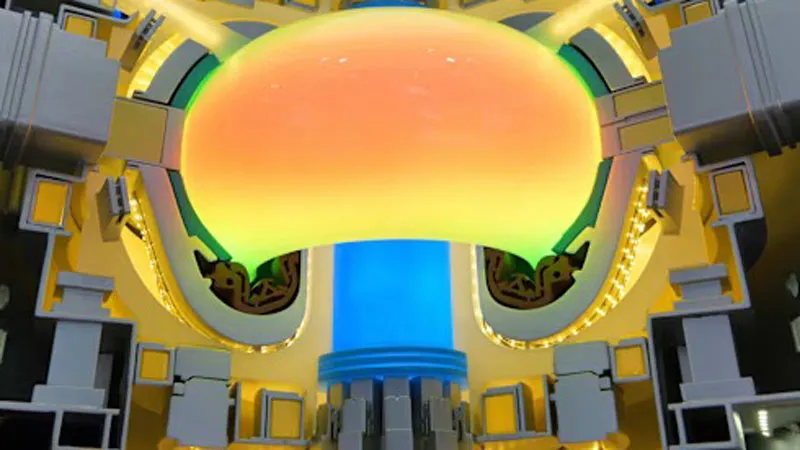
The latest editorial from the Financial Times devoted China is leading the way in nuclear power plants, small modular reactors and advanced fusion power plants to meet the growing demand for artificial intelligence. Under U.S. sanctions and technology export bans, China has actually become a leader in the development of peaceful nuclear energy, gaining advantages that the Western world only dreams of.
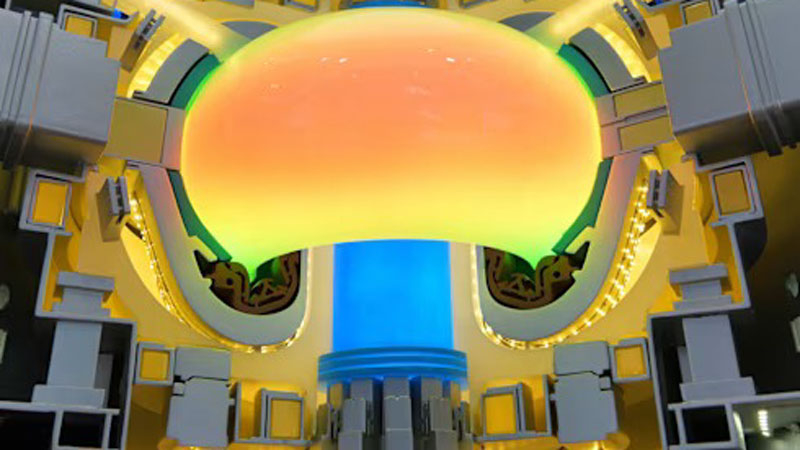
Standing at the Beijing April Exhibition. Image source: Costfoto/NurPhoto
The authors link the beginning of a process of rapid growth in China’s energy production to the country’s production base aimed at meeting global demand for commodities. In modern reality, energy consumption is closely related to artificial intelligence platforms. China still lags behind the United States in artificial intelligence platforms, but it has a historical advantage in the generation and distribution of forms of electricity developed to support industrial production in the past.
Meanwhile, artificial intelligence has raised the bar—there’s never enough electricity. In the first phase, China will rely on classic nuclear power plants to meet its needs. According to the Financial Times, more than half of the 58 new power nuclear reactors currently under construction around the world are being built in China. At the same time, Beijing is investing in conventional nuclear power plants, small modular reactors (SMRs) and fusion power plants simultaneously, viewing nuclear power as a way to ensure long-term growth in electricity consumption, increase energy independence and reduce carbon emissions.
Wood Mackenzie estimates that China’s data center electricity consumption could quadruple to 774 terawatt hours per year by 2030. The main driver of this growth is the expansion of artificial intelligence computing, which not only requires large amounts of electricity, but also requires a stable 24/7 power supply. In comparison, the International Atomic Energy Agency noted that global electricity consumption related to artificial intelligence and data processing may grow from about 460 terawatt hours in 2022 to more than 1,000 terawatt hours by the end of 2026.
Sources lamented that China’s “undemocratic” approach to economic regulation has given it an advantage over developed countries. Thanks to these levers and funds from the state and large enterprises, many energy projects are being implemented, creating the best conditions in the world for the country to maintain energy security and expand power production.
In particular, while building conventional nuclear power plants, China is building its own technology chain for the production and operation of small modular reactors. The source cited the example of Junhe Atomic Corporation, which was founded in 2025 by a former deputy chief engineer of China National Nuclear Corporation and China Guangdong Nuclear Power, China’s two largest nuclear power companies.
The company expects to start operating the SMR around 2031 and is considering building the compact reactor on the site of a former coal-fired power plant. This approach will potentially allow the use of existing sites, network infrastructure and off-the-shelf substations. Unlike large nuclear power plants, SMRs are designed for more compact placement and mass production of significant parts of the equipment in factories. Finally, it is also important that former power plant workers can find new jobs.
However, controlled thermonuclear fusion remains the most ambitious direction. China has several experimental thermonuclear devices and is building new ones. Many private companies are developing unique projects that follow different principles to obtain thermonuclear reactions.
For example, sources point to Chinese company NovaFusionX. Its founders worked for a long time in the United States and laid the foundations for thermonuclear pulse devices with field reversal configuration (FRC). For example, his work formed the basis of the Helion Energy reactor project. China is currently building a similar reactor and is expected to produce the first positive energy output through fusion reactions around 2030. However, so far, China does not expect to see thermonuclear power plants in the foreseeable future. The Chinese themselves agree to develop thermonuclear energy in the country no earlier than 2050. There are many fundamental issues that need to be addressed to achieve this goal, but it will be worth it.
If you find an error, select it with your mouse and press CTRL+ENTER.