
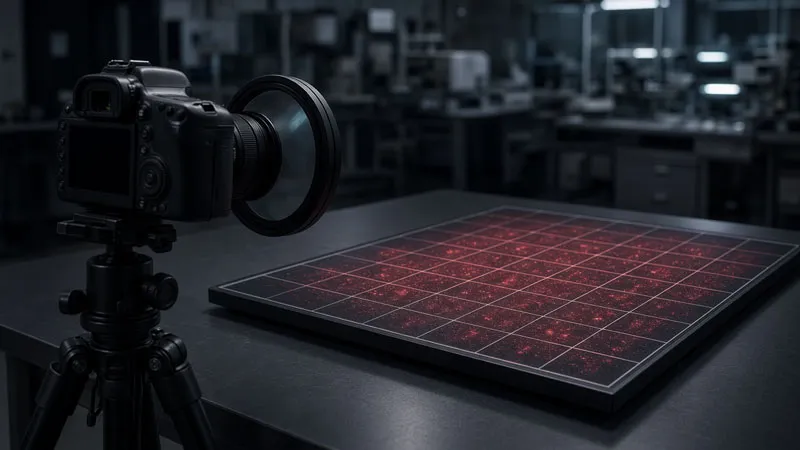
German researchers showLow-cost consumer digital cameras can be converted into measurement instruments for quantitative diagnosis of silicon solar cells and modules. This method is based on electroluminescence – the panel emits its own light when connected to a current source. Improved Canon EOS 4000D cameras and algorithms can literally evaluate solar panel properties from photos.
Image source: AI Generation Grok/3DNews
When an electrical bias is applied – when the panel is connected to a current source – silicon solar cells emit weak infrared radiation, whose properties are related to the quality of the material and its open circuit voltage. To obtain images in this range, the researchers removed the camera’s standard infrared-blocking filter and instead installed a Heliopan ES RG850 long-wavelength filter to block visible light. Ideally, shots should be taken in the dark since the panel itself emits very little light, but calibration can take care of that too.
The key task is not only to record the infrared radiation emitted by the panel, but also to convert the brightness of the image into quantitative physical parameters of the component’s properties. The camera’s silicon-based CMOS sensor detects radiation around 1120 nm, the wavelength of electroluminescence in silicon solar cells, and the Bayer color filter is very transparent.
To perform calibration, the researchers developed a model that takes into account the sensor’s linear and nonlinear operating modes. With its help, the pixel intensity is converted into the absolute external electroluminescence quantum efficiency EQE_LED. To reference the measurement results, a reference component or module with known EQE_LED value and open circuit voltage is used.
The relationship between the measured parameters is very direct: at room temperature, a tenfold increase in the luminescence-related signal corresponds to an increase in the open circuit voltage of about 60 mV. The method was tested on old and new solar panels. With the newer modules, the data is very accurate, while with the older modules, the calculated readings lag behind the directly measured readings, which still needs to be understood.
Therefore, electroluminescence photography can be used not only to visually search for defects in the form of dark and light areas on the panel, but also to quantify the properties of the solar cells in each area of the image. The authors believe that calibrated cameras will make it possible to determine key properties of components and modules that have not been previously studied in the laboratory, and that the developed model is suitable not only for electroluminescence but also for photoluminescence measurements.
In the future, the researchers intend to test the possibility of making such quantitative measurements even during the day. Today, this diagnosis is performed using expensive scientific instruments, and as more and more panels are installed in the world and there is an urgent need to constantly monitor their effectiveness, the creation of devices for cheap and rapid diagnosis is coming to the fore.
If you find an error, select it with your mouse and press CTRL+ENTER.