



NVIDIA has officially released the new RTX Mega Geometry 2.0 SDK and RTX Kit 2026.3 update, introducing a set of tools designed to overcome one of the biggest bottlenecks in modern rendering: Manage 3D scenes with extremely high polygon density with real-time ray tracing.
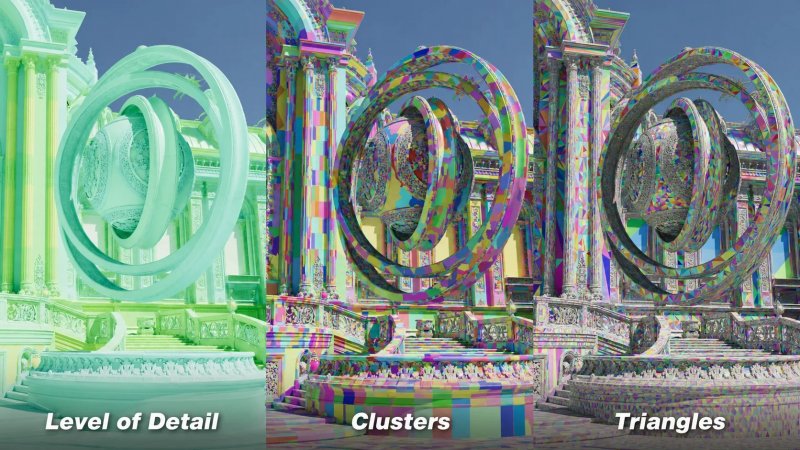
In the next generation engine, Nanite virtualized geometry technology is currently forced to rely on low-detail proxy mesh support models to calculate ray traced shadows and reflections. RTX Mega Geometry 2.0 introduced via Continuous flow of geometry clusters with dynamic level of detail (LOD)allowing the graphics card to instantly load and track the exact polygon density required for the scene.
RTX Mega Geometry 2.0 also appears in Gears of War: E-Day
The first major commercial testbed for the technology will be Gears of War: E-Day, developed by The Coalition. The integration of RTX Mega Geometry and DLSS will allow you to apply full ray tracing directly on the highest detail Nanite geometry, ensuring Significantly more accurate shadows and reflections without saturating the computational pipeline. To demonstrate the scope of the system to developers, NVIDIA showed how a complex mesh from the Zorah demo could be segmented and loaded into dynamic clusters.
NVIDIA said that the use of these technologies improved image quality and rendering performance, but did not provide specific game benchmarks.
GeForce NOW Welcomes CONTROL Resonant: Let’s Explore This Week’s Other Games

RTX Kit 2026.3 also introduced RTX neural texture compression 0.10 betacompatible with DirectX 12 Agility SDK preview with linear algebra. This change allows RTX GPU Tensor Cores to accelerate neural decompression of textures directly in DirectX shaders. The same component has added support for Windows ARM64.
Other updates include RTX Dynamic Lighting 3.1, which incorporates DLSS light reconstruction and changes to ReSTIR PT. RTX Character Rendering 1.4 changes to intervening hair rendering, improving BCSDF sampling of the farthest areas and saving energy. RTX Neural Shading 1.4 updates support for the DirectX Linear Algebra toolchain and its dependencies. RTX Texture Filtering 1.3 finally introduces collaborative texture filtering, a technology designed to improve the quality of textures amplified through random filtering. The component now also supports Windows ARM64.
At the same time, NVIDIA has updated the in-game inference SDK to integrate support for RTX Spark, Gemma 4 models, a Stable Diffusion plug-in with sample code, and an updated llama.cpp library. Since these are tools designed for development studios, as new production graphics engines incorporate new libraries, new features and related performance optimizations will appear in PC games.