


Intel’s 14A process technology, classified as 1.4nm or 14 Angstrom, will have performance comparable to TSMC’s A14 process technology within 5%. This was stated by Naga Chandrasekaran, director of technology and operations and head of Intel’s foundry division.
Image source: BoliviaInteligente / unsplash.com
In recent years, Intel’s technology processes have been inferior to TSMC’s solutions in terms of transistor density, but they have remained competitive in terms of speed and power consumption. But in the future, the balance of power may shift in favor of Big Blue.
Intel promises that compared with the current 18A, the new 14A process technology will provide a 15-20% performance improvement at the same power consumption, or a 25-35% power consumption reduction at the same frequency and transistor count. TSMC said that compared to the current N2, its A14 will improve performance by 10-15% at the same power consumption, or reduce the latter by 25-30% while keeping the frequency and transistor count unchanged. If the claims of these manufacturers are to be believed, then even in the most conservative scenario, Intel’s 14A process technology will have an advantage, albeit a small one.
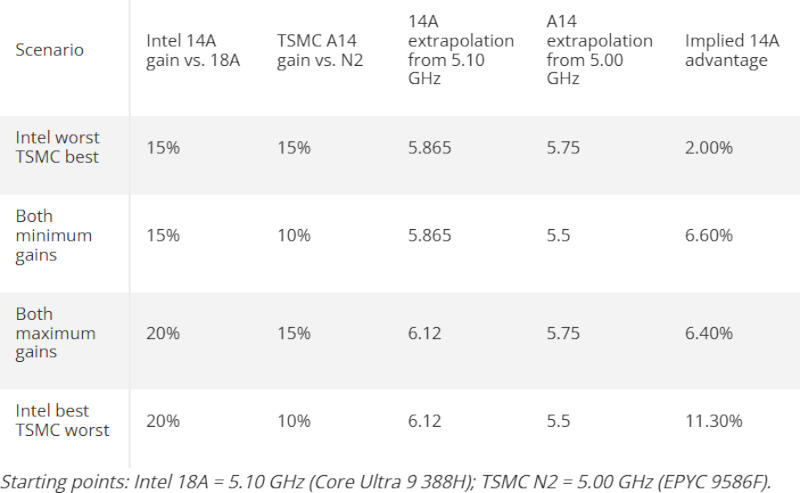
Image source: tomshardware.com
Against this background, Intel’s claim that its 14A will be “within 5% difference” from TSMC’s A14 seems quite cautious. However, this wording does not mean that Intel will necessarily be slower: the company did not specify whether we are talking about an advantage or a lag over TSMC’s solution. In addition, we are talking about the characteristics of the technical process itself. The actual performance of the finished processor depends on factors such as architecture, standard cell library, voltage, and heat dissipation conditions.
Tom’s Hardware points out that the current 18A can already produce chips with high clock speeds. For example, the 18A-based Core Ultra X9 388H has a maximum frequency of 5.1GHz. In comparison, the AMD EPYC 9586F, which uses TSMC’s 2nm process technology, claims a frequency of up to 5.0 GHz. These numbers can’t be used to directly compare process technology performance, since the processors are based on different architectures and run under different conditions, but they do show that the 18A is competitive with the N2 at least in terms of maximum clock speed.
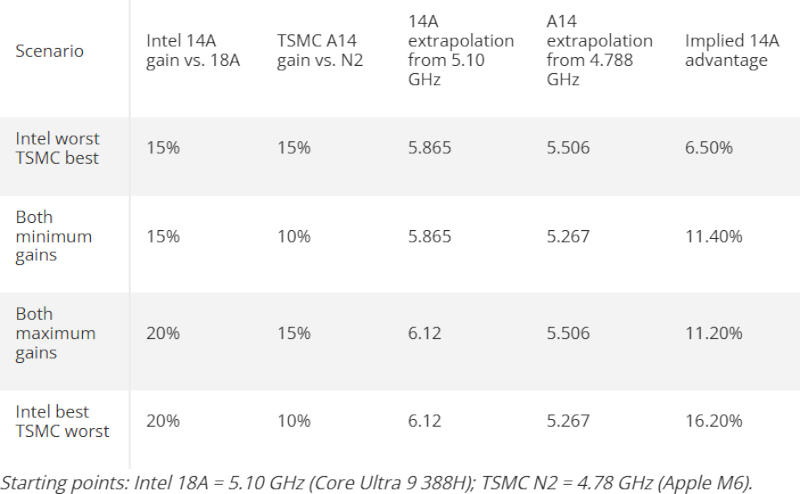
Image source: tomshardware.com
If we simply compare the manufacturer’s claimed improvement to the maximum frequency of existing wafers, we get a more optimistic estimate for Intel. If we take the Intel Core Ultra X9 388H and AMD EPYC 9586F processors as a starting point, taking into account their maximum clock speeds achieved using 18A and N2 process technologies, Intel maintains a 2% to 11.3% advantage with the same power consumption. Similar calculations using the same Core Ultra X9 388H processor as the Apple M6 showed the “blue” advantage to be between 6.5% and 16.2%.
So even in Intel’s worst-case scenario, when the 14A’s performance improvement is at least 15% and the A14’s performance improvement is at most 15%, Intel’s process performance is significantly higher than the 5% gap announced by executives, and this gap can fluctuate in both directions. Of course, the above rough calculations don’t pretend to predict the clock speeds of 1.4 nm processors, but they give a clear indication of what the manufacturer claims themselves might mean. If the Intel representative wasn’t modest, he also took a few other factors into consideration.
TSMC plans to begin test production of chips using A14 process technology as early as the second quarter of 2027, while Intel plans to enter the same stage of 14A process technology in the second half of next year. Both companies plan to start mass production in 2028 using 14 Angstrom technology processes.
If you find an error, select it with your mouse and press CTRL+ENTER.