

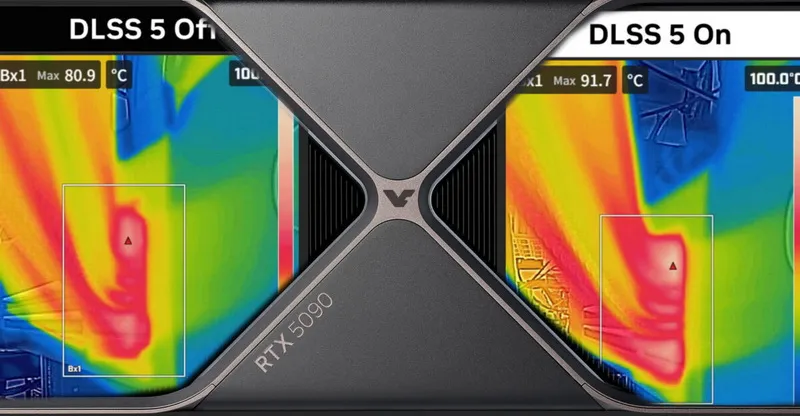
Previous tests have shown that DLSS 5 causes the card’s GPU to consume more power, thereby increasing overall power consumption. just recently even Case has been recorded The power connector on a GeForce RTX 5090 graphics card melted among users testing Nvidia’s new neural rendering technology. Korean resource QuasarZone decided to study this issue in detail.
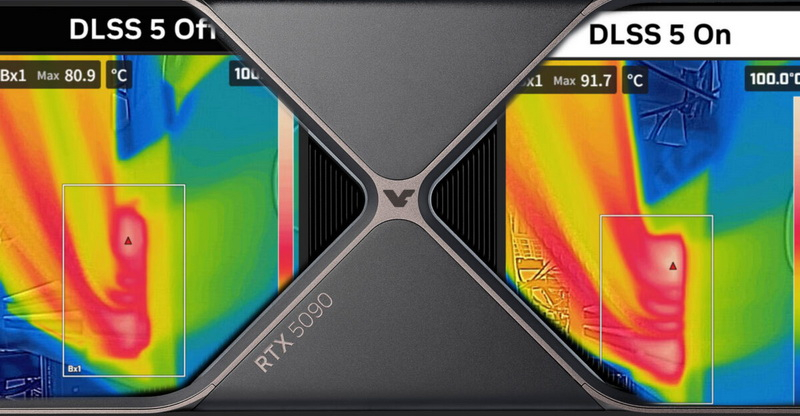
Image source: QuasarZone
During our testing, we focused not on image quality or visual changes in games when using DLSS 5, but rather on power consumption, as well as the temperatures of the GPU itself and the 12+4-pin graphics card power connector when the technology is enabled.
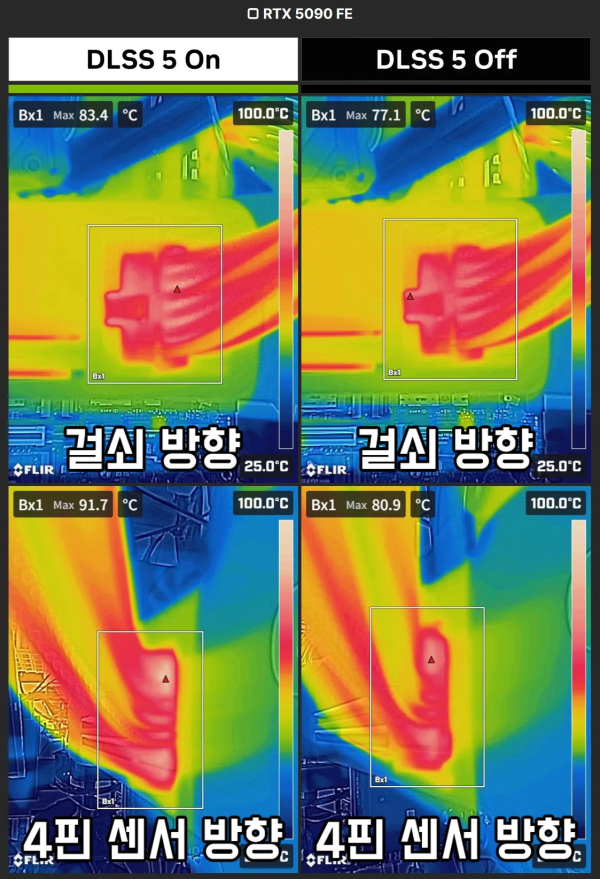
GeForce RTX 5090 power connector temperature with DLSS 5 enabled and disabled
The results show that DLSS 5 imposes significant load on the GPU. Testing of the RTX 5090 card shows how this affects the 12+4-pin connector. 12V-2× 12V-2× 125 °C 1575 °C 12V-2× on a GeForce RTX 5090 Founders Edition card with DLSS 5 enabled in Cyberpunk 2077 (4K resolution, Ultra preset, DLSS Quality mode, test time 20 minutes, room temperature 27.5 ±0.5 °C) 12V-2× 575 80.9 °C.
Use a thermal camera to measure the temperature on both sides of the RTX 5090 power connector. On the side where the four signal contacts are located, the temperature rose from 80.9°C to 91.7°C. The latch side temperature increased from 77.1°C to 83.4°C. The power connector of the GeForce RTX 5080 FE graphics card generates significantly less heat: with DLSS 5 enabled, the temperatures at the same two points are 48.6 and 52.2 °C respectively.
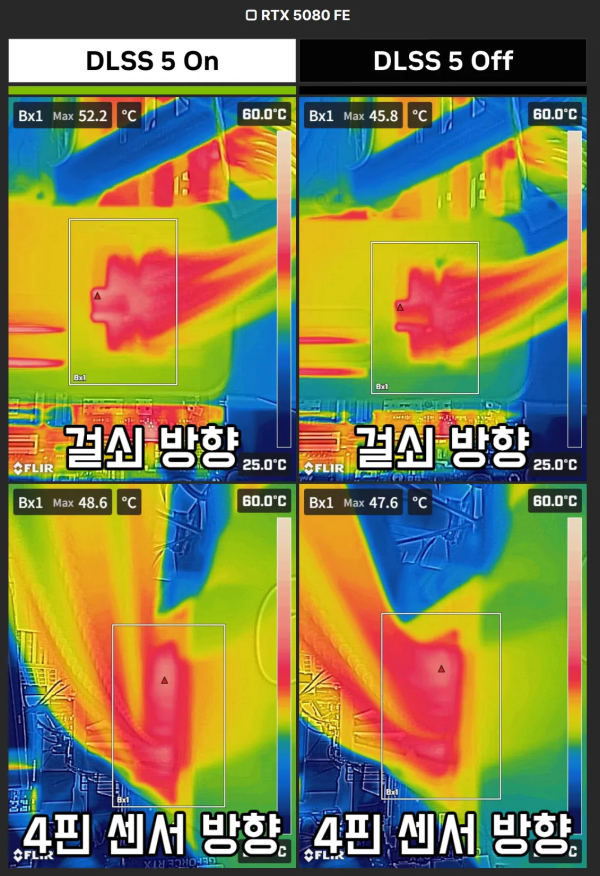
GeForce RTX 5080 power connector temperature with DLSS 5 enabled and disabled
The temperature rise is not due to external heating, but due to power consumption. According to data from the HWiNFO utility, with DLSS 5 enabled, the average power consumption of the GeForce RTX 5090 increases from 509.2 W to 575.1 W, and the RTX 5080 increases from 298.2 W to 350.3 W. Therefore, both graphics cards operate in modes close to their power consumption limits (575 W and 360 W respectively).
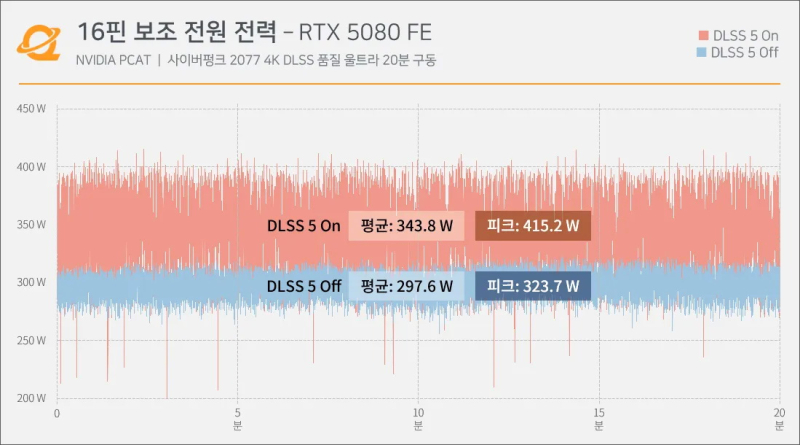
RTX 5080 with DLSS 5 power consumption
External measurements using PCAT, a special adapter that reads the card’s power consumption, show higher numbers because they also record short-term spikes in power consumption. The total power consumption of the GeForce RTX 5090 increased from an average of 527.3 W to 593.9 W, and the peak power consumption increased from 582.5 to 658.0 W. If we only consider the power consumption directly through the 12V-2×6 connector, the average power consumption of the GeForce RTX 5090 is 582.7 W (peak – 646.7 W), while without DLSS 5 these values are 516.5 and 571.7 W respectively.
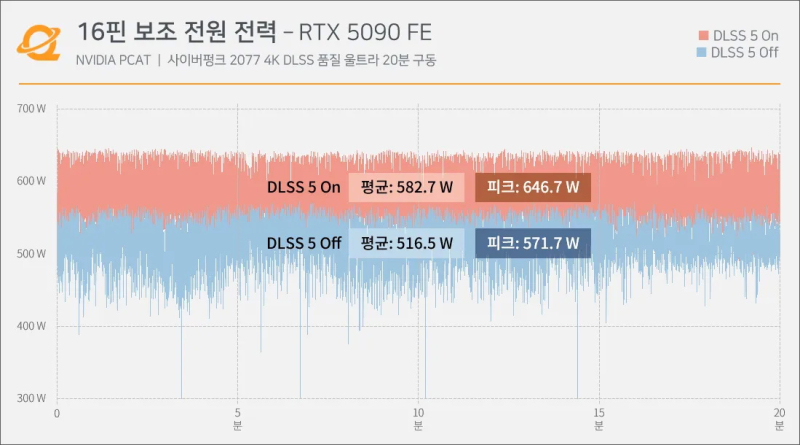
GeForce RTX 5090 with DLSS 5 power consumption
We also used the ASUS ROG Astral RTX 5090 graphics card during testing, with a power limit of 575W (the same as the Founder Edition). Measure the amperage at each pin of the power connector. Without DLSS 5, the load range on the six pins is 6.94 to 7.47 A. With DLSS 5 enabled, these numbers increase to the range of 7.83 to 8.51 A. Although all six pins are still below the 9.2 A spec limit, the difference between the most loaded and least loaded pins is about 0.7 A.
Calculations were also made for situations where one of the contacts stops conducting current due to wear or poor contact. When DLSS 5 is disabled, load redistribution results in approximately 8.9 A on the most loaded pin. Under load conditions of DLSS 5, the same theoretical situation would result in an increase in current to 10.1 A, which exceeds the allowable limit of 9.2 A.
The temperature of the GPU did not rise as much as the temperature of the power connector during testing. The average core temperature of the GeForce RTX 5090 increased from 79.4℃ to 83.0℃, and the peak temperature increased from 82.3℃ to 86.3℃. Therefore, the hottest point of the GeForce RTX 5090 during the test was not the GPU itself, but the power connector, with a temperature as high as 91.7°C.
If you find an error, select it with your mouse and press CTRL+ENTER.