
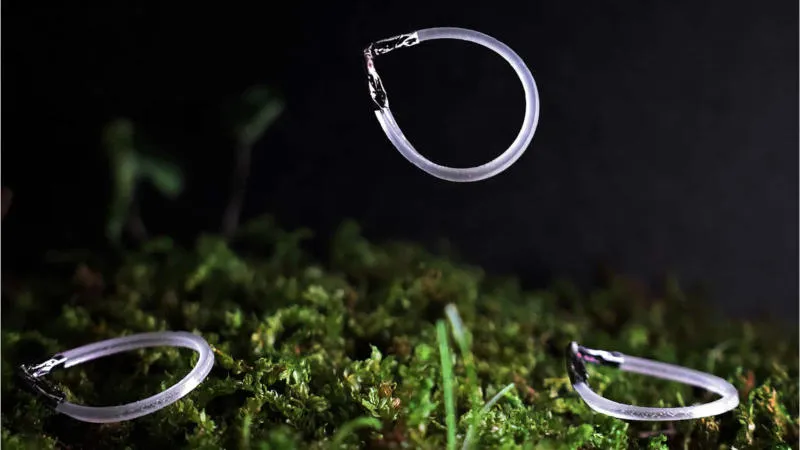
American scientists have developed a ring-shaped jumping robot whose energy is infrared radiation. The authors of the project have not yet proposed a practical application of these mechanisms, but have learned to control the properties of their movements.
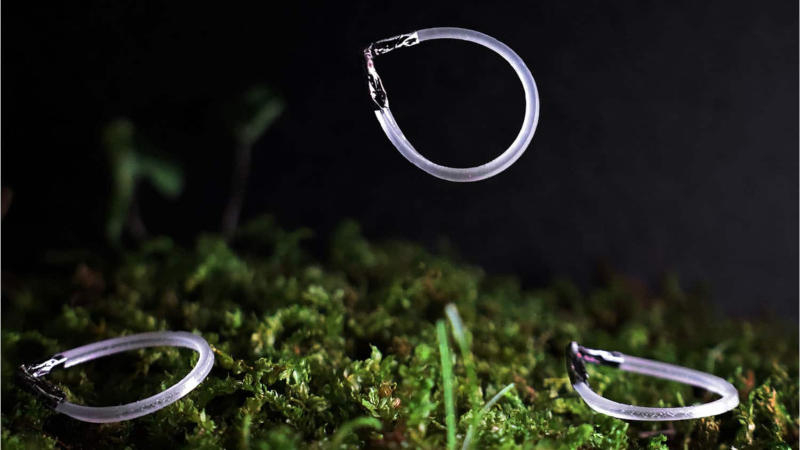
Image source: ncsu.edu
In the popular imagination, robots are thought of as complex mechanical beings, but the field of soft robotics offers a variety of limbs, sensors, and designs that expand understanding of the forms and tasks of autonomous mechanisms. Scientists at the University of North Carolina have built a non-electronic robot in the shape of an arc-shaped ring – which receives energy from infrared radiation and is able to jump endlessly.
The main part of the robot consists of a liquid crystal elastomer-based rope, the ends of which are held in place by V-shaped aluminum clips. Under the influence of infrared radiation, this rope contracts, twists and stretches around its own longitudinal axis. The clamp is not allowed to roll back or unfold, and as the rope accumulates maximum reserve energy, the aluminum clamp swings sharply downward, striking the surface and throwing the entire structure forward or upward. As it moves, the rope returns to its original shape and, with further exposure to infrared radiation, can jump countless times.
By changing the design, you can control its movement: if you give the V-shaped cutout an angle of 120°, the robot crawls forward; by reducing the angle to 90°, you force the mechanism to jump forward; if you reduce the angle to 50°, the robot jumps straight upward. He can jump forward 3 times his body length, or upward 80 times his height. To increase the distance of a jump, a load can be suspended opposite the V-shaped limiter. The robot’s center of mass will shift and the forward motion will become more powerful and stable, similar to how a swimmer leans forward before taking off from a jumping platform.
What is unique about this project is that after buckling, such a robot does not need to manually return to its original state. The scientists have not yet proposed specific areas of application for the design, but they have no doubt that over time it will be discovered – they could be equipped with lightweight and compact sensors that consume minimal energy and can even be sent over long distances to hard-to-reach places. These machines can easily adapt to different types of surfaces, liquid media and overcome obstacles.
If you find an error, select it with your mouse and press CTRL+ENTER.