



TrendForce analysts predict that RAM and flash memory will not fluctuate as quickly in the fourth quarter as in the previous quarter. In the DRAM field, prices will increase by 10-15% quarterly, and in the NAND direction, prices will increase by 15-20%. Only enterprise-class SSD prices will continue to grow rapidly.

Image source: Micron Technology
According to experts, in the NAND field TrendForcethere will be some layering trends happening this season. AI infrastructure will continue to experience flash memory shortages, but the consumer segment will face lower demand due to high prices. Regardless, prices across the solid-state memory market will continue to rise, with prices continuing to rise by an average of 15-20% by the end of the quarter. Growth was expected to be 18-23% last quarter.
DRAM prices increased by 13-18% last quarter, but taking HBM into account, the increase was 8-13%. According to a TrendForce representative, classic DRAM prices will increase by 10% to 15% this quarter, and if HBM is taken into account, the increase will be between 15% and 20%.
In the PC space, DRAM prices will increase, which will impact the cost of finished computers and negatively impact demand. At the same time, memory manufacturers will continue to actively increase the inventory of RAM chips, with shortages expected to continue in 2027 and prices to rise further. Formally, memory suppliers in the PC space have been fulfilling their obligations to customers throughout this year, but the shortage is likely to worsen next year due to high demand for memory in the server space.
On the server side, as server processor availability begins to improve, demand for DRAM continues to grow. Memory vendors have increased the share of small-capacity RDIMMs in their product portfolios. However, there are still bottlenecks in the manufacturing stage of memory chips that cannot meet demand. Price dynamics can be smoothed by long-term contracts for memory supply, which are already common in the server world.
In the mobile space, the market continues to be pressured by a shortage of low-volume storage chips and high prices. At the same time, the mobile storage format is becoming increasingly popular among server equipment manufacturers, attracting them for its energy efficiency. In this case, mobile DRAM prices can only rise in the near future, although not as vigorously as in the first three quarters of 2026.
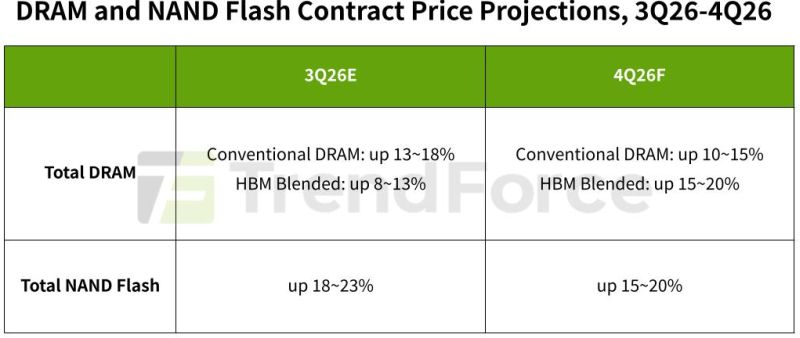
Image source: TrendForce
In the field of graphics memory, PC manufacturers are paying attention to GDDR6, hoping to reduce the cost of finished products. The demand for GDDR7 chips is still mainly concentrated in the production of AI accelerators, but compared with GDDR6, its demand is higher. The problem is that GDDR6 production is gradually being phased out, while GDDR7 production is not growing fast enough to saturate the market, so prices remain high and continue to rise further.
In the consumer DRAM space, demand is surging due to the impact of adjacent markets. For example, SSD manufacturers need such chips, which are mainly supplied to the server field. It is no longer profitable for large manufacturers to produce consumer-grade DRAM, so the market is increasingly dependent on Taiwanese suppliers. Fortunately, the pace of price increases is slowing slightly.
In the client SSD space, PC manufacturers can be content with inventory of products produced in the first half of this year. At the same time, PC manufacturers are trying to reduce the capacity of the drives offered as part of their systems to save on purchase costs. This is an area where demand for NAND memory will eventually be less than before. Vendors’ pricing policies have become more flexible and will not cause drive prices to rise at the same rate.
But in the field of SSD servers, demand for hard drive capacity is expected to grow by more than 80% by the end of this year, as cloud providers expand their artificial intelligence computing infrastructure and there is a huge demand for hard drives. The development of agent applications is increasing the demand for SSDs, which can speed up data processing compared to traditional hard drives. Enterprise SSD price growth should accelerate in the fourth quarter compared with the third quarter.
In the eMMC and UFS (memory card) space, smartphone manufacturers prefer to make do with previous inventory, while consumer electronics manufacturers are not eager to purchase such memory at the current high prices. Therefore, the demand dynamics in this area are not particularly clear. Purchases are made in accordance with the minimum quantities specified in the agreement with the supplier.
The price of silicon wafers used to make NAND memory has reached an all-time high, so consumers, represented by chip manufacturers, are in no rush to buy the required quantities. Meanwhile, silicon wafer suppliers themselves are trying to limit supply to avoid price cuts and ensure the existing profitability of their businesses. Likewise, buyer resistance will limit further increases in wafer prices.
If you find an error, select it with your mouse and press CTRL+ENTER.