


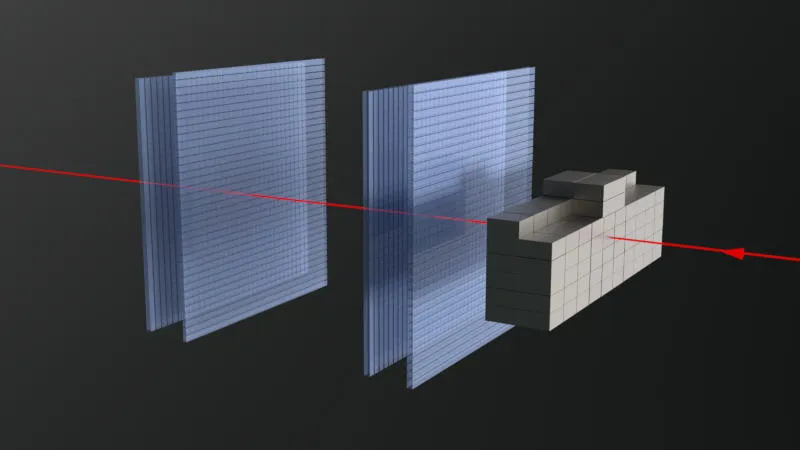
Superman’s “X-ray” vision has become a reality—sort of. Using the world’s most powerful laser, a team of physicists at the ELI-NP (Aurora Infrastructure – Nuclear Physics) research center in Romania have achieved object imagehidden behind a two-meter-thick layer of concrete.
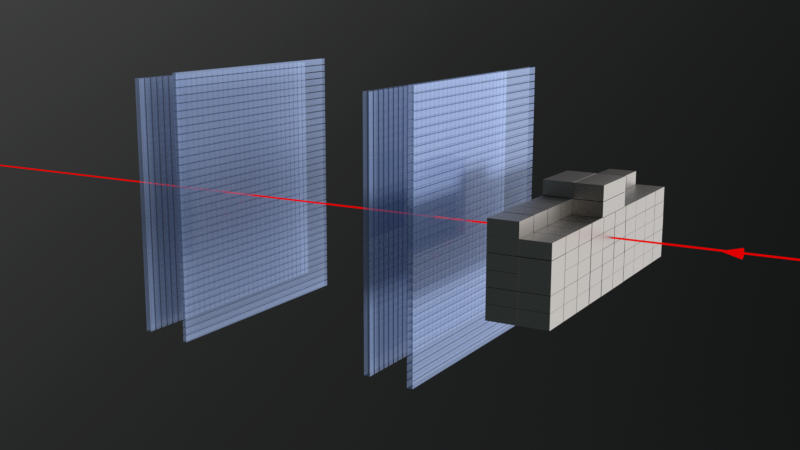
Image source: arxiv.org
There are particles called muons, which are a bit like electrons on steroids. The phenomenon occurs when high-speed protons flying from space hit atoms in the upper layers of Earth’s atmosphere and hit pairs of quarks (pions), which decay into pions. Muons also only exist for a short time before decaying into lighter electrons and neutrinos, but even in their raw form they can reach the Earth’s surface. Because of their large mass, they can pass through soil, dense rock layers, and penetrate deeper than the most powerful X-ray radiation.
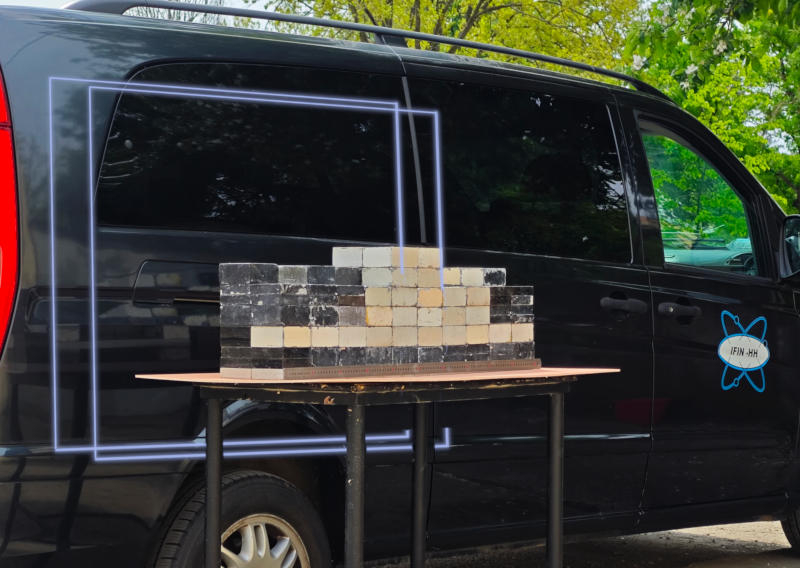
Archaeologists and engineers have long used cosmic particle streams – using muon radiography – to search for voids inside pyramids or mineral deposits deep underground. The problem is that, in their natural state, muons hit surfaces at finite angles, and their flow is extremely weak—about one particle per square centimeter per second. Muons can also be produced artificially by using powerful lasers to accelerate electrons. The feasibility of this technology has been confirmed by Chinese, British and American scientists. In one experiment, the technique was able to image lead cargo inside a truck, but the exact number of muons in the particle stream remains unclear, and the images’ status as the first of their kind is questionable.

Scientists at the ELI-NP Center used a laser with a power of 10 petawatts – in the shortest time, this beam exceeded the total power of all energy carriers on Earth. This flash accelerates electrons and carries them through radiation waves until they hit the lead barrier. To filter out as many non-muon particles as possible, the scientists developed a filter by wrapping a block of paraffin in a sheet of polyethylene. The relatively pure stream of muons is sent through the concrete wall to a series of detectors on a truck parked on the other side of the barrier. After detecting a “shadow” in a pile of lead blocks, scientists declared success – obtaining the first muonogram, an image created artificially using a laser. With further development, these principles could form the basis of compact, portable systems. It would make it possible to “see through” the shells of missiles and shipping containers, the stone foundations of mountains and ancient buildings.
If you find an error, select it with your mouse and press CTRL+ENTER.