

Fears that the introduction of humanoid robots will lead to mass unemployment are premature, human researchers say. It will take about 40 years for humanoid machines to be cost-competitive with 10% of the U.S. workforce.
Image source: Unitree Robotics
At the same time, humanoid robots can theoretically take on up to 75% of the physical work in the U.S. labor market, such as notes study author. Her work hours account for approximately 34% of all work hours in this market. At the same time, at the current stage of development of robotics and “physical artificial intelligence,” machines can compete with humans for only 0.3% of the workload in the United States. This is largely because they can only work effectively in a clearly structured environment, which is hard to find in real life.
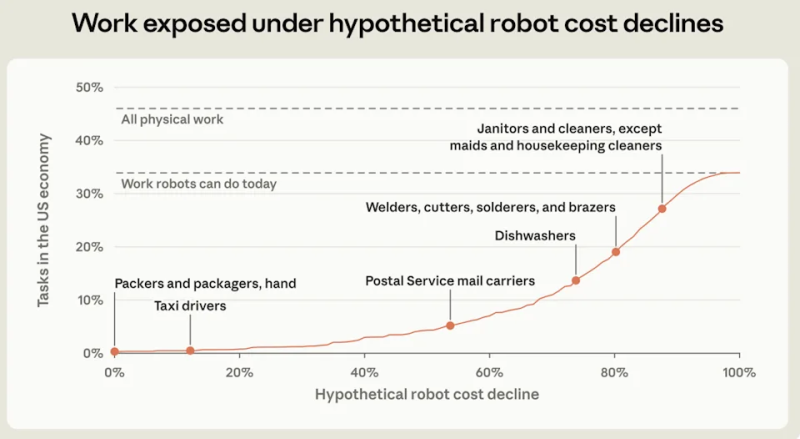
Image source: Anthropic, Yahoo Finance
Judging from the example provided by Anthropic, in the US labor market, as costs continue to fall (3% per year), robots will be able to replace taxi drivers and packers at the earliest, and they will replace postal workers later, but dishwashers will be able to resist for a longer time. Welders, welding equipment operators and plumbing experts are slightly luckier, but in the cleaning industry, maids will be the first to give up. Indeed, cleaners of large areas rather than sites will be luckier, since in the first case robots are less adapted to unpredictable working conditions.
Even if the cost of humanoid robots falls significantly faster and their skills improve significantly, there will still be enough time for humans to adapt to new labor market conditions. For example, if robots start to become cheaper at four times the historical rate and learn twice as fast, they will only be able to replace half of manual workers by 2050.
Requirements and legal restrictions on robots’ physical abilities may also limit their expansion. For example, for a long time only humans could untangle the thinnest wires in cables, but in some places robots would not be used for ethical reasons.
But in the field of knowledge work, artificial intelligence poses a greater threat to human employment. Anthropic CEO Dario Amodei has warned that up to half of all entry-level office jobs could be replaced by artificial intelligence by 2030. Research from Anthropic shows that employment rates of young workers have declined since the end of 2022 in fields most vulnerable to replacement by artificial intelligence. However, Anthropic representatives said that overall, the expansion of artificial intelligence will not have a significant impact on the labor market in the coming year.
Meanwhile, a new report from the company claims that as many as half of all office tasks may have been affected by the spread of AI models like Cloud, with the time required to complete tasks in these areas cut in half. In knowledge work, the cost of replacing workers with artificial intelligence is not as high as with robots, so advances in software will affect this part of the labor market more quickly. Management, finance, computer science, and engineering are more likely to be affected by AI models than occupations involving physical activity. Interestingly, the utility sector is also affected by “physical AI” and software, but is also well protected from the coming automation.
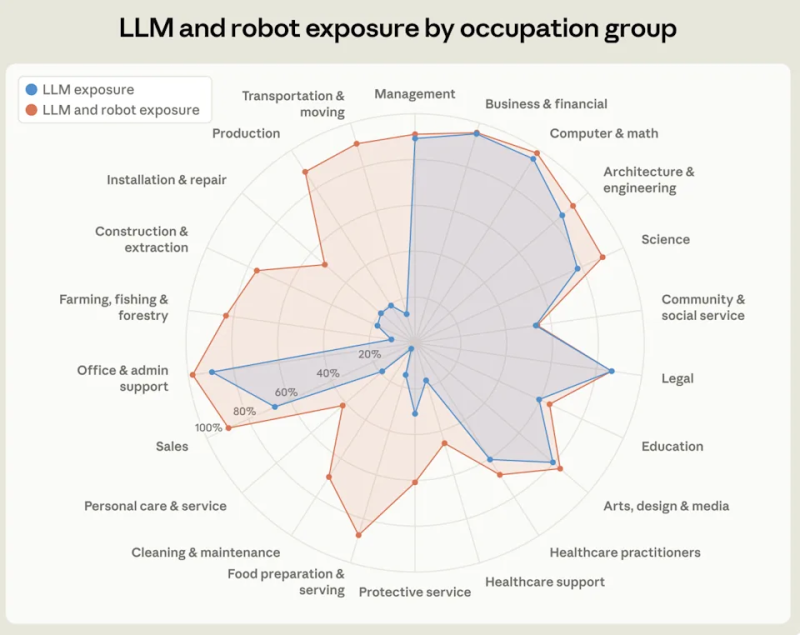
Image source: Anthropic, Yahoo Finance
Cleaners, cooks, security guards, medical staff, nurses and nannies are also largely protected from being replaced by robots, while in sales, algorithms will not be as aggressive in replacing humans as it seems. Farmers, construction workers, and repairmen will also be the least likely to be affected by the expansion of robots, but manufacturing and logistics will be the first to be affected by automation.
The general rule is that tasks that require personal interaction with a human will resist the onslaught of automation the longest, especially when it comes to requiring subtle operations.
If you find an error, select it with your mouse and press CTRL+ENTER.