



Chinese manufacturers of hand-held smart cameras, DJI and Insta360, now control more than 90% of the market, in which the American GoPro occupied the leading position in terms of revenue back in 2023. The latter recently changed not only its course, but also its business owners.
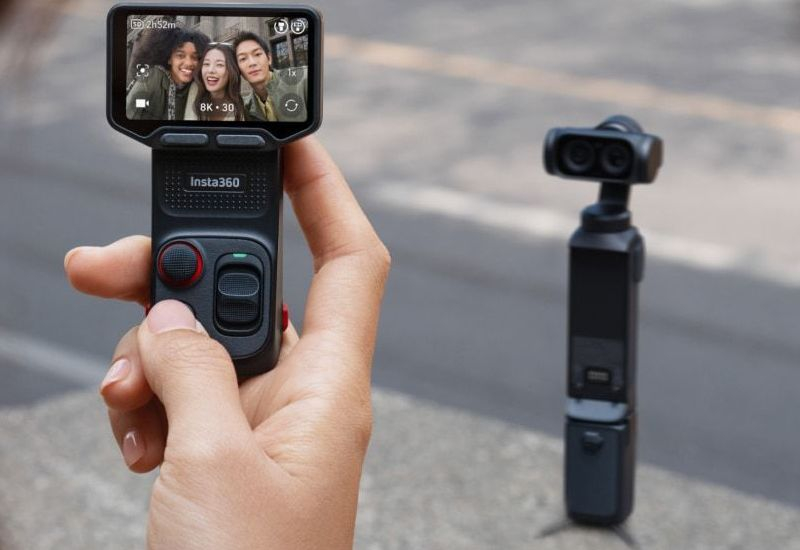
Image Source: Insta360
GoPro is widely considered the pioneer of the action camera genre used by extreme sports and travel enthusiasts, but last month it was sold to new owners and has signaled that it will at least deviate from its original business. Chinese competitors, meanwhile, have already managed to “divide the bear’s skin”, the two of them occupying more than 90% of hand-held smart cameras, based on IDC statistics.
Since we are talking about the global market, the progress of DJI and Insta360 shows how quickly Chinese companies can move into high-tech product markets even outside of China. Based in Shenzhen, China, these companies practice relentless competition. A similar precedent has already taken place in the market of robotic vacuum cleaners: the creator of the Roomba robotic vacuum cleaner, who is considered the “founder of the genre,” could not survive the competition with Chinese companies. He filed for bankruptcy last year.
Fierce domestic competition is producing highly effective Chinese companies that are well-prepared to capture the global market, as representatives of the consulting company iMpact admit. Founded in 2002, GoPro had long been considered the market leader, but an onslaught of Chinese rivals meant it had just 3% of the global market in the second quarter. Having accumulated debts of $92 billion, last month it agreed to a deal with Starman Holding, which was ready to pay $285 million for it. GoPro’s capitalization peaked in 2014, when it was valued at $12 billion.
IDC representatives cite the low rate of updating of the model range as the reason for the collapse of GoPro. Chinese competitors in this sense turned out to be more efficient and more aggressively promoted their products. While DJI was originally known as a quadcopter maker, it now offers the Osmo 360 panoramic camera, venturing into Insta360 territory. The latter, in turn, began producing drones.
By the second quarter of this year, DJI managed to capture 73% of the global smart wearable camera market, Insta360 accounted for 20%, but it also dominates in narrower segments such as panoramic cameras. Both companies are pursuing each other in US courts, challenging the ownership of patents related to the design and design of the cameras.
DJI, which had already faced a ban on importing its drones into the US, was forced to try its hand at other market segments by launching a line of robotic vacuum cleaners. Insta360, which opened its first large branded store in the United States last month in New York, in the comments Financial Times admitted that it wants to become the largest brand among smart camera suppliers in the United States. It will not be able to compete on price with the larger DJI, so it hopes to get ahead of it in the speed of releasing new models.
According to Insta360 vice president Max Richter, if the company had to compete on price, the company would be drawn into a spiral that would lead to an unfavorable outcome not only for the company itself, but for the entire market. The average cost of implementing a handheld smart camera, according to IDC, has remained stable since 2024, amounting to $380.
If you notice an error, select it with the mouse and press CTRL+ENTER.


