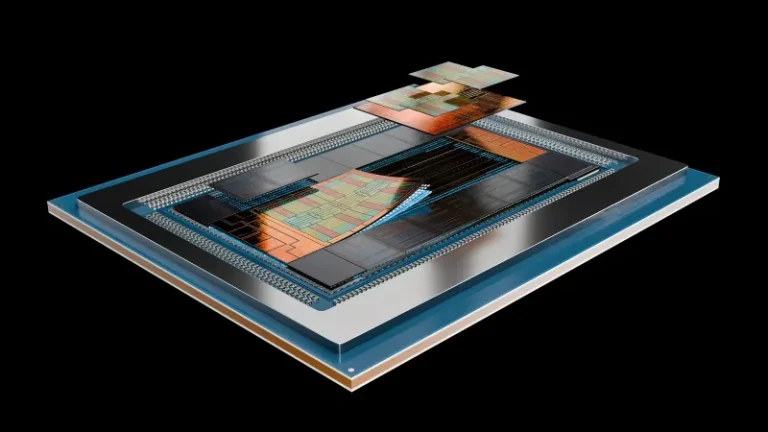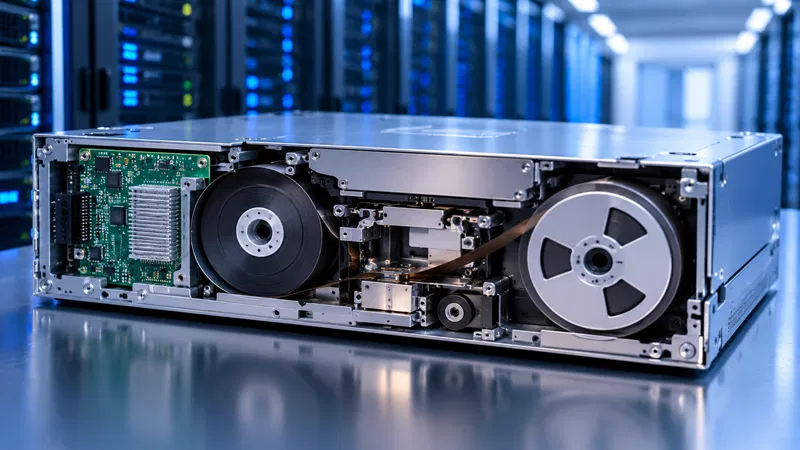
Chinese sources report that Huawei has begun real-world testing of a never-before-seen storage system based on its own Magneto-Electric Disk (MED) technology. MED drives combine in one case an SSD and a “tape recorder” – a magnetic tape with a drive and read/write heads. The technology makes it easier to work with archives and reduces dependence on scarce hard drives.
Image source: AI generation ChatGPT/3DNews
The development of MED technology by the company became known exactly two years ago. Now development has moved from the laboratory to verification at the client’s site – Yunshangtun company in Guiana (Guizhou Province). Anticipated applications for MED include storing datasets for large language models, media content archiving, backup, disaster recovery, and scientific research.
The main goal of the development is to combine the low cost of long-term storage, characteristic of magnetic tape, with the ability to relatively quickly retrieve information characteristic of hard disk drives (HDD). In other words, to improve the work with “cold” and “warm” data, which the AI can at any time, at its own discretion, demand to turn into “hot” – load into RAM or SSD.
Analysts believe that the share of “warm” and “cold” data in data processing and storage systems will grow. At the same time, the number of simultaneously working AI agents will increase, and they may suddenly need information from heavily “chilled” archives. For example, such a need often arises when using AI in scientific research.
Huawei’s SSD and magnetic tape hybrid is optimized for fast searches in archives: the SSD stores metadata that allows you to quickly retrieve the information you need from the tape. At the same time, storing data on tape does not require energy consumption typical for hard drives. In addition, Huawei may lose access to the HDD at any time due to sanctions, which also prompted the company to work on MED technology. Fortunately, China’s flash memory production is more or less in order.
MED (Magneto-Electric Disk) technology is based on the magnetoelectric effect, which allows you to control the magnetic state of a material using an electric field. Unlike conventional hard drives, where an electric current in the recording head coil creates a magnetic field that changes the direction of magnetization of areas of the platter surface, magnetoelectric materials provide the ability to switch the magnetic state by directly applied electrical voltage due to the relationship between electrical polarization and magnetization. Thus, it is possible to influence the magnetic material directly with an electric field.
To achieve this, materials are used in which electrical and magnetic properties are interrelated: an applied voltage can change the direction of magnetization, allowing bits to be written without the traditional magnetic influence of a head coil. This approach potentially reduces recording energy costs and heat dissipation, but the specific design of the Huawei media, the composition of the magnetic material and the mechanism for reading information have not yet been disclosed in detail.
The needs of AI and the need to store more and more multimedia data, including data for training models, are increasing the demand for magnetic tape and cold data storage systems. So a couple of weeks ago Fujifilm reported the largest investment in 20 years to expand LTO magnetic tape production for data storage libraries. This is not a spontaneous decision: in the first quarter of 2026, shipments of LTO tape media grew by 57% year on year, although the year before there was a year-over-year decline in sales.
In addition to solving the problem of media shortages, Huawei’s magnetoelectric disks and libraries promise to occupy an intermediate position between hard disk storage systems and tape drives. Real-world testing must show the benefits of this technology or ruin it.
If you notice an error, select it with the mouse and press CTRL+ENTER.