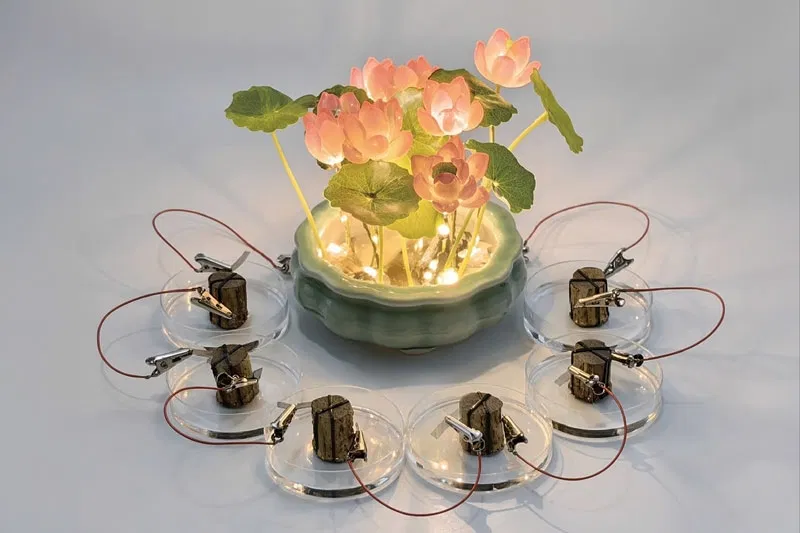
Chinese scientists have developed a generator that converts the energy of water evaporation directly into electricity. This required lotus stems, electrically active bacteria and a source of water. It turned out that in the field it is possible to assemble low-power generators that generate energy around the clock.
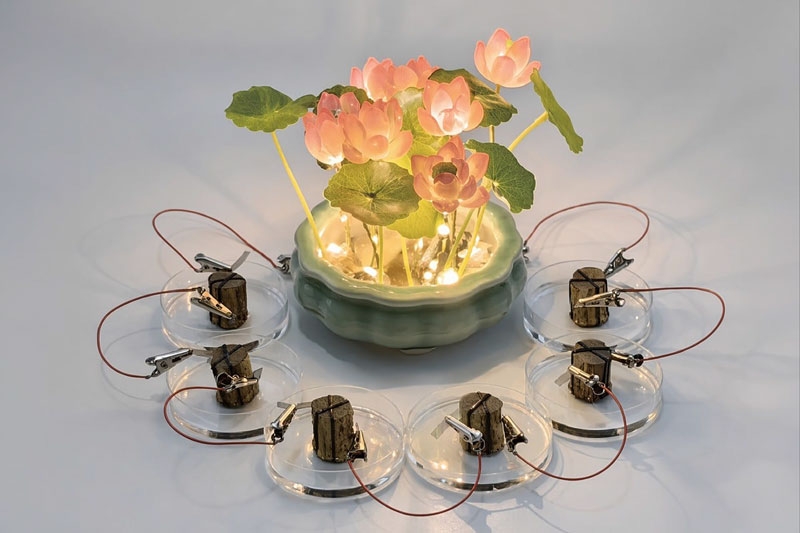
Night light in the form of flowers with illumination, which is powered by generators from lotus and bacteria. Image source: SCMP
At the heart of the device lies natural movement of ions through the microchannels of the lotus stem. Scientists have only optimized this process. In laboratory conditions, artificially created generators operated continuously for more than one month. The technology belongs to the direction of hydrovoltaics – the production of electrical energy through the interaction of water with solid materials and the movement of ions.
As the basis of the generator, scientists used the longitudinal hollow channels of the lotus stem, which ensure the directional movement of water. Previously, the stems were kept for 24 hours at a temperature of 4 °C in a suspension of Geobacter sulfurreducens bacteria so that the microorganisms populated the internal channels and formed an electroactive biofilm. The samples were then dried for eight hours, after which porous titanium electrodes were attached to opposite ends of each piece of stem.
The bacterial film increased ionic conductivity and facilitated the transfer of electrical charges, while the ordered structure of plant channels ensured the directional movement of water and dissolved ions. Let us add that the electrical activity of bacteria means their ability to give electrons to the external environment, as if pushing them out of their cells, which facilitated the generation of electric current. The ions that rose to the electrode created a potential difference at the opposite ends of the lotus stem segment, which led to the generation of an electric current.
In the experiment, a separate generator showed an open circuit voltage of 1.48 V and a short circuit current of up to 0.73 mA (stable value was about 0.3 mA). The maximum specific output power reached 63 μW/cm2. In this mode, electricity generation continued for more than 30 days.
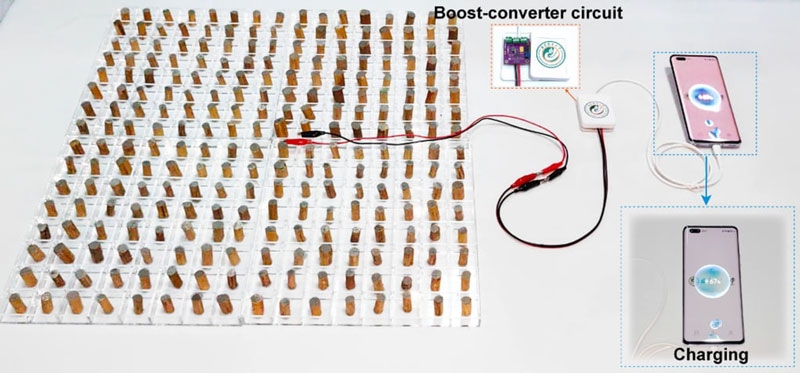
To test scalability, a system of 256 generators arranged in a 16 × 16 matrix was assembled to power several portable devices, including a backlit digital watch, an e-ink display, a calculator, and a mobile phone. The ability of the generator to switch the states of a field-effect transistor directly connected to its circuit was also tested, which opens the way to the creation of digital interfaces.
Calculations and experimental data made it possible to establish that the performance of the system is especially affected by the rate of water evaporation and the electrical conductivity of the material. Compared to traditional generators based on disordered porous structures, the lotus stem design provided more organized paths for the movement of liquid and ions, and the bacterial biofilm reduced losses during charge transfer.
The study showed the possibility of converting weak thermal energy from the environment into electricity through the evaporation of water. Of course, this requires suitable conditions, which occur quite often in nature, especially in humid environments. Thus, such low-power generators can be used to power a variety of sensors designed to monitor the environment and agricultural land.
If you notice an error, select it with the mouse and press CTRL+ENTER.