In 2027, the global NAND flash memory market will face an oversupply, which will lead to a decrease in contract prices, TrendForce analysts expect. The main reasons will be the expansion of production, a reduction in orders for corporate SSDs from Chinese cloud providers and a further weakening of consumer demand.

Image source: Vasilis Chatzopoulos/Unsplash
Po forecast analysts, global shipments of NAND Flash in terms of bits will increase by 25-30% year on year. At the same time, capital expenditures of manufacturers will increase by 26.7%, reaching $29.9 billion, and the expansion of production will be facilitated by the transition to more multi-layer memory and an increase in the share of QLC NAND, which allows storing more data in one chip.
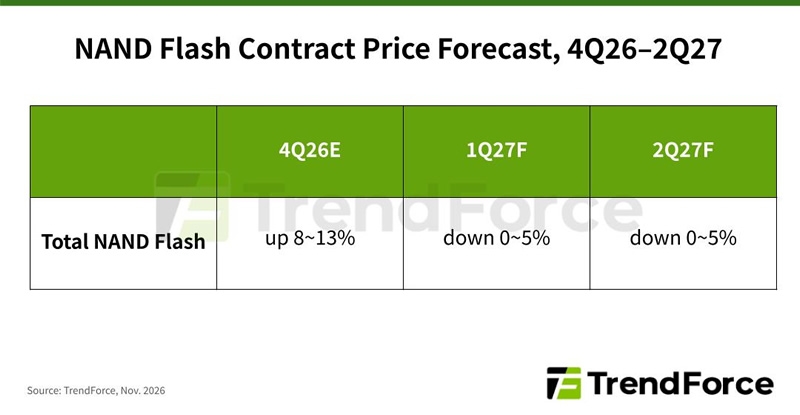
Image source: trendforce.com
The situation with demand for corporate SSDs varies differently in different regions. US cloud providers have raised their procurement forecasts for 2027 by building server infrastructure for AI agents and general-purpose computing tasks. However, Chinese companies, faced with GPU shortages, excess inventory and increased price competition in the AI token market, have reduced orders so much that the decline exceeded additional demand from the United States.
Additional pressure will come from the consumer segment. In 2027, supplies of inexpensive memory are expected to run out, which could lead to higher prices for finished electronics and a reduction in device supplies. Manufacturers will also reduce on-board storage capacity to control production costs. Against this background, TrendForce has already revised its forecast for contract price growth in the fourth quarter of 2026 to 8-13%, and spot prices have recently corrected by more than 20%.
Going forward, analysts expect contract prices for NAND Flash to decline by 0-5% in the first quarter of 2027, and from the second quarter the decline should affect all product categories. The situation will be affected by the speed of inventory reduction by Chinese cloud providers, restrictions on the purchase of foreign graphics processors and plans by electronics manufacturers to reduce the amount of memory in devices in 2028.
Another important factor will be US politics after the midterm elections, as possible changes could affect the implementation and support of large AI data center projects planned for 2028, as well as the timing of approval and funding for these projects.
If you notice an error, select it with the mouse and press CTRL+ENTER.