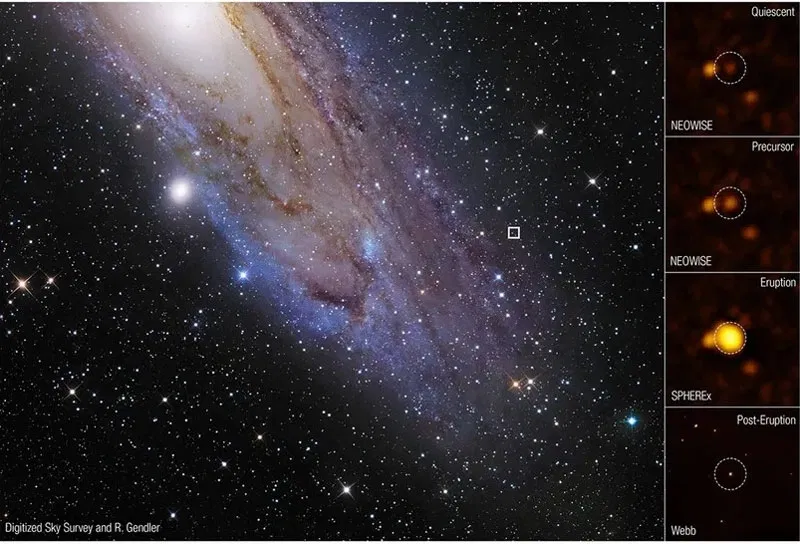
Astronomers have witnessed a first-of-its-kind observation of a star engulfing its system companion. The tragedy occurred in the Andromeda galaxy, approximately 2.5 million light years from Earth, and became the first observational confirmation of the theory and models of such events.
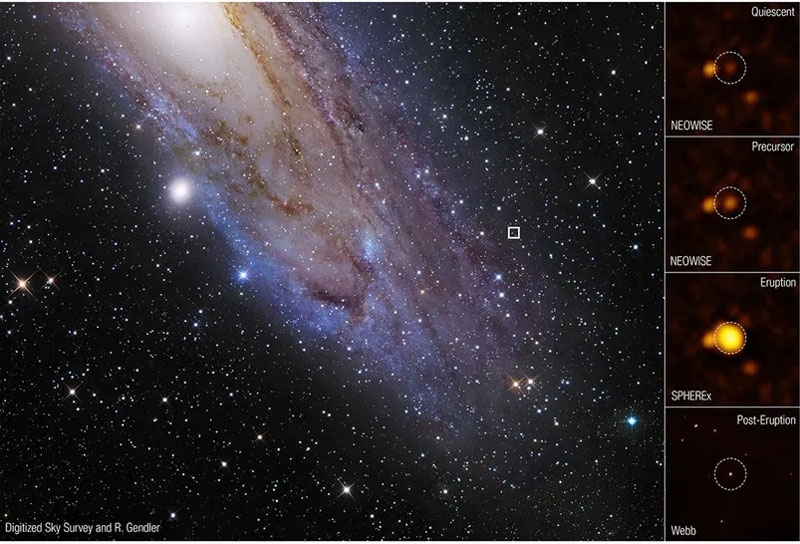
The square shows the observation location, and the inset shows telescope data. Image source: Nature 2026
The AT 2025abao system has attracted the attention of scientists consisted of two stars. The more massive star in the system was at a late stage of evolution – it had entered the phase of an asymptotic giant branch (AGB) star, had a mass of about seven solar masses and a radius of about 350 times the solar one. The mass of its companion was approximately 0.7 solar masses. In 2018, a smaller star began to penetrate the outer gaseous shell of the giant and gradually move closer to its core.
This interaction is called the evolution of the common shell. In such a bundle, both stars find themselves inside a common gas shell, and the companion moving in it experiences resistance from the surrounding plasma. The resulting hydrodynamic braking leads to a loss of orbital energy and a gradual decrease in the orbit. In this case, the energy of movement is transferred to the gas (shell), causing it to heat up and release the substance. According to the researchers’ reconstruction, this process lasted about seven years and was accompanied by a gradual increase in the brightness of the system. At the end of 2025, there was a sharp increase in brightness, accompanied by the ejection of matter. Researchers linked this to the immersion of the companion into the giant’s core and the merger of stars.
Data from several observatories were used to reconstruct the sequence of the event. The first signs of unusual behavior were found in archival observations of NASA’s NEOWISE infrared telescope and the ground-based WINTER telescope at the Palomar Observatory. Additional optical and infrared observations made it possible to trace changes in the brightness and spectrum of the object. Particularly important were data from the James Webb Space Telescope, which observed the system just 47 days after the outburst. Spectral and infrared measurements helped evaluate the properties of the ejected material and compare them with merger models. According to calculations, about 0.1–0.2 solar masses of matter from the outer layers of the giant were ejected into the surrounding space.
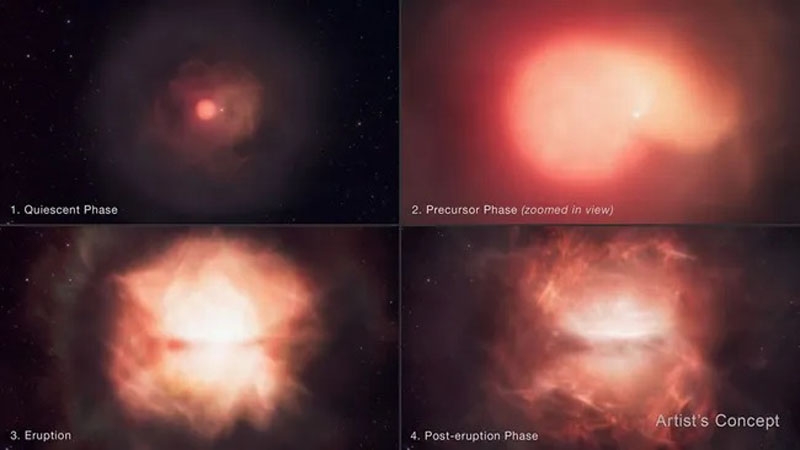
Reconstruction of the event in the eyes of the artist
The authors of the study consider the AT 2025abao event to be the first case when it was possible to directly trace the development of the evolution of a common envelope – from the beginning of the immersion of one star into the envelope of another to the final flare, accompanied by the ejection of matter. At the same time, scientists admit that the stars could retain their individuality, but in much closer orbits. Whether this is true remains to be seen, which will require new observations.
If you notice an error, select it with the mouse and press CTRL+ENTER.