
OpenAI introduced two new artificial intelligence models – GPT-6.2 Astra and GPT-6.2 Sol, aimed at performing complex professional tasks and everyday affairs. Each of them became smarter and more accurate in their answers, while the cost of use did not increase, but even decreased.

Image source: AI generation ChatGPT/3DNews
Most noticeable Improvements to the GPT-6.2 Astra model have been implemented in the preparation of professional documents, data analysis and scientific research. In the Agents’ Last Exam benchmark, which evaluates the performance of multi-step professional tasks, the new model outperformed the GPT-6 Astra by 5.2%, spending less than a third of the cost of completing tasks. Comparison with Claude Fable 5.2 turned out to be even more favorable: GPT-6.2 Astra was ahead of its competitor by 5.5% at a cost of only 5% of the cost of Claude Fable 5.2.
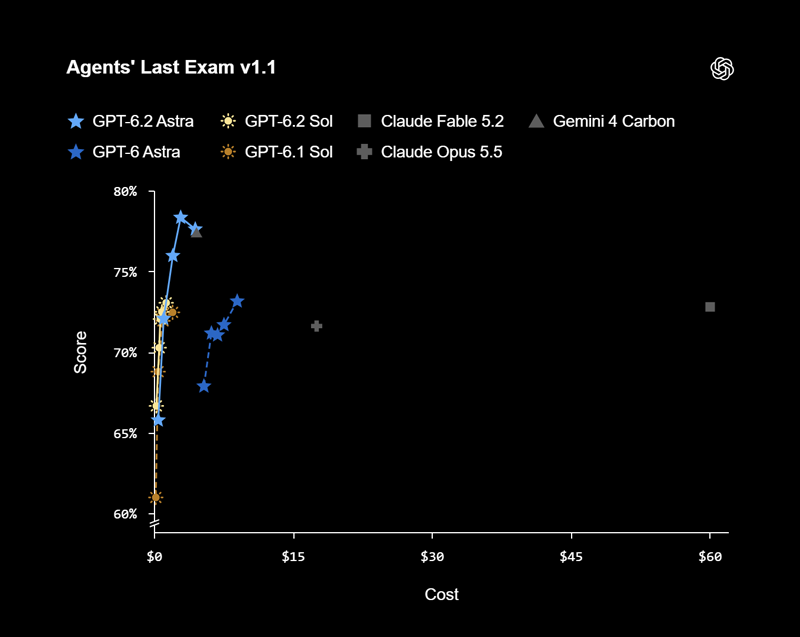
Image source: OpenAI
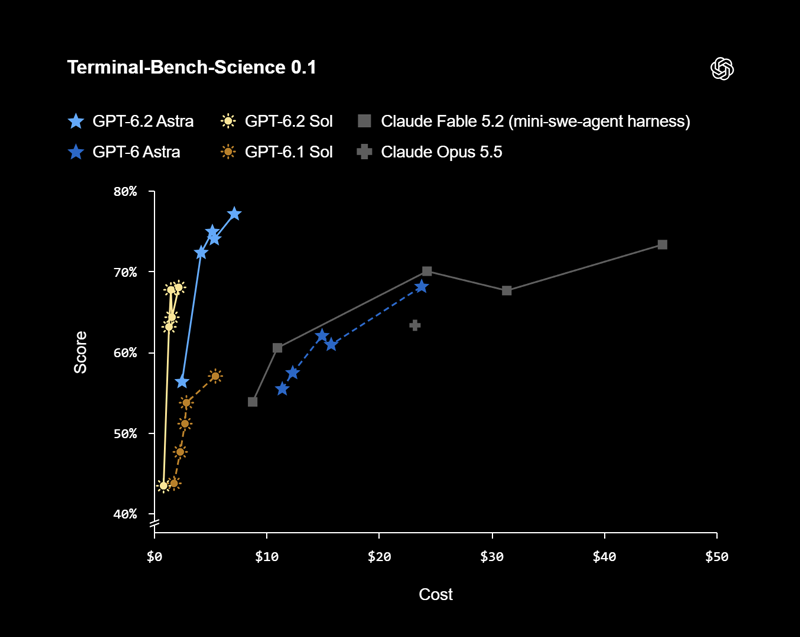
According to OpenAI, the Terminal-Bench-Science 0.1 benchmark clearly confirms that GPT-6.2 Astra is the best model for scientists. This test shows how well the models perform scientifically when controlled from the command line. Thus, GPT-6.2 Astra showed a result 9% higher than its predecessor, while the cost of its use is one third lower. The new model also scored top on the Vals Science Index, which asks models to interpret real biological data and run experiments to understand how a modeled system works.
Separately, OpenAI notes improvements in the quality of presentations, financial tables, legal documents and analytical reports. According to the company, the texts of the reports have become simpler and more accessible to understand, and also contain less “water”. The internal test of GDPval v2 showed an increase of 6.2% relative to GPT-6 Astra while reducing the consumption of output tokens by 22%.
The slides, tables and documents produced by the GPT-6.2 Astra model are less AI-like and more consistent with the design of documents provided as samples or accepted industry standards. The new model also writes cleaner code and creates interfaces that look and perform better, especially for websites, games and 3D design.
Based on multiple benchmarks, both new OpenAI models approach or outperform other leading models at much lower cost per task.
GPT-6.2 Astra has achieved very impressive success in 3D modeling. The press release illustrates this by visualizing the dynamics of a car chassis on a mountain road. Astra created a 3D model and wrote a calculation block in Python to simulate complex tire-suspension dynamics, then animated the results in Blender.
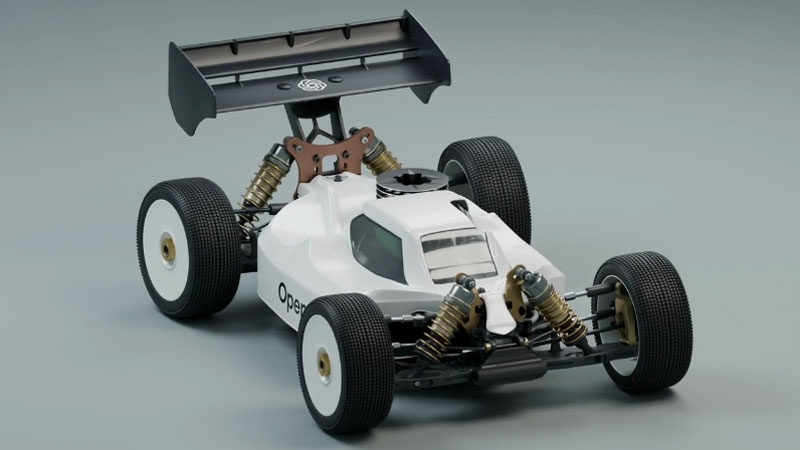
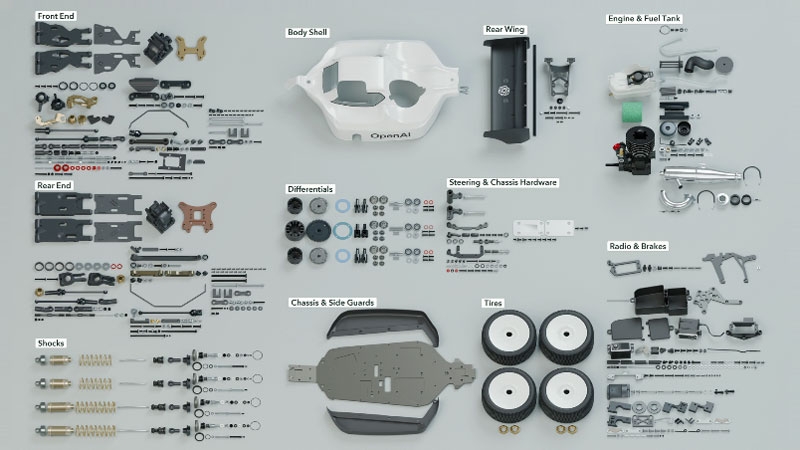
This allows engineers to quickly test new designs and improve simulation accuracy over time. What is important is that the new model has increased the accuracy of calculations of the interaction of individual parts and assemblies, which allows you to quickly check various combinations and select the most successful and reliable ones. Also impressive is the demonstration of completing a task to develop a radio-controlled car with the provision of designs, drawings and a list of necessary components for self-assembly.
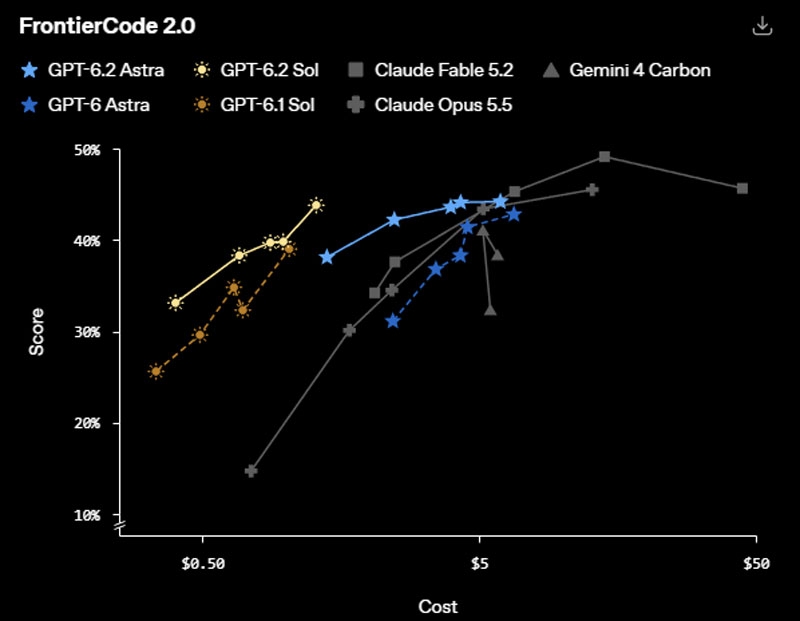
In the AA-3D test, the GPT-6.2 Astra scored 1318 Elo points, ahead of the Claude Fable 5.2 with 1271 points and the GPT-6.2 Sol with 1259 points. At the same time, Sol came close to Astra’s result in FrontierCode 2.0 programming testing, losing to it by less than 0.5% at a cost about five times lower.
OpenAI also says GPT-6.2 Astra brings deeper visual content to web design by selecting layouts and images that give each site a unique look and arranging elements according to its actual purpose. The model recreates virtual worlds, digital twins and computer games, which is also reflected in the announcement.
As for the GPT-6.2 Sol, it is positioned as the main model for everyday work. Compared to GPT-6.1 Sol, GPT-6.2 Sol is smarter and more efficient and allows you to perform more tasks within the same data plan. The model supports multi-step agent workflows, writes clearly and naturally, and interacts with it intuitively. In particular, many OpenAI collaborators use GPT-6.2 Sol as a base model to solve both technical and non-technical problems. Cognition’s FrontierCode 2.0 benchmark shows that the GPT-6.2 Sol lags behind the GPT-6.2 Astra by just 0.5% at a cost of about five times lower (both models were tested at maximum settings).
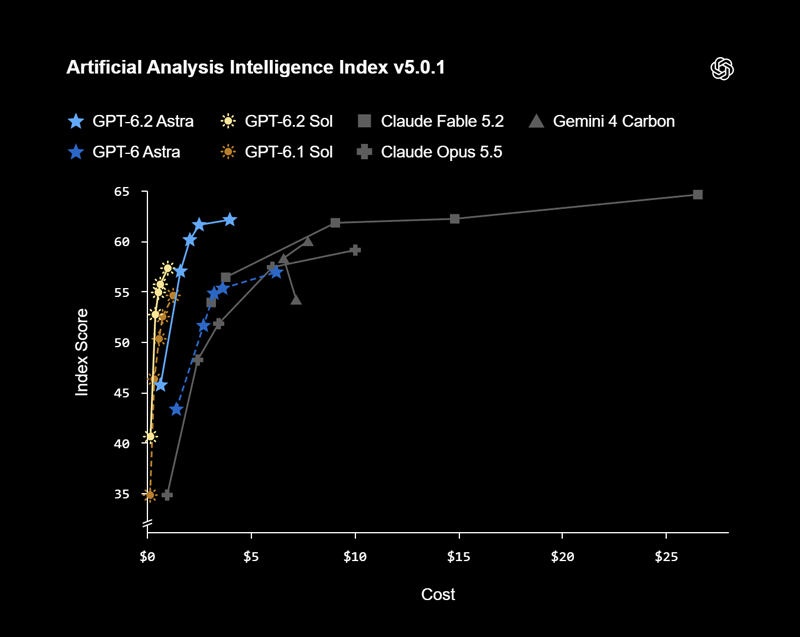
GPT-6.2’s speed and intelligence make Sol also well suited for the high-value tasks that people assign to artificial intelligence in their spare time. In this area, GPT-6.2 Sol outperforms GPT-6 Astra by about seven times.
Special attention in both new models is paid to cybersecurity and control over potentially dangerous capabilities. According to the company’s classification, both models achieved the level of “critical” in the field of cybersecurity and “high” in the field of biology and chemistry.
The GPT-6.2 Astra model also became the first publicly released OpenAI model to reach the “High” level of the AI Self-improvement criterion, which evaluates the ability to accelerate the research and development of new artificial intelligence systems – roughly speaking, self-learning. In this regard, the company has strengthened restrictions on potentially dangerous requests and expanded monitoring of model actions.
In terms of availability of the new models, GPT-6.2 Astra and Sol are available to ChatGPT Plus, Pro, Enterprise and Edu users via ChatGPT Work and Codex, as well as to developers via the API. Astra costs $8 per million input tokens, $0.40 per million cached input tokens, and $40 per million output tokens. For Sol, the tariffs of the previous version are retained – $2, $0.10 and $10, respectively.
If you notice an error, select it with the mouse and press CTRL+ENTER.