



GlobalFoundries abandoned the development of the 7-nm technology process back in 2018, but now ten years later it expects to launch in Germany the production of chips with the speed of digital logic at the 7-nm class level. This opportunity should be provided by the new FDX Fusion platform, production of which the company plans to begin in 2028.
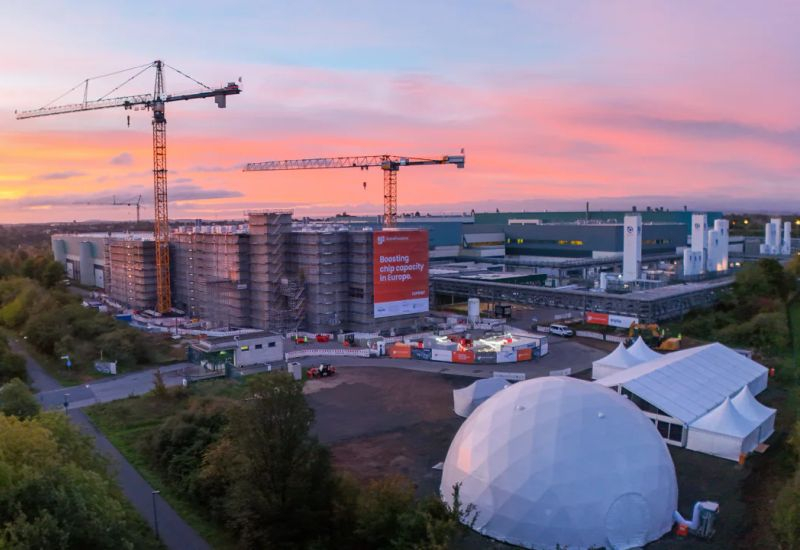
Image source: GlobalFoundries
We are talking about the further development of FD-SOI – silicon-on-insulator technology with a completely depleted channel. The stated comparison with the 7-nm class refers specifically to the speed of digital logic, and not to the physical dimensions of the elements or the equality of all characteristics. GlobalFoundries is not announcing a return to the previous 7nm FinFET program or promising comparable transistor densities.
AMD’s historically former German facilities became GlobalFoundries’ first production base after its founding in 2009. The Dresden site will now become the site of development and initial production of FDX Fusion. In parallel, the company is expanding its capacity as part of the SPRINT project worth about €1.1 billion. By the end of 2028, the annual production capacity should exceed 1 million silicon wafers with a diameter of 300 mm. These investments relate to plant expansion and not solely to new technology.
In 2018, GlobalFoundries suspended its 7nm FinFET program indefinitely and focused on improving 12nm and 14nm processes and custom technologies. FDX Fusion should allow the company to reach new levels of performance while maintaining its focus on energy efficiency and combining various functions into a single chip.
In its official press release, GlobalFoundries calls FDX Fusion is a platform for “physical AI” – systems that analyze sensor data and interact with the outside world. Anticipated applications include robotics, industrial automation, autonomous systems, automotive electronics, and connected devices with local AI processing.
Such tasks require not only computing units, but also analog signal processing, memory and communications. FDX Fusion is designed to combine dense digital logic, analog and RF components, on-chip non-volatile memory, and in-memory computing capabilities. This will reduce system complexity, latency and power consumption.
The first generation of FDX Fusion, according to the company, is being developed from the ground up as the next major development of its FD-SOI line. The changes will affect the substrate, transistor structure, interconnects and integration methods. The transistor density is planned to more than double compared to the first generation FDX. At the same time, specific indicators that allow an independent assessment of comparison with the 7-nm class are not given in the announcement.
GlobalFoundries already offers embedded resistive RRAM as part of the 22FDX+ platform, so non-volatile memory itself is not new to the FDX Fusion. The peculiarity of the new platform is the combination of such capabilities with higher performance of digital blocks and advanced signal processing tools.
Among the partners who commented on the announcement were BMW, Bosch, Siemens, Infineon, NXP and Tesla. Infineon specifically mentioned its collaboration with GlobalFoundries on future FDX Fusion 7nm-class technologies for radar and wireless communications. Bosch and NXP have also expressed interest in combining sensing, control, communications and energy-efficient computing.
It is noteworthy that Infineon, NXP and Bosch are simultaneously participating in the ESMC joint venture with TSMC, which has been under construction in Dresden since 2024. However, cooperation with GlobalFoundries does not mean abandoning other contractors: different production technologies can be used for different product categories.
The development of FDX Fusion in Dresden is subject to approval by the German federal government to launch the project under the IPCEI Advanced Semiconductor Technologies program. The SPRINT expansion itself already receives support from the European Union, the federal authorities of Germany and Saxony under the European Chips Act, but this does not guarantee automatic approval of the new technology project.
The company expects to have the first FDX Fusion demonstrators available to customers for evaluation in early 2027, and the initial PDK design kit to be released by the middle of that year. For the development of chips, it is planned to use the GlobalFoundries ecosystem, including MIPS and ARC processor solutions, RISC-V architecture and specialized computing units. The start of production in Germany is scheduled for 2028.
If you notice an error, select it with the mouse and press CTRL+ENTER.


