



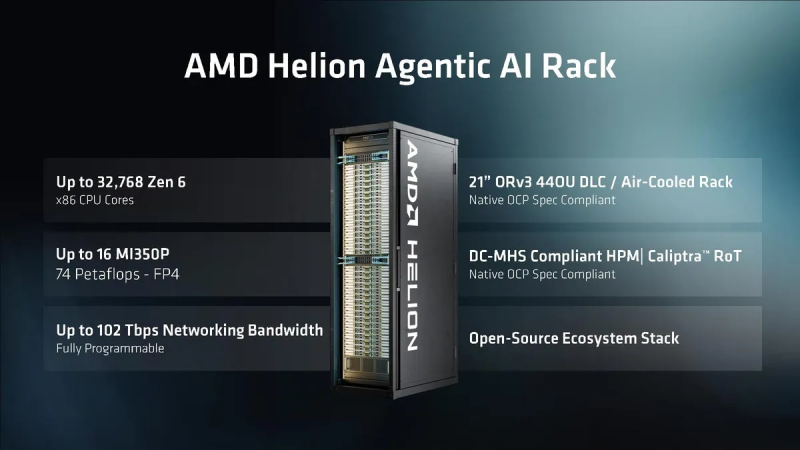
AMD is introducing a new rack-mount reference solution to the data center ecosystem. Helion is a standardized 21″ rack design that complements Helios rackwhich AMD presented last year at the OCP Global Summit. According to AMD, the new Helion can accommodate up to 32,768 Zen 6 cores in a CPU-only configuration thanks to the high-density packaging of the 256-core EPYC 9996 Venice chips.
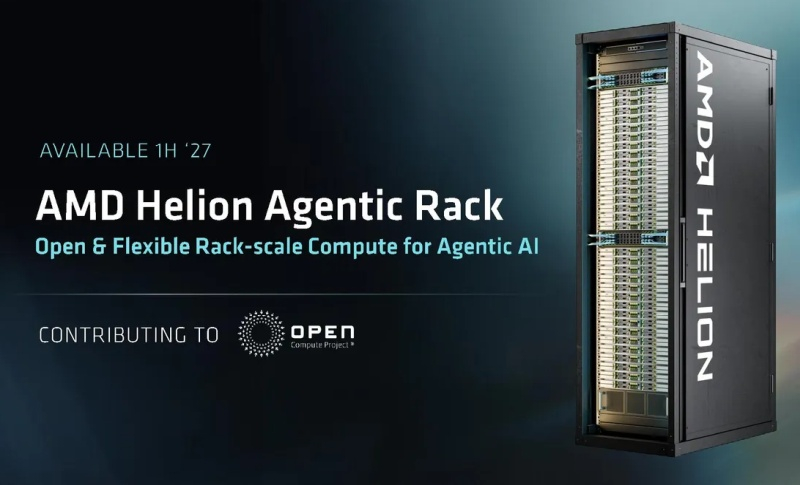
Image Source: AMD
The Helion rack design is standardized and based on the ORv4 (Open Compute Project) specification. It differs from standard racks in increased width and height. Helion is designed to accommodate 44 OpenU format modules (trays) with a width of 21 mm and a height of 48 mm, which is slightly larger than the parameters of the standard EA1-310 module. The reference design supports both air cooling and direct liquid heat removal systems.
Helion’s design complies with the OCP DC-MHS (Data Center Modular Hardware System) standard. According to OCP, the MHS standard is designed to provide “compatibility of key infrastructure elements of data centers, edge computing and enterprise systems”.
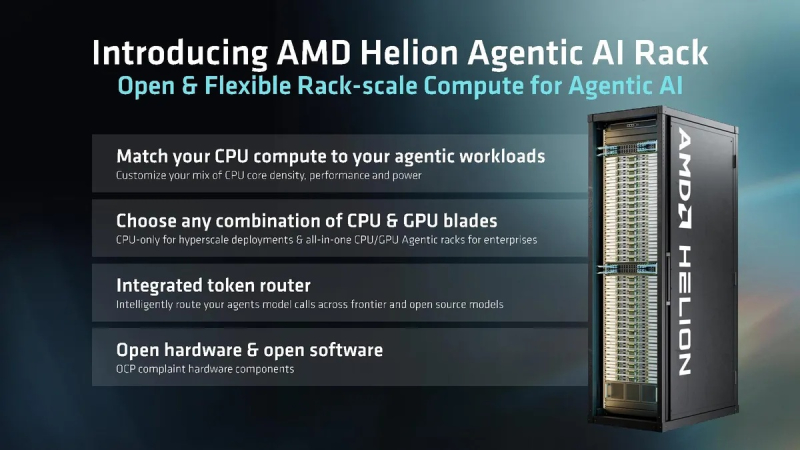
Although AMD has prepared renderings of the project, the company itself will not sell finished racks. This is a reference design that AMD is sharing with the OCP community and will be brought to market by OEMs and ODMs. AMD CEO Lisa Su will announce the list partners later during a keynote address at the OCP Global Summit. AMD did not name the companies that will implement the system, but hinted that Helios customers will likely use Helion racks.
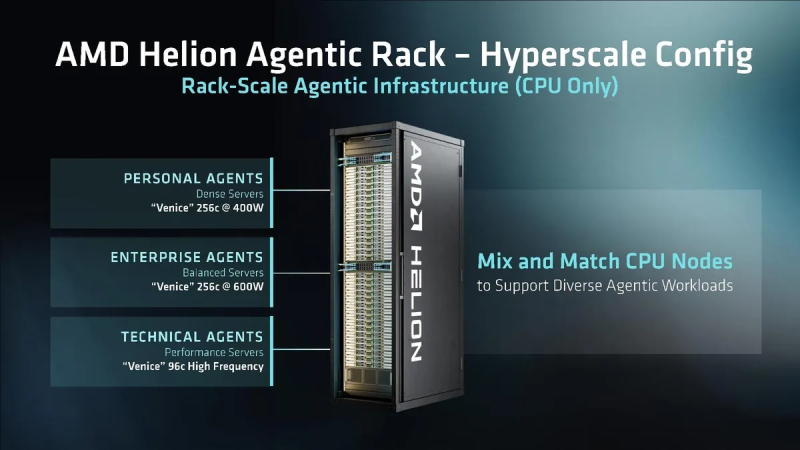
Unlike Helios, which was designed to train AI and perform inference tasks, Helion is a more flexible rack-mount solution focused primarily on the use of central processing units. In a CPU-only configuration, the system can accommodate up to 128 EPYC 9996 processors, providing an impressive total of 32,768 cores per rack. Such a layout will likely resemble a “sandbox” for the work of AI agents, connected to an inference system.
This model for organizing the work of personal AI agents is already used today – for example, in the Meta projects✴ Muse and OpenAI Dots. Each user has an isolated environment (“sandbox”) that uses part of the computing resources of the host system, which relies on the server to perform inference. Some tasks, such as software compilation, are performed on these CPU servers, while resource-intensive AI inference operations take place on other capacities.
Presumably, this is the model AMD is focusing on when developing the Helion system, given that hyperscalers are increasing CPU computing power to support AI agents. At the same time, the solution architecture is flexible: it supports installation of up to 16 MI350P graphics processing units (GPUs) and provides network throughput of up to 102 Tbps, although at the expense of a reduction in the number of central processing units. According to AMD, this hybrid configuration is intended for the enterprise sector and is a universal all-in-one solution that combines data management, networking and AI functions.
According to AMD’s plans, Helion racks will become available in the first half of 2027. Their release will likely coincide with the period of active introduction of processors based on the Zen 6 architecture, the mass deployment of which is expected at the end of this year.
If you notice an error, select it with the mouse and press CTRL+ENTER.


