

Engineer from Ecole Polytechnique Fédérale de Lausanne (EPFL) developed Unusual tiny engine converts sound waves directly into thrust – without the need for electric motors or onboard electronics. Scientists exploited the same phenomenon where when you blow into an empty bottle, it starts buzzing. Microdrone engines are identical resonant cavities that produce jet thrust in response to sound vibrations at a given frequency.
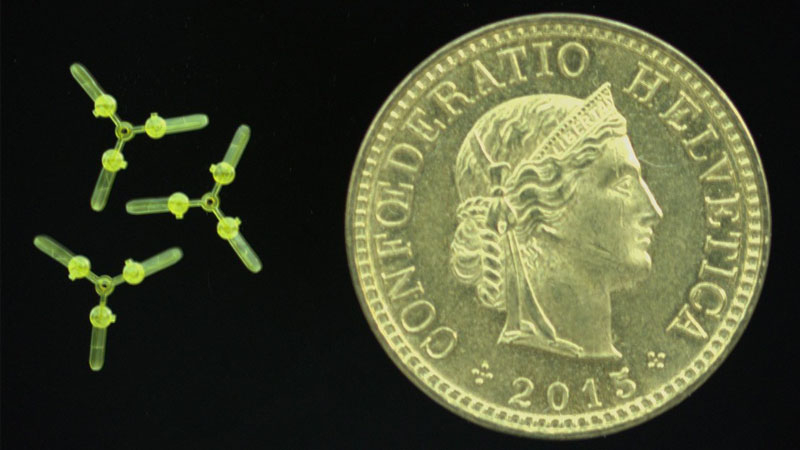
Image source: Ecole Polytechnique Fédérale de Lausanne
The technology is based on Helmholtz resonance. Researchers at the Microbiological Robotic Systems (MICROBS) Laboratory created circular and bell-shaped hollow resonators whose size and geometry were chosen based on specific sound frequencies. When it resonates, the air within the cavity begins to vibrate violently, turning a simple hollow structural element into an acoustic micromotor.
The principle of generating thrust is based on the asymmetry of airflow. With each acoustic vibration, air enters the resonator in a relatively dispersed stream but exits through the holes in a more concentrated jet. This causes the mean impulse of the outflow to gain direction and the structure receives the jet thrust.
This approach is fundamentally different from acoustic levitation, where an external sound field directly fixes or moves a passive object, such as a tennis ball in front of a humming speaker. In the new approach, sound appears to inject energy into a resonator built into the device, which itself creates the driving force. Such cavities can be freely 3D printed or printed with plastic, glass and other materials.

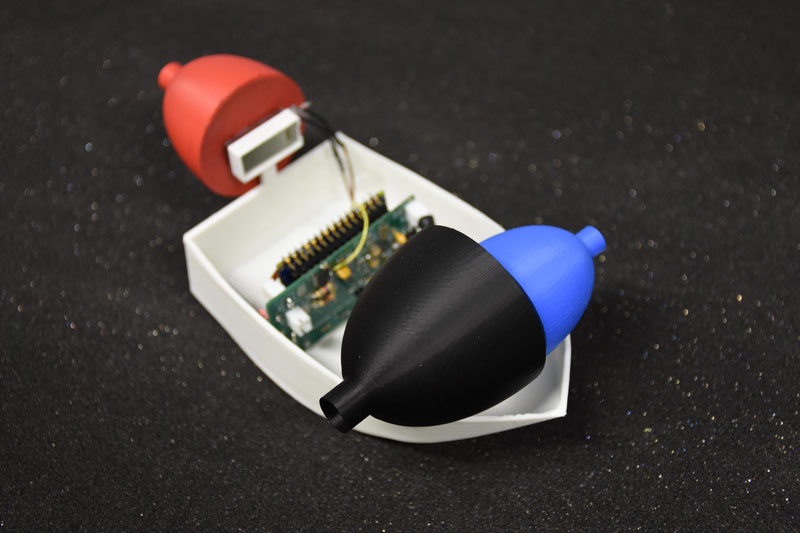
To demonstrate the technology, the researchers first built microscale ships with one, two or three acoustic resonators. Each cavity is tuned to its own frequency within the audible range and oriented so that the thrust it generates acts in a certain direction. By changing the frequency of the speaker signal, engineers can selectively turn on different “motors” to move the ship forward, turn and avoid obstacles. With this control, the researchers also demonstrated programmable autonomous movement.
Subsequently, the team used 3D nanoprinting technology to create a more complex flying microrobot, and built three microresonators directly into the polymer body. They already work at ultrasonic frequencies that are inaudible to humans. One of the devices, which weighs just 150 micrograms, generates upward jet thrust directly from acoustic jets and works essentially on the same principle as a microrocket.

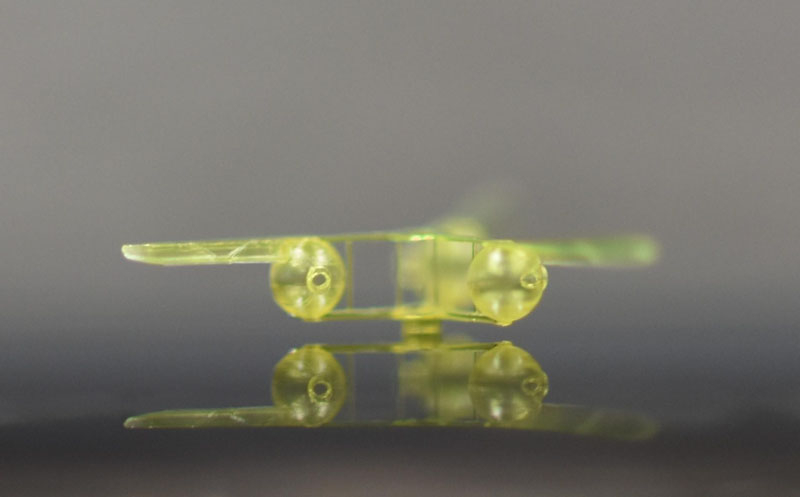
In another design, resonators spin tiny blades at speeds up to 13,000 rpm, creating sustained aerodynamic lift similar to that of a helicopter. Developers say further reductions in size will make it possible to create flexible robots with multiple resonators, each responding to its own frequency and independently bending, rotating or changing parts of the device under the influence of sound.
If you find an error, select it with your mouse and press CTRL+ENTER.