

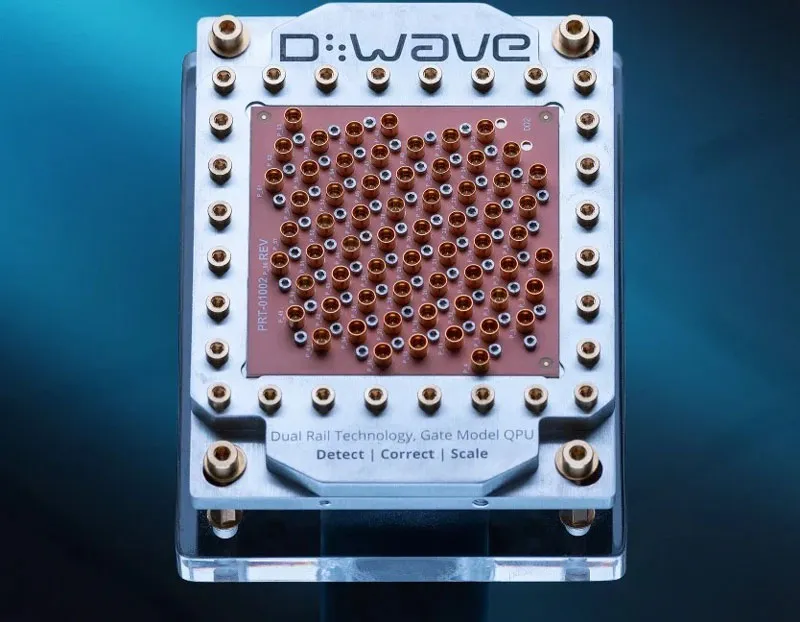
This summer, D-Wave entered the new realm of universal quantum computers. Prior to this, she was a world-leading expert on quantum annealing systems for solving optimization problems. Universal quantum computers are capable of solving a wider range of problems, so the potential demand is greater. And, D-Wave immediately raised the bar, propose A new quantum gate architecture with impressive error detection capabilities – one of the major bottlenecks of quantum platforms.
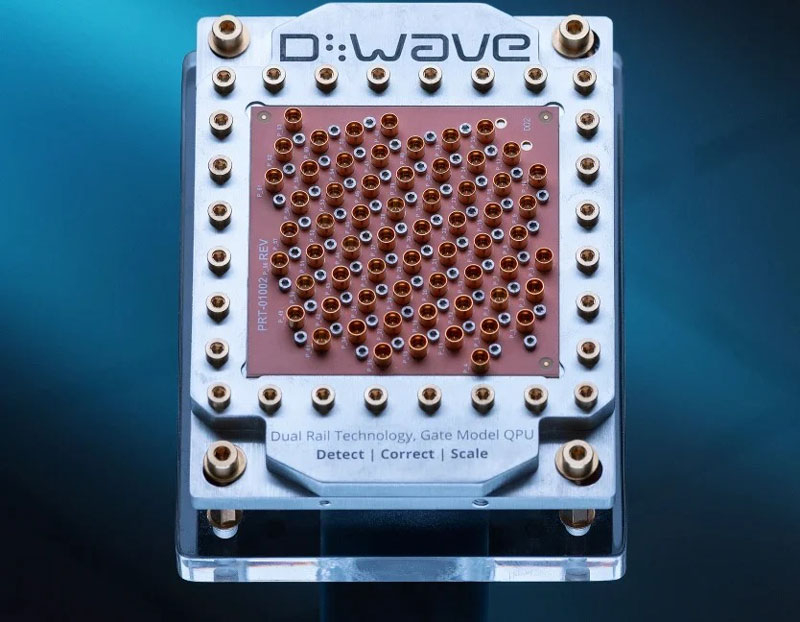
Image source: D-Wave
Recently published in Nature Work D-Wave researchers demonstrated a new component of a quantum computer they created that is capable of independently identifying most errors that occur during calculations. The main idea is to make errors not only more rare, but also noticed by the system as soon as they occur. This could greatly facilitate the creation of reliable quantum computers.
In traditional quantum processors, qubits are extremely sensitive to interference, so their state can easily be distorted. Furthermore, the system does not always know exactly where the failure occurred. D-Wave uses a special type of so-called dual-rail qubits. The quantum state of each qubit is distributed between a pair of coupled resonators. Due to its physical principles, this architecture makes it possible to detect errors directly at the qubit level without the need for additional circuitry and correction algorithms. In other words, the system not only receives incorrect results, but also information about which qubit failed.
Until now, a serious problem has been connecting these qubits to each other: when performing joint operations, their ability to detect errors in themselves may be reduced. In the new work, the researchers demonstrate a two-qubit quantum gate that allows the qubits to interact and create quantum entanglement while maintaining the ability to detect operational errors.
In experiments, the dual-rail gate demonstrated approximately 99.9% accuracy when performing a two-qubit operation lasting 500 ns. The proposed architecture makes it possible to efficiently detect errors at the qubit level. As a result, the level of logic errors can be reduced by about ten times each time it switches to the next level of error-correcting code, the researchers said. This will ultimately help create logical qubits from fewer physical qubits, paving the way for scaling quantum computers.
Today, error correction is considered one of the main obstacles to creating practical quantum computers. Often, multiple physical qubits must be used to protect a useful logical qubit from failure. If the processor knows in advance where the error will occur, fixing the error is much easier and may require less additional hardware. So far, D-Wave has only demonstrated principles of operation on small systems of two interacting qubits, so it is still a long way from a full-fledged fault-tolerant quantum computer.
If you find an error, select it with your mouse and press CTRL+ENTER.