Key to the quantum internet is the transmission of entangled photons—particles with the same quantum properties that can protect data and enable decentralized quantum computing. But entanglement is difficult to maintain even in sterile laboratory conditions, let alone spread through ordinary urban communications. American physicists succeeded at something – they Sent first Entangled photons span 62 kilometers of conventional overhead lines.

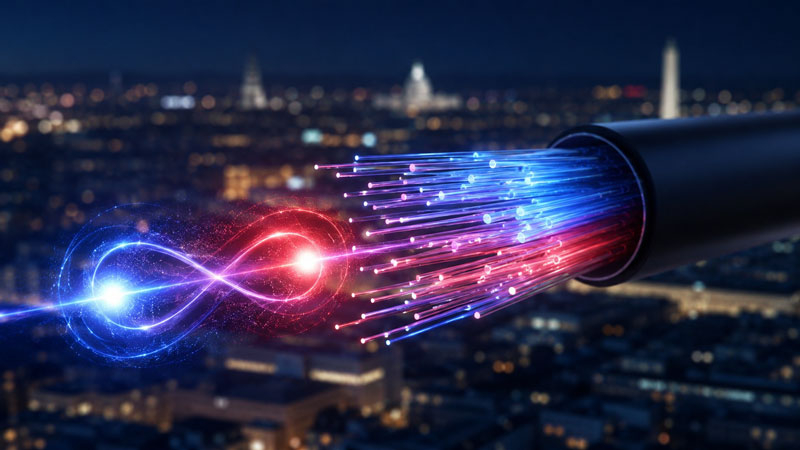
Image source: AI Generation ChatGPT/3DNews
The communication channel was established between the National Institute of Standards and Technology (NIST) in Gaithersburg and the University of Maryland in College Park. The peculiarity of the experiment lies not in the distance, but in the conditions: approximately 70% of the lines pass through overhead cables suspended from poles and are exposed to wind, temperature changes, transport vibrations and other external influences. This perturbation permanently changes the birefringence of the fiber and thus the polarization of the transmitted light, which is particularly dangerous for quantum states. The experiments show that even on such unstable infrastructure, polarization entanglement can be maintained long enough for future quantum networks to operate.
The NIST laboratory’s light source produces photon pairs in the entangled Bell state Φ+, in which their horizontal and vertical polarizations are quantumly correlated. The pair of photons are separated by wavelength: The center signal photon remains at NIST, while the second is sent along a 62-kilometer-long fiber to the University of Maryland. Direct losses in the line amount to about 18 dB, with connectors and polarization-capable devices adding about 3 dB. Photons are detected by superconducting nanowire single-photon detectors with a detection efficiency of over 70%. When measured locally, the source produced about 200,000 pairs per second, and after passing through the wire, the researchers recorded about 1,500 matching pairs per second.
The main challenge is to continuously compensate for changes in polarization. To stabilize it, the researchers periodically passed a reference laser signal with a power of about 0.5 mW through a line of 1549.32 nm, the same wavelength as the transmitted quantum photons. The system measures the transformation of several reference polarization states and uses algorithms to reconstruct them. When the reliability of the reference state drops below 98%, correction to a level above 99% is initiated. Quantum transmission and calibration lasers work alternately in time so that bright reference signals do not interfere with single photon detection.

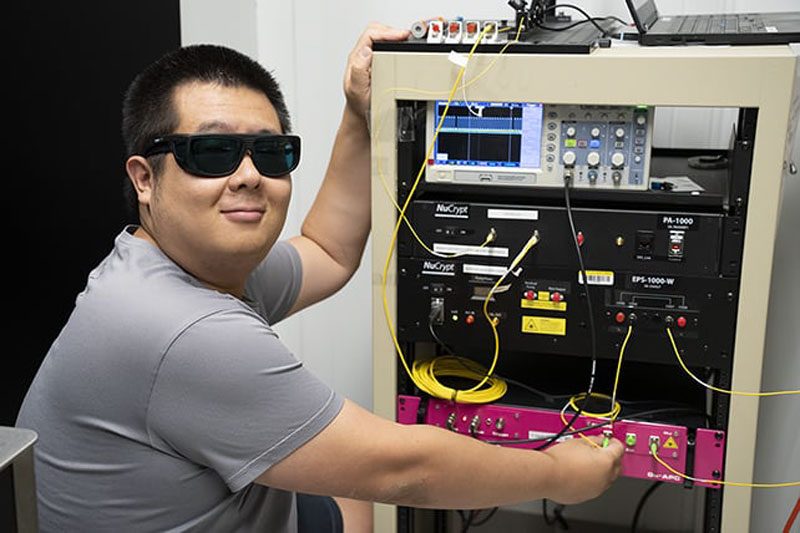
Photo credit: Megan King/NIST
During the 24-hour experiment, the system spent only 7.2% of the time correcting the polarization, leaving 92.8% of the time transmitting the entangled photons. When stabilization is disabled, the transmission quality of entangled states is greatly degraded and never recovered. Therefore, the main conclusion of the completed work is that even existing low-quality cable infrastructure allows the transmission of entangled states and thus allows the operation of a quantum internet. But we need to work on transmission speeds – and no one is hiding that.
If you find an error, select it with your mouse and press CTRL+ENTER.