


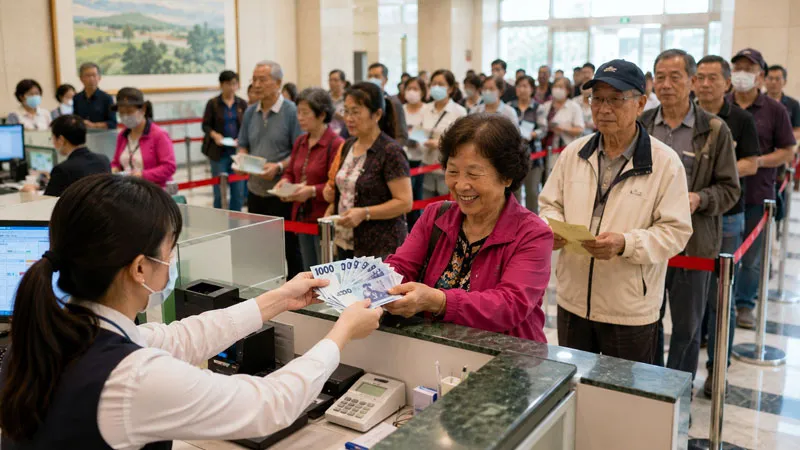
Taiwan authorities Intend Allocating NT$235.7 billion (approximately US$7.4 billion) for one-time payments to people, tying the measure to rapid economic growth brought about by artificial intelligence. According to the proposed 2027 national budget draft, each citizen should receive NT$10,000, approximately US$310, referred to as the “artificial intelligence dividend.”
Image source: AI Generation ChatGPT/3DNews
The initiative was announced by Taiwanese President Lai Ching-te. He called the payments a way to share AI revenue with the public. Currently, this is a draft that must pass the third reading. If the budget is approved by the end of 2026, the money could be distributed to citizens before the Lunar New Year in 2027.
The reason for this unusual generosity is the island’s unusually rapid economic growth, which is currently driven by demand for semiconductors and artificial intelligence computing equipment. In the first quarter of 2026, Taiwan’s real GDP increased by 15.43% annually, in the second quarter it grew by 12.93%, and in the first half of the year it grew by 14.15%. This is the strongest growth in more than 30 years, so it was decided to celebrate it in such a novel way, by allocating a certain amount of money to every citizen of the country.
Taiwan’s economic recovery is directly related to the continued expansion of global artificial intelligence infrastructure. DGBAS said that technology development is shifting from large-scale model training mainly based on the cloud to inference, artificial intelligence agents and edge computing, while the demand for general artificial intelligence accelerators and specialized customized chips is increasing. To this end, Taiwanese manufacturers are expanding capacity to produce semiconductors, memory, chip substrates, equipment, and chip packaging and testing services. Therefore, real private sector fixed investment is expected to grow by 11.58% in 2026, and real exports of goods and services are expected to grow by 21.28%.
The authorities plan to return some of the additional revenue to the technology industry. The budget draft budget for science and technology development is NT$229.2 billion, an increase of 12.7% from this year. Among them, 40.6 billion yuan is used for the “New Ten Artificial Intelligence Infrastructure Projects”, covering research, computing power, training and key technologies.
In addition, the authorities also propose to raise another NT$100 billion within eight years through expanded financing, investment tax incentives, and allowing companies to obtain artificial intelligence computing resources. Therefore, the one-time payment to the people is not seen as a separate social action, but as part of the income redistribution brought about by Taiwan’s current technology boom.
Finally, the country has many other social programs to support the population, aiming to increase birth rates and increase social welfare, including subsidies for children under 18 and other assistance to families.
If you find an error, select it with your mouse and press CTRL+ENTER.