


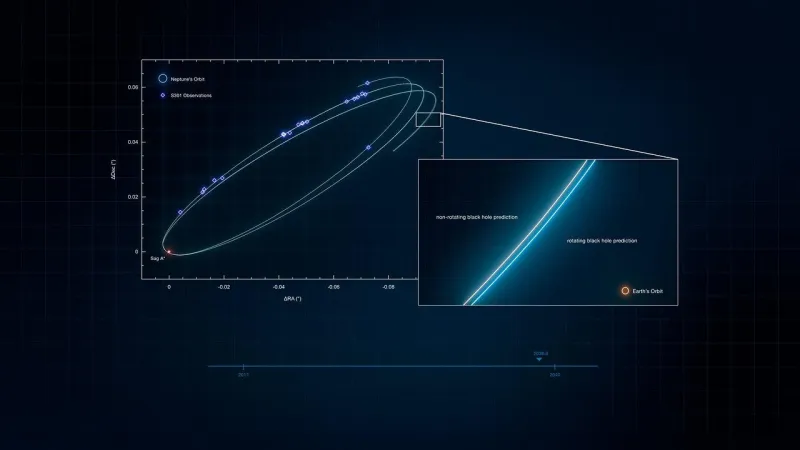
the scientist Found A star in an extremely elongated orbit around Sagittarius A*, the supermassive black hole at the center of the Milky Way. This star is closer to a black hole than any other star known. By studying its motion, astronomers will be able to estimate Sagittarius A*’s angular momentum.
Image source: eso.org
The new discovery is part of the European Southern Observatory’s Very Large Telescope gravity instrument program. Researchers have been using the instrument to track stars near Sagittarius A* since 2017. In 2023, he helped them discover a star that was moving away from the black hole—this star was named S301. Further calculations by the scientists showed that in early 2023 it was closer to the black hole than any other star previously discovered. Orbital models show that it will take only 8.7 years to complete a complete orbit, more than three years less than any other orbit in the region.
The star’s orbit is extremely elongated—it’s a very flat ellipse. The eccentricity of a circle is zero, and any value greater than 1 represents an open path. S301’s eccentricity is 0.9832, indicating that the star is on the verge of breaking through the gravitational pull of Sagittarius A*. This can lead to surprising consequences. For example, at its closest approach to a black hole, a star is moving about 25,000 kilometers per second, or 8% of the speed of light. At this time, S301 is ten times farther away from Sagittarius A* than the nearest previously discovered star. Researchers estimate that this distance may be only 11 astronomical units – much further than the distance from the Sun to Saturn. It is speculated that S301 is 1.5 times the mass of the sun, and if it were larger, the black hole’s gravity would destroy it. Researchers believe that S301 ended up in this orbit as part of a two-star system that got too close to Sagittarius A* and that its companion star was ejected from the vicinity of the black hole.
The researchers found that we already have a way to track S301’s orbit with enough accuracy to estimate Sagittarius A*’s rotational moment based on about a decade of data. Further increases in resolution or longer durations will make it possible to study more subtle aspects of supermassive black hole properties, such as deviations from a perfect sphere, or whether Sagittarius A* has other properties besides spin that influence its behavior. The discovery of S301 itself could be akin to developing a more precise tool to study supermassive black holes.
If you find an error, select it with your mouse and press CTRL+ENTER.