


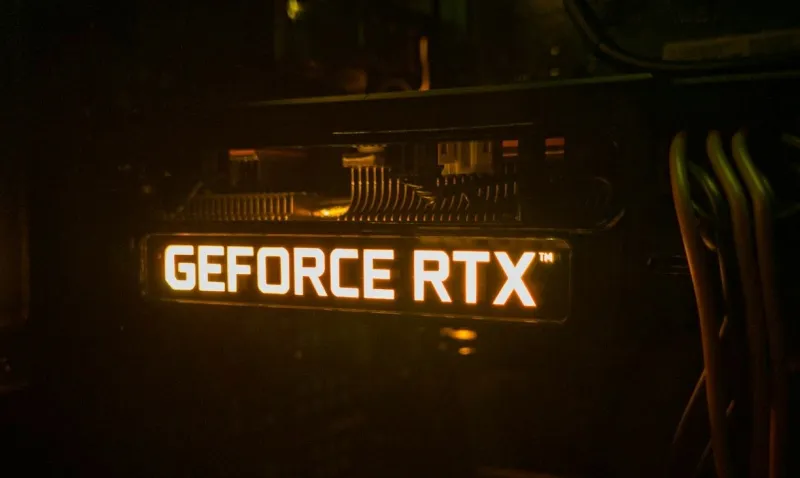
NVIDIA released its second quarter report for fiscal year 2027 ending July 26, 2026. For the first time, some data on gaming revenue has completely disappeared, and there’s no mention of GeForce RTX graphics cards at all. This is due to a recent change in Nvidia’s financial reporting structure that puts its gaming business into the broader edge computing category.
Image source: unsplash.com
Nvidia now splits revenue between just two major market segments. Data centers brought the company $89 billion in revenue in the second quarter, an increase of 18% from the previous quarter and an increase of 117% from the same period last year. Edge computing accounted for US$7.2 billion, growing 13% quarterly and 27% annually. However, it’s currently impossible to determine which part of this comes directly from the GeForce gaming graphics card. In May, Nvidia adjusted its quarterly financial report to eliminate the gaming segment, which covered GeForce RTX desktop and handheld devices, as well as revenue from custom consoles like the Nintendo Switch 2 and services like GeForce NOW.
Instead, the company bundles gaming revenue into the broader edge computing space, which also includes workstations, robotics and cars. According to the company, the change ‘Better reflection’ she “Current and future growth drivers”which makes sense since Nvidia hardware is the first choice for native AI, including repurposing gaming graphics cards like the GeForce RTX 5090 to run complex models.
In its latest report, Nvidia detailed its progress in local artificial intelligence, robotics and self-driving cars, but didn’t talk much about gaming. Among the major events in edge computing, the company highlighted its partnership with Microsoft to create RTX Spark, a Windows PC platform with up to 1 Pflops performance focused on local AI tasks. Also mentioned were DGX Station for Windows, optimization of popular open AI models for local execution, and expansion of the DRIVE Hyperion automotive platform ecosystem.
The disappearance of individual gaming statistics comes against the backdrop of a troubled consumer graphics card market. Rising costs of memory and other components have led to significant increases in gaming device prices, which has weighed on demand. However, it’s impossible to determine from Nvidia’s new report whether GeForce sales are actually starting to decline. But that may well be the case, and AMD’s quarterly financial report indirectly confirmed these assumptions, which showed that the company’s gaming division revenue fell 31% from the same period last year.
If you find an error, select it with your mouse and press CTRL+ENTER.