
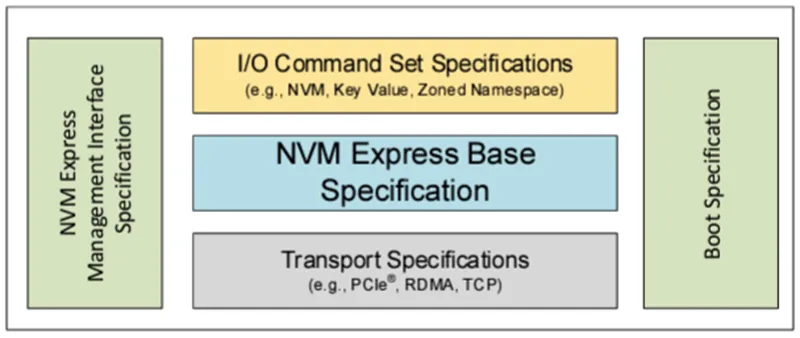
NVM Express Alliance declare About updating all 11 NVMe specificationsadding enhancements such as support for post-quantum encryption, SSD virtualization, and live migration to better support virtualized environments. According to the press release, these updates represent the next step in the evolution of NVMe technology, enhancing security, management and resiliency to meet the growing demands of resource-intensive applications in artificial intelligence, cloud, enterprise and consumer environments.
As you know, the NVMe (Non-Volatile Memory Express) protocol has changed to an annual release cycle. Mike Allison, senior director at Samsung and member of the NVM Express board of directors, told Source Electronic Engineering TimesThis update consolidates this year’s work on existing specifications rather than introducing an entirely new specification.
The updated specifications include NVMe 2.4 basic specification, command set specification (NVM Command Set 1.3, ZNS Command Set 1.5, Key Value Command Set 1.4, Subsystem Local Memory Command Set 1.3, Computational Programs Command Set 1.3), Transport Layer Set 1.3, Computational Programs Command Set 1.3), Transport Layer Specification 1. 1.3, NVMe over TCP Transport 1.3), NVMe-MI (NVM Express Management Interface 2.2) specification and NVMe Boot 1.4.
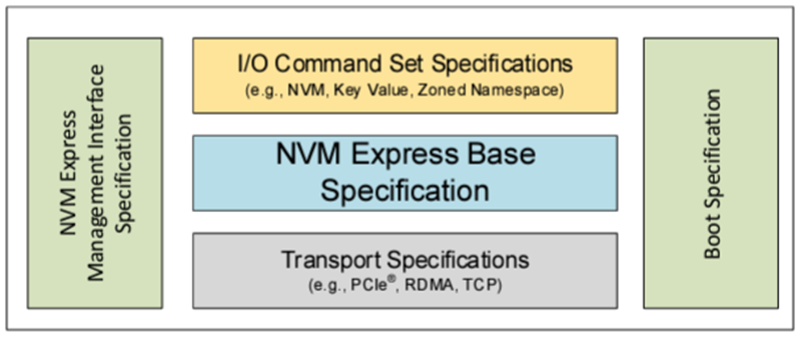
Image source: NVM Express
“The latest NVMe specification brings essential security capabilities into the post-quantum era while simplifying device management and increasing resiliency, future-proofing NVMe storage in enterprise, cloud, artificial intelligence and client environments,” said Amber Huffman, President of NVM Express.
This is the first version of NVMe to embed NIST-approved post-quantum encryption algorithms directly into the data link between the host and the SSD. The document also formalizes Key-Per-I/O (KPIO) encryption, TLS 1.3 data transfer security for network-attached storage, and a new virtualization architecture that allows local PCIe SSDs to participate in live virtual machine migration without hypervisor intervention, giving enterprise storage regulatory companies a standardization goal to meet the federal compliance deadline (the regulations will begin on the 149th). Science and Technology Times.
Most important resource updates register Called the possibility to migrate the NVM subsystem exported via PCIe, this extends the existing NVMe virtualization To a locally wired PCIe SSD. This is accomplished by abstracting physical disks into a host-defined virtualized NVM subsystem, allowing virtual machines to be moved without reconfiguring storage. “Through NVM subsystem migration, NVMe SSD can provide an exported NVM subsystem, hiding the complexity of the underlying hardware.” said Mike Allison, senior director at Samsung and member of the NVM Express board of directors. “The host only sees the exported controller and namespace, rather than interacting with the physical controller and namespace. This creates a clear separation between what the virtual machine sees and what is happening “behind the scenes.” – he explained.

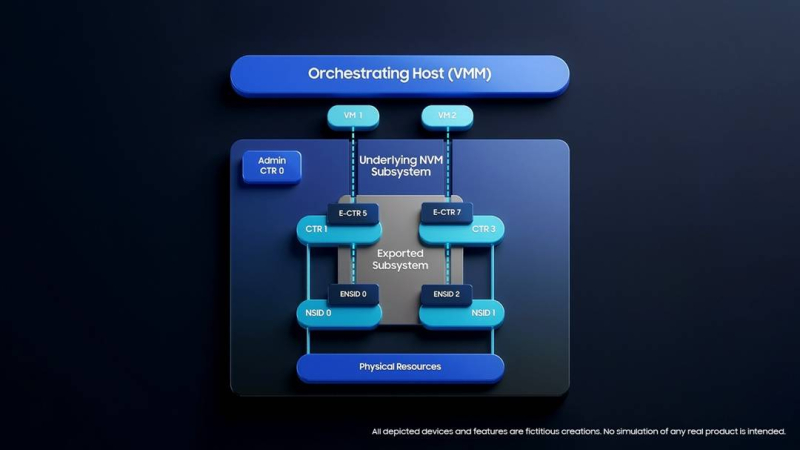
Image source: NVM Express
There is also a performance limitation. This feature is designed to optimize storage performance through controller-side QoS, allowing you to set bandwidth and IOPS limits directly on NVMe drives. Hardware-based QoS ensures consistent application performance, prevents resource contention, and improves efficiency in multi-tenant environments. This feature adds new controls for allocating PCIe bandwidth and IOPS among multiple controllers sharing this transport. Ellison noted that NVMe previously had no way of determining which controller would receive which portion of the PCIe and IOPS bandwidth.
Other NVMe management enhancements include host subsystem addressing, free block memory size reporting, NVMe-MI status reporting, and a redesigned NVMe-MI architecture that reduces redundant data structures and memory consumption. This release also adds support for new form factors EDSFF E2 And improved control behavior through I2C.
Voltage monitoring capabilities have also been added to provide a deeper understanding of the operating status of NVMe devices through built-in telemetry, allowing anomalies to be identified before they impact performance or reliability. There is also a feature to restore the NVMe subsystem to factory default settings, making it easier for the host to reset and configure the device. Additionally, the locking functionality has been improved. If lock settings were previously lost after powering off and on, they will now be saved after rebooting. Separate locking controls have also been added for virtualized environments.
source: