

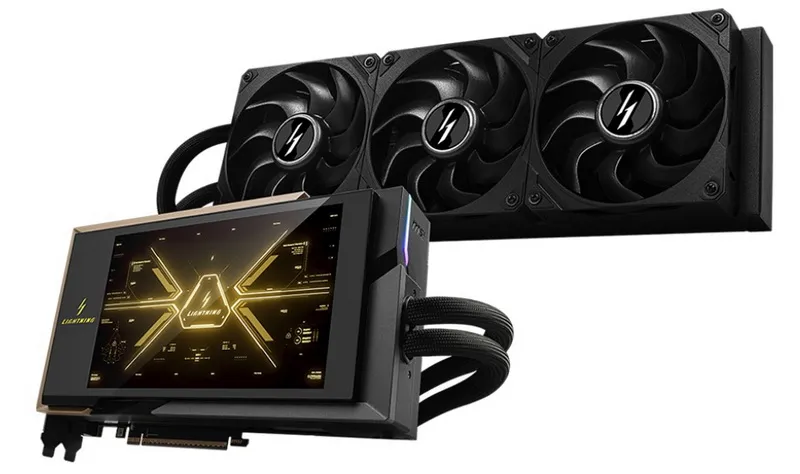
Tom’s Hardware’s early testing of DLSS 5 suggests that Nvidia’s neural rendering model may place an unusually high load on GeForce RTX 50-series graphics cards. In these tests, the reference model of the flagship GeForce RTX 5090 Founders Edition repeatedly reached or approached the stated power limit of 575 W, while the custom MSI GeForce RTX 5090 Lightning Z, which has a higher power limit, hit 802 W.
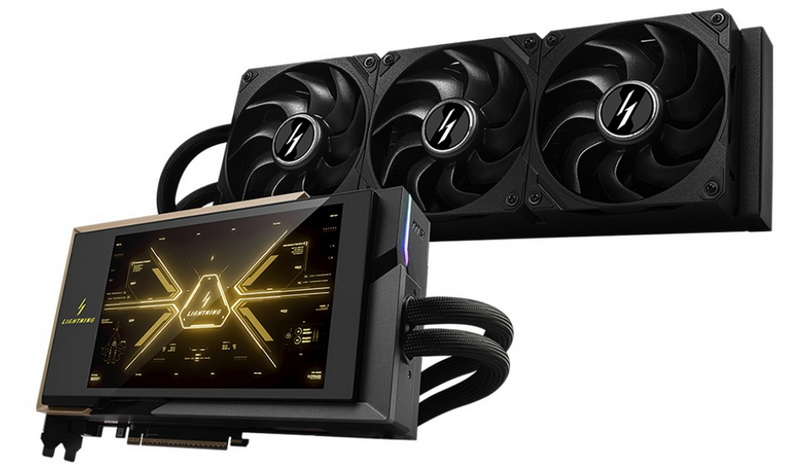
Image source: MSI
Since DLSS 5 has not yet been officially released (it will be soon), the tests used the OptiScaler community’s implementation of the DLSS 5 model rather than the official integration. One of the games tested was Cyberpunk 2077. It uses path tracing, enables ray reconstruction where supported, and disables multi-frame generation.
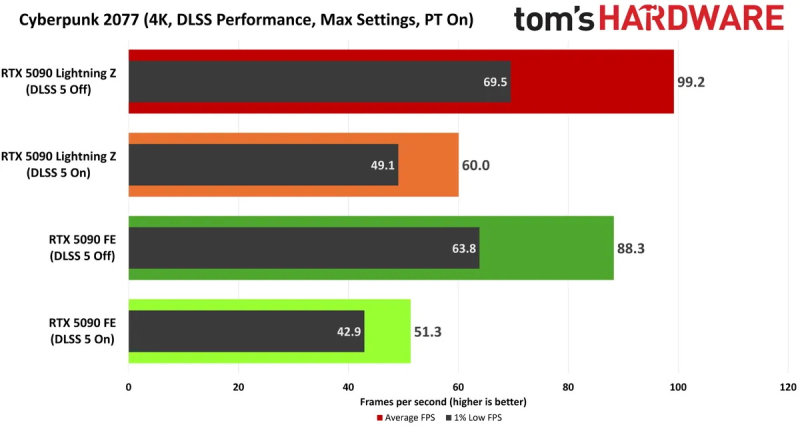
The game is rendered at 4K resolution using Performance Mode of the DLSS (Performance) setting, which provides an internal resolution of 1920 × 1080 pixels and maximum raster and ray tracing settings.
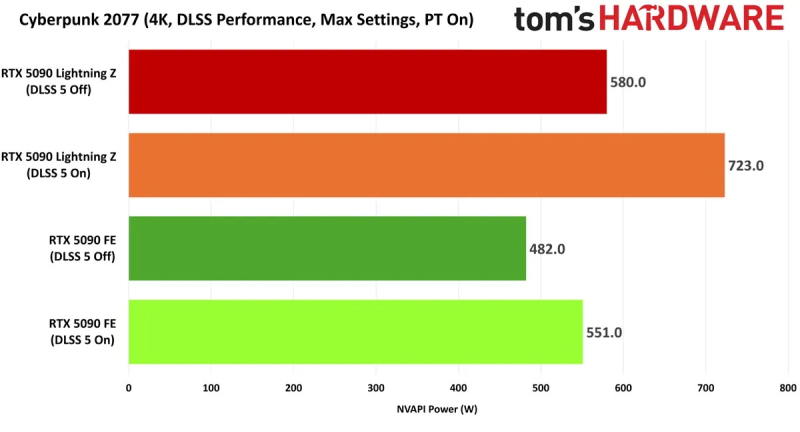
According to test data, the power consumption of the reference RTX 5090 using DLSS 5 neural rendering increased from 482 W to 551 W. In turn, the power consumption of the custom MSI GeForce RTX 5090 Lightning Z increased from 580 W to 723 W – an increase of about 25%. At the same time, the reference model’s gaming performance dropped by 42%, and the MSI card’s gaming performance dropped by 39%.
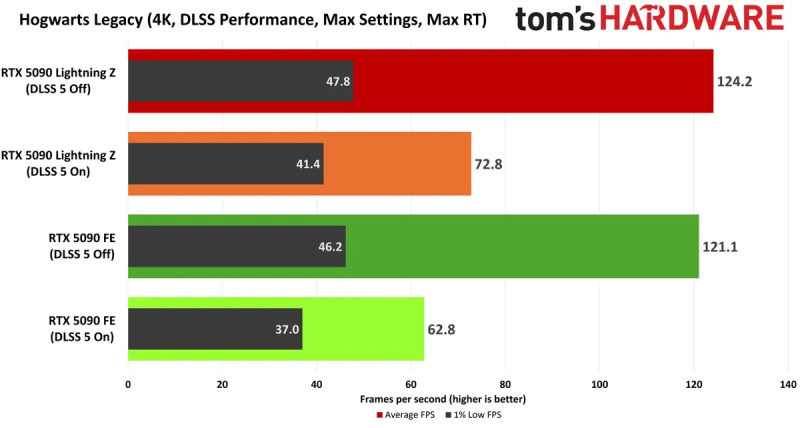
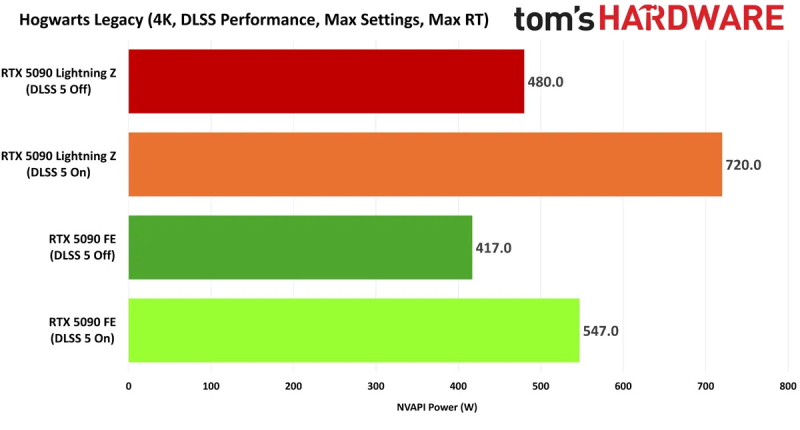
In Hogwarts Legacy, the power consumption of the MSI GeForce RTX 5090 Lightning Z increased from 480 W to 720 W during peak load times when using Neural Rendering, an increase of 240 W or 50%. Meanwhile, the reference RTX 5090 FE card’s performance dropped by 49% in this test, while the Lightning Z model, which claims significantly higher power limits, dropped by 42%.
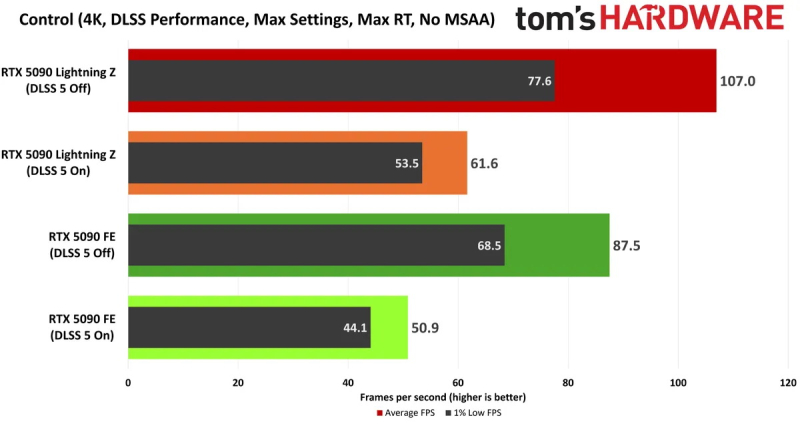
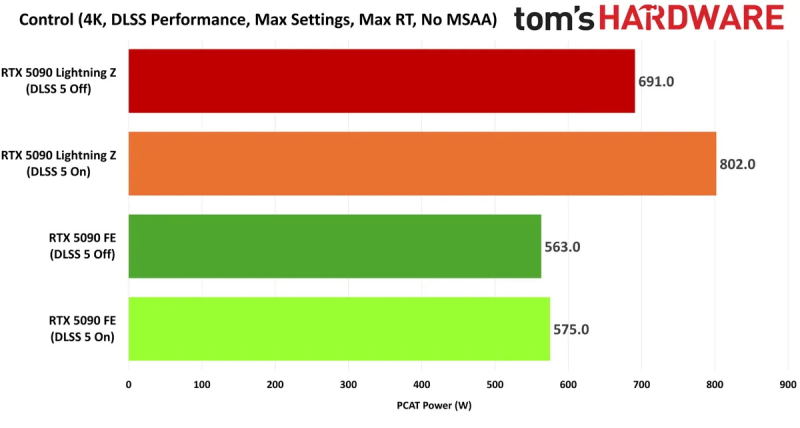
Among the three games tested, “Control” had the highest power consumption data. Without DLSS 5, the Lightning Z model consumes a whopping 691 W in this game, but with neural rendering added, power consumption increases to 802 W. The Founders Edition reference model reaches the power limit of 575 W. Both cards saw a performance loss of up to 42% when using Neural Rendering, but due to the increased power constraints, the Lightning Z model’s frames per second increased by about 20% on average.
The MSI GeForce RTX 5090 Lightning Z model is equipped with two 12V-2×6 power connectors and has a claimed power consumption of 1000 W – these settings can be achieved through the graphics card’s special firmware (vBIOS). This gives it more power headroom than the reference model RTX 5090 (575 W). The results do not prove that the presence of a single 12V-2×6 power connector on the graphics card limits the performance of DLSS 5, as some media outlets have claimed. However, this suggests that neural rendering technology may require more GPU power and additional space.
So, DLSS 5 may be the new stress test for GPUs. Unfortunately, this technique only works with Nvidia graphics cards, so it can’t be used as a general test in graphics card reviews.
If you find an error, select it with your mouse and press CTRL+ENTER.