

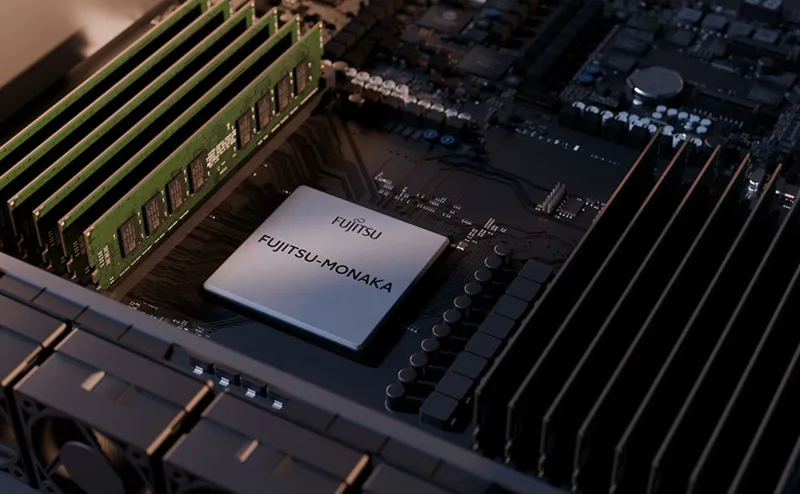
Fujitsu declare About a new generation of processors about to begin global sales Fujitsu supremeIt is planned to launch in November 2026. The company will also release Fujitsu MONAKA servers, a new product based on sovereign artificial intelligence infrastructure, which will be available for order from November 2026 to data center operators, enterprises, academic institutions and HPC centers in Japan and Europe, as well as the defense sector. Volume deliveries will begin next April.
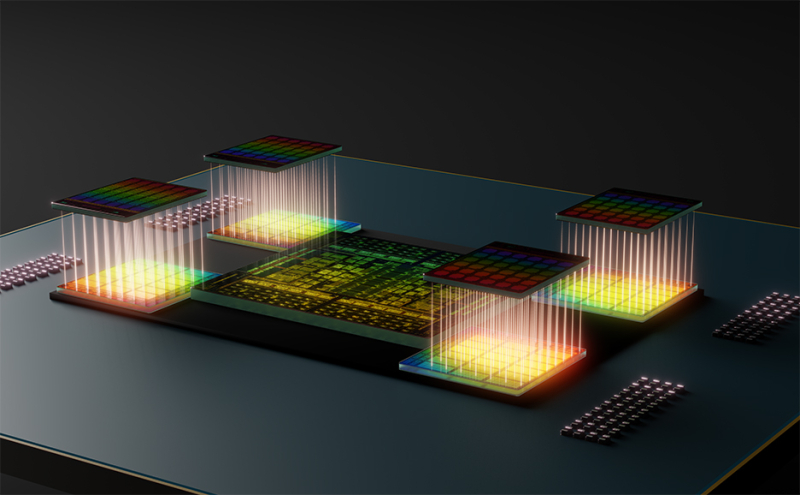
Fujitsu MONAKA processor uses a 3D stacking architecture, the Arm core uses 2nm process technology, and the cache and I/O blocks use 5nm process technology. The chip has up to 144 cores, runs at up to 3.8 GHz, and supports DDR5-8800 memory. return reportMONAKA processors will feature advanced packaging Broadcom 3.5D XDSiP. The use of proprietary ultra-low voltage technology ensures the processor’s high energy efficiency.
MONAKA uses special instructions to provide hardware acceleration of matrix operations. Combined with SVE2 vector calculation support and software optimization, it can directly accelerate AI inference at the CPU level. According to Fujitsu, this chip provides twice the AI inference bandwidth of other processors.
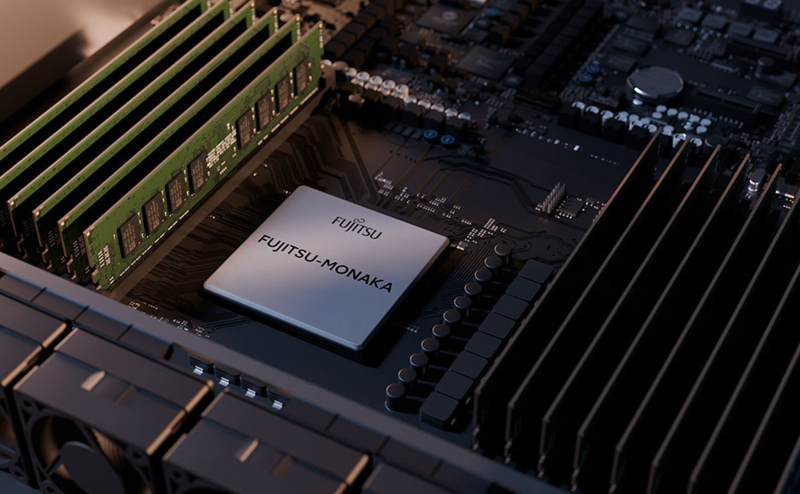
Image source: Fujitsu
MONAKA also supports confidential computing, protecting data and applications at the hardware level using Arm CCA technology, which encrypts applications and data while running in memory, including when running in multi-tenant cloud environments with shared resources.
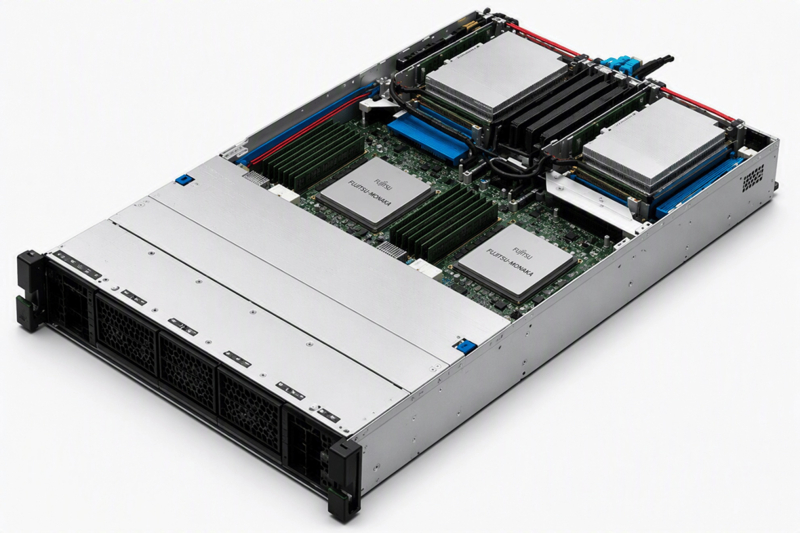
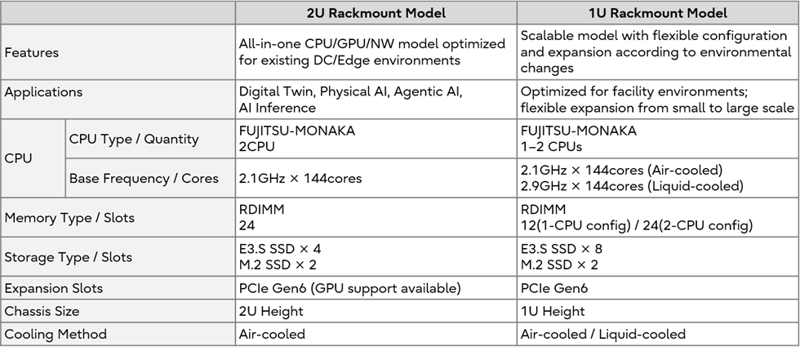
Initially, MONAKA-based servers will be available in 1U (one or two sockets) and 2U (two sockets) configurations for AI inference and AI agent workloads. It also plans to release a standalone multi-node system in 2U4N format (two slots per node) for academic purposes and HPC. The system is particularly suitable for creating surrogate models and CFD calculations.
The 1U version supports air cooling at ambient temperatures up to +40 °C (base core frequency – 2.1 GHz) and liquid cooling at water temperatures up to +45 °C (base core frequency – 2.9 GHz) without the need for dedicated cooling infrastructure. According to Fujitsu, proprietary server cooling technology can reduce cooling system energy consumption by up to 80%. Each processor has 12 memory slots. The storage subsystem includes eight E3.S slots and two M.2 slots. The main bus is PCIe 6.0, but GPU support has not yet been announced.
In addition, the available memory of the 1U version can be expanded through the use of decomposition and CXL. We’re probably talking about an external shared memory pool. Fujitsu said this approach solves the common memory shortage problem in artificial intelligence inference and maximizes resource efficiency, allowing for flexible adaptation to future large-scale artificial intelligence model and workload changes.
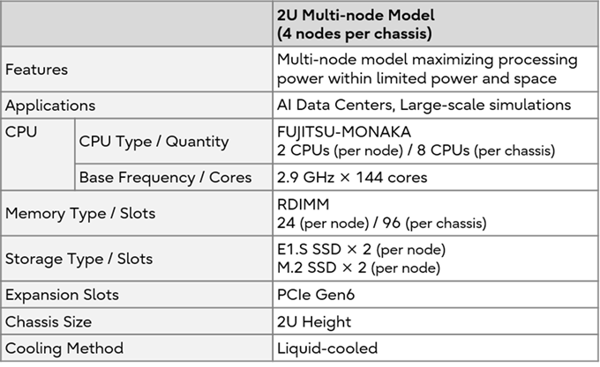
The 2U server contains two processors with a base frequency of 2.1 GHz, 24 RDIMM memory slots, 4 E.3 SSD slots and 2 M.2 slots. Only supports air cooling. GPU can be installed. Finally, the multi-node 2U server with LSS contains 8 MONAKA processors clocked at 2.9 GHz and 96 RDIMM slots. Each node only has a pair of E.3 and M.2 SSDs, but has PCIe 6.0. Also engaged in the development of new CPU servers Super Micro.
Fujitsu MONAKA servers are designed, developed and manufactured in Japan for systems that ensure technological sovereignty. Production takes place at Fujitsu’s factory in Kasashima, and the origin and manufacturing history of components can be traced at all stages of production. Fujitsu MONAKA servers build a vertically integrated “sovereign AI” model that combines Fujitsu AI technologies (such as Fujitsu Kozuchi platform and Takane enterprise generative AI) with professional industry models to create a secure environment for enterprises and government agencies.
source: