

AMD has introduced tetrahedral cage technology in computer graphics to significantly reduce the memory and processing costs of ray tracing in complex animation scenes.
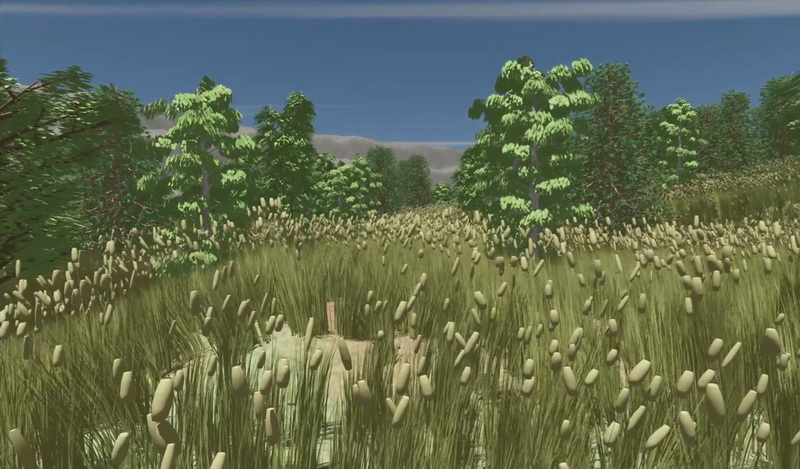
Image source: AMD
The tetrahedral frame approach allows for on-the-fly ray tracing of hundreds of millions of independently animated triangles, while avoiding the huge overhead of accelerating structures called bounding volume hierarchies (BVH) that often accompany such tasks.
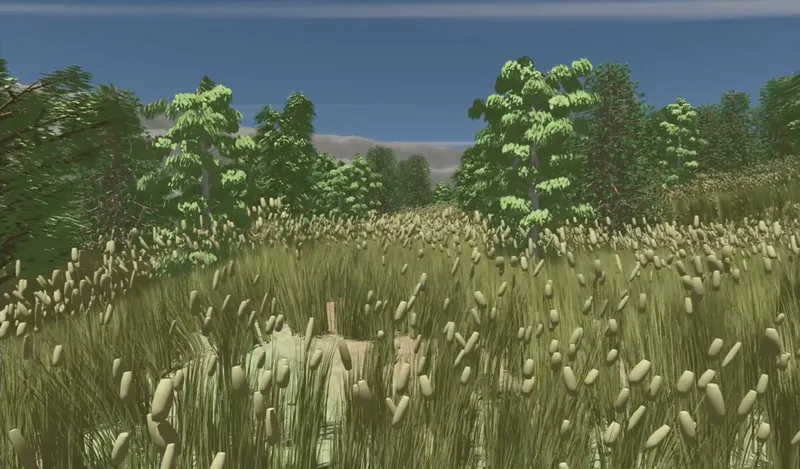
In a new article on the portal GPUOpenPublished on September 17, AMD Senior Scientist Holger Gruen demonstrated tetrahedral framing technology using a large landscape scene containing approximately 25,000 individually animated plants. At the highest level of detail (LOD), the plants consist of approximately 2.8 billion triangles. After selecting the level of detail for each frame, ray tracing (main and shadow) is performed on approximately 500 million animated triangles. The scene was rendered at over 60 frames per second (FPS) at 1080p resolution on a Radeon RX 9070 XT graphics card.
The real breakthrough, however, is that this technology radically reduces memory usage and the cost of updating acceleration structures. Traditional ray tracing implementations require each independent animated object to maintain and update its own bounding volume hierarchy (BVH), an accelerated structure that effectively determines which geometric elements a ray can intersect. As scenes become more complex, the computational effort of updating such structures can become prohibitive.
In contrast, the AMD approach involves enclosing dense geometries within a relatively simple deformable tetrahedral framework. Rather than updating each individual vertex and its associated acceleration structure, the system animates the surrounding mesh, while the original dense geometry and its BVH remain static and can be reused. The ray is transformed back to the geometry’s original coordinate system before checking for intersection.
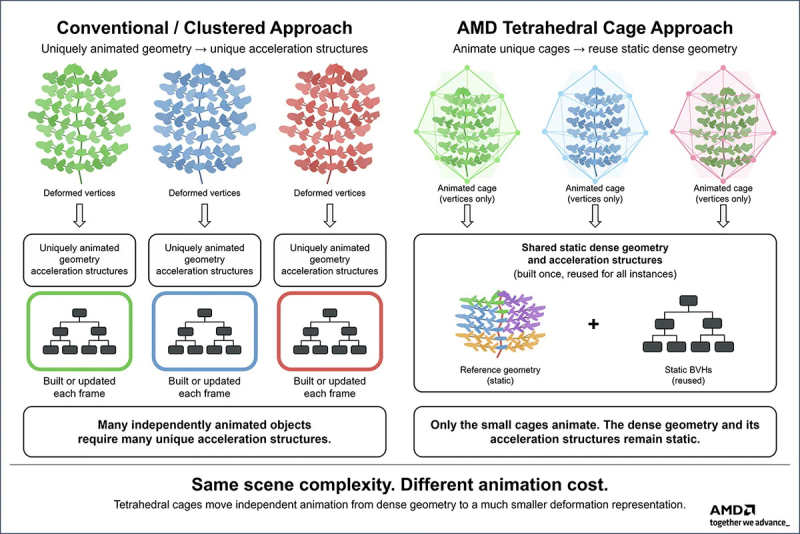
This results in an approximately 47x reduction in the memory footprint of the acceleration structure (reducing the cost from a theoretical 80 GB to 1.7 GB) and a more than 90x reduction in BVH update time compared to traditional approaches. Most importantly, these improvements address two major bottlenecks that prevent efficient ray tracing in animated scenes.
However, this approach also has its limitations. Using a tetrahedral mesh does not allow detailed control over the animation of individual vertices, so this technique is best suited for dense foliage, grass, crowds, and distant characters, rather than animations that require precise deformations or changes in mesh topology. Therefore, this method is of little use for detailed animation of a character’s face or body deformation in close-ups.
Fundamental research detailed in AMD’s “Ray Tracing Massive Animated Geometry” paper won third place and the Wolfgang Straßer Best Paper Award at the 2026 High Performance Graphics Conference. AMD is also developing DirectX Ray Tracing (DXR) use cases and header-only C++ libraries to help developers implement the technology into the rendering pipeline.
At this time, this is just a demonstration of the research results and is not a feature that is already implemented in the released game. However, it opens a promising path for creating geometrically complex and fully animated environments without requiring the use of video cards with large amounts of video memory.
If you find an error, select it with your mouse and press CTRL+ENTER.