

In terms of sales, bulky virtual and augmented reality headsets can’t compete with more common smart glasses, which overwhelmingly don’t have displays. As analysts pointed out counterpoint studyAccording to first-half results, the market for smart glasses with AI support (including AR versions) grew by 263%.
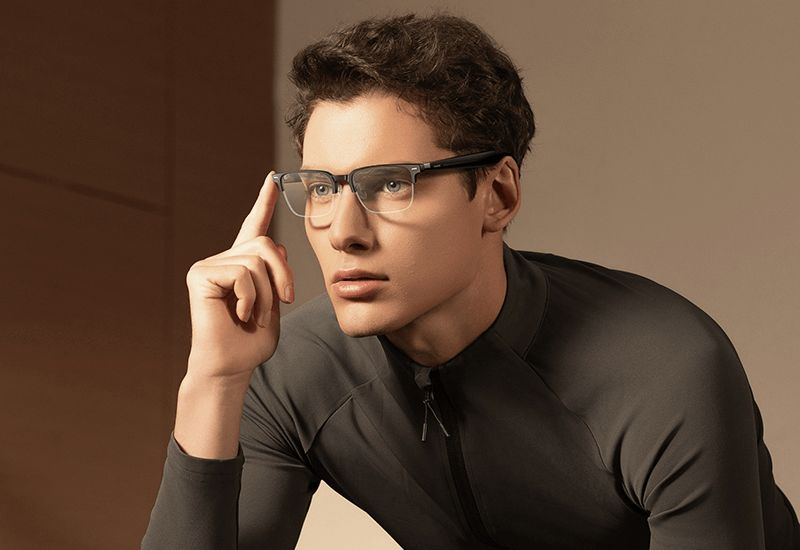
Image source: Xiaomi
Within this category, devices without displays but capable of processing AI-related queries autonomously form the most representative group, accounting for 96% of the market share. According to the first-half results, supply increased by 258% year-on-year and 22% quarter-on-quarter. Meta tandem remains the market leader✴ Platforms and EssilorLuxottica control 94% of the non-display AI glasses market, but beyond that, the market is highly fragmented. The alliance’s supply increased by 260% year-on-year and 22% month-on-month in the second half. The report’s authors did not provide absolute figures for product supply in its public version. Xiaomi and Alibaba have also launched AI glasses without displays, but currently each accounts for less than 1% of the global market share. Outside the top three, Meta leads by a wide margin (94%)✴all other players share 4% of the market.
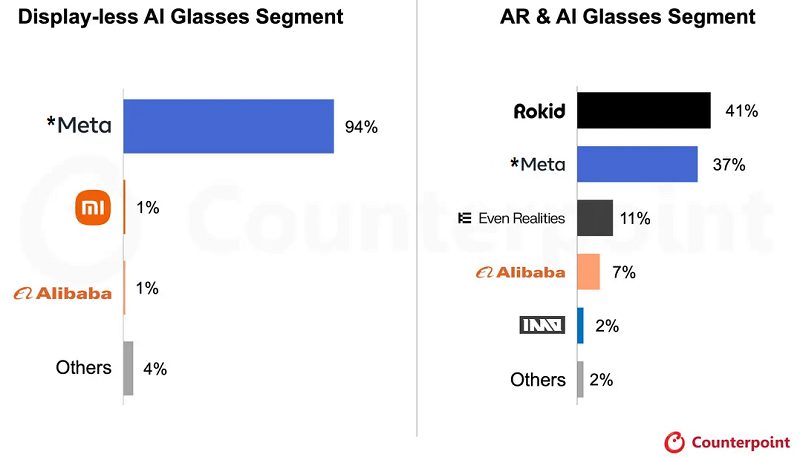
Image source: Counterpoint Research
Due to the low base effect, shipments of artificial intelligence glasses with display screens (including augmented reality devices) increased by 449% year-on-year and 18% quarter-on-quarter. Chinese manufacturers such as Rokid (41%), Even Realities (11%) and Alibaba (7%) have been the most successful in penetrating the market, leveraging China’s relatively mature supply chains. The country accounts for 45% of finished product supply, but North America lags behind less significantly, accounting for only 41%. We would like to emphasize that such devices currently account for only 4% of the global artificial intelligence smart glasses market. Currently, their popularity is hampered by immature technology, high costs, and cumbersome designs. It is worth noting that the American Meta✴ As a veteran player in this field, it ranks second with a 37% share, but overall, Chinese manufacturers are in the lead.
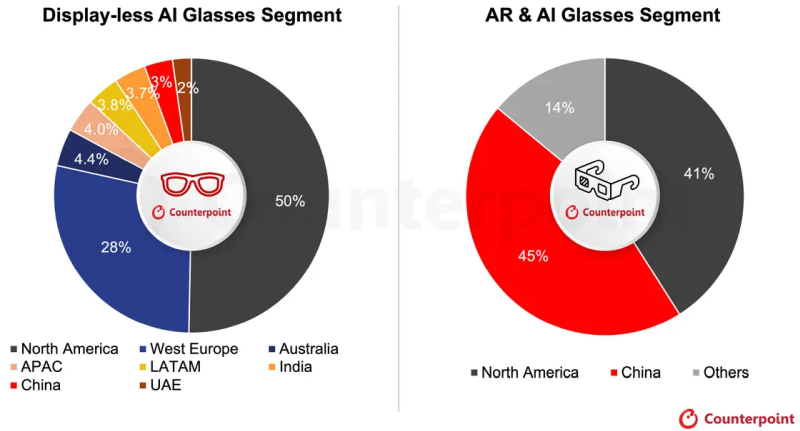
Image source: Counterpoint Research
Geographically, China remains the largest market for the latter type of equipment (45%), with North America accounting for 41% and other regions accounting for only 14%. The display-less AI glasses market is more segmented by geography, but half of sales are provided by North America, with Western Europe ranking second at 28%. Australia (4.4%), Asia-Pacific countries (4%) and Latin American countries (3.8%) border India (3.7%), with China (3%) and the United Arab Emirates (2%) also on the list. Obviously, this geographical distribution is largely determined by Meta’s marketing strategy✴ and EssilorLuxottica, leaders in display-less AI glasses.
Counterpoint Research analysts believe that uncertain factors that may hinder the dynamic development of the AI glasses market include rising prices of components such as memory chips, as well as growing public dissatisfaction with privacy violations by users of glasses with built-in cameras. Regardless, the segment will grow due to the popularity of glasses that allow you to collaborate with artificial intelligence agents and be more aware of environmental context. New sensor and power-saving technologies will ensure the advancement of such devices, and in the software realm, voice interfaces will improve. Manufacturers will try to address privacy concerns by limiting camera functionality and denying use of cameras, relying on microphones for data processing. Competition in this space will intensify as Google, Samsung and Apple enter the market with specialized devices.
If you find an error, select it with your mouse and press CTRL+ENTER.