


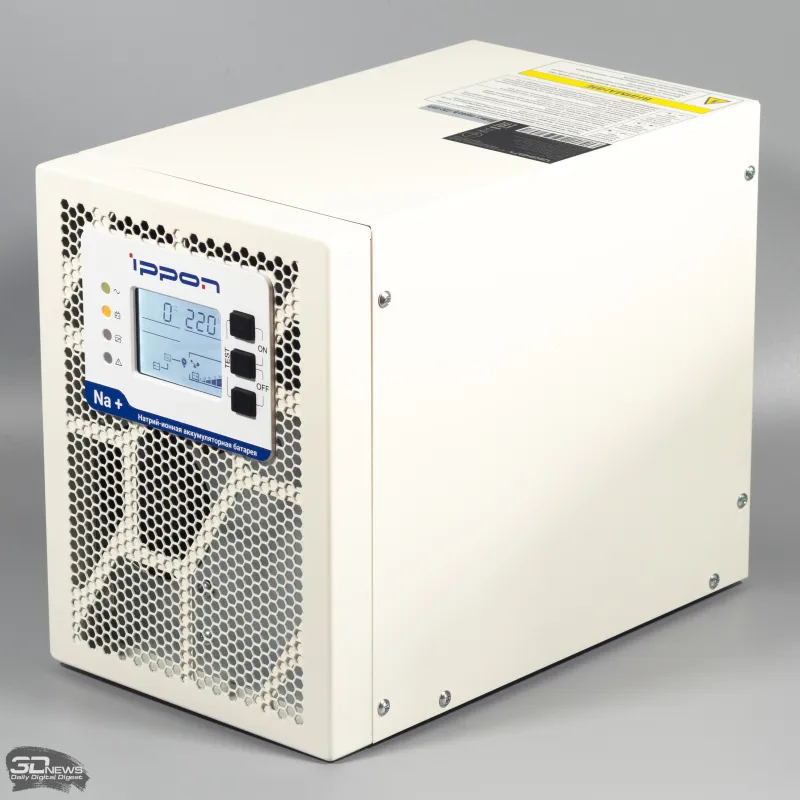
Uninterruptible power supplies are a very conservative category of equipment that rarely undergo any fundamental changes, especially when it comes to home and small office products. In particular, most UPS are equipped with lead-acid batteries. The advantage of lead-acid batteries is that they are cheap, but their energy density is not high and they need to be replaced quite frequently. However, lead-acid batteries already have more advanced alternatives in the form of sodium-ion chemistry. Today we will introduce a stand-alone uninterruptible power supply for servers and powerful workstations, equipped with Na+ batteries.
⇡#Technical features, price
The Ippon Na+ II TAE 1000 is the entry-level member of a series of devices that also includes models with a total power of 2,000 VA and 3,000 VA. What’s surprising about all three, including our kilowatt unit, is that their active power is consistent with the total power, with no limit on load power in stand-alone mode. Thanks to double conversion, the UPS can digest input voltages from 110 to 300 V and frequencies from 40-70 Hz. The output voltage is adjustable from 208 to 240 V (but at 208 V, the maximum load power is reduced by 10%), and the frequency is 50 or 60 Hz. Importantly, if the UPS is overloaded or fails, automatic bypass will initiate.
In addition to increasing energy density, the Ippon Na+ II TAE 1000 sodium-ion battery can operate in a temperature range of -40 °C to +80 °C (although the UPS itself has an operating temperature range of -20°C to +40°C), charging 4 times faster compared to lead-acid analogues. But best of all, according to Ippon, new batteries can withstand 2,000 full discharge cycles, while lead-acid batteries can withstand 300-500 50% discharge cycles.
| manufacturer | Yi Peng |
|---|---|
| Model | Na+ II TAE |
| Topology | online |
| exit | |
| Apparent power, volt-ampere | 1000 |
| Active power, W | 1000 |
| Voltage, V | 208/220/230/240 |
| Voltage stability, % | ±1 |
| Frequency, Hertz | 50/60 |
| Frequency stability, Hz | ±0,1 |
| Voltage form | pure sine wave |
| Battery powered connector | Shuke CEE 7/3 × 3 |
| efficiency, % | > 97 |
| log in | |
| Number of phases | 1 |
| Voltage, V | 110–300 |
| Frequency, Hertz | 40–70 |
| power connector | IEC C14×1 |
| Battery | |
| type | Sodium ions |
| Installed | 12V/6.4A·h×3 |
| Battery life at 50% load, min. | 11,5 |
| Battery life at 100% load, min. | 4,5 |
| Charging time, hours | 1 |
| Protect and filter | |
| from short circuit | Yes |
| Linear mode overload protection | Yes |
| Overload in battery mode | Yes |
| Battery deeply discharged | not applicable |
| LAN protection | No |
| From pulse overvoltage, J | Chapter 585 |
| communication and control | |
| communication interface | USB Type B; RS-232; European Patent Office; “Smart Slot Machine” |
| Physical properties and properties | |
| Overall dimensions, mm | 165×220×275 |
| Net weight, kg | 6,8 |
| cool down | positive |
| Noise level, decibels | < 50 |
| Housing protection level | IP20 |
| Retail price, rub. | From 36,991 (market.yandex.ru) |
Ippon Na+ II TAE 1000 is by no means a cheap uninterruptible power supply in terms of its power: at the time of review work, the minimum cost of a new product was nearly 37,000 rubles. The manufacturer backs it with a three-year warranty.
⇡#Appearance, delivery package
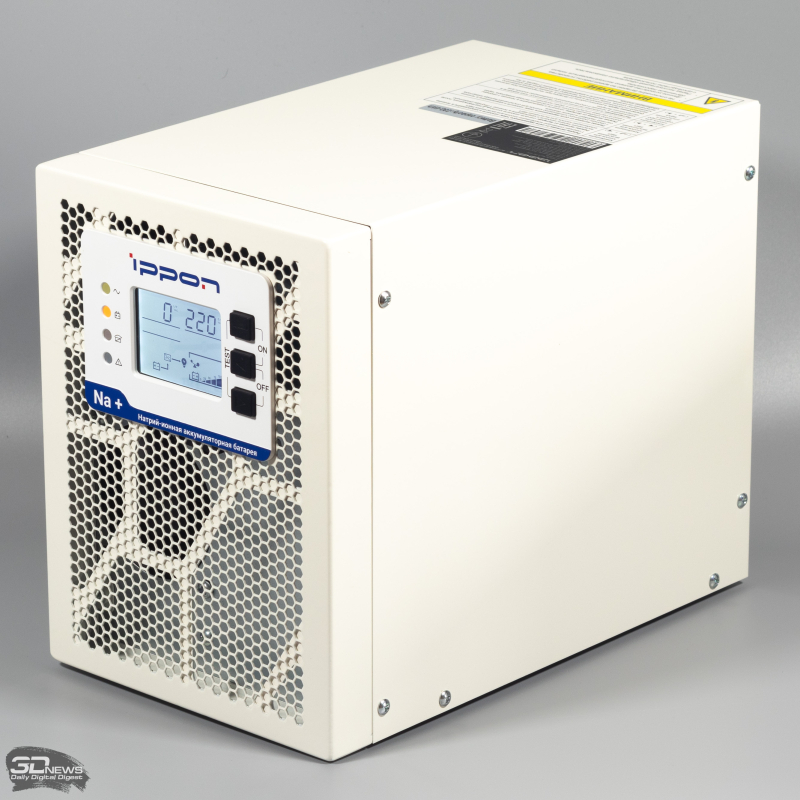
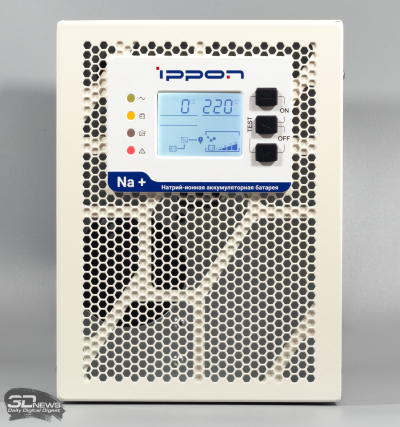
Thanks to its sodium-ion battery, the Ippon Na+ II TAE 1000 takes up less space and weighs less (6.8 kg) than equivalent UPS units based on lead-acid batteries. The device has a white all-metal casing with abundant perforations on the front panel through which a cooling fan draws cool air. The Na+ II TAE series is similar to Ippon’s other series of UPS, with controls – a bright backlit screen, three buttons and multiple colored LED indicators (inverter, battery, bypass operation and fault signals).
Unlike the home model, the Ippon Na+ II TAE 1000 starts working as soon as external power is present – in this case, it operates in bypass mode and emits a periodic acoustic signal. The audible alarm can be turned off, but the fan cannot; it makes a noise even when there is no load, and it speeds up when the load increases. A so-called economy mode is also available: as long as the characteristics of the grid are within acceptable limits, the inverter is not used and the consumer is supplied via bypass. Otherwise, double conversion is activated and power is then supplied from the battery.
Parameters that can be adjusted through the on-screen menu include output voltage and frequency, as well as “fine settings” such as EPO function, battery charging current, minimum allowed battery voltage, and input neutral and phase reverse connection alarms. Additionally, the firmware allows you to disable the bypass option and switch the UPS to generator supply mode (reducing the requirements for external voltage quality).
 |
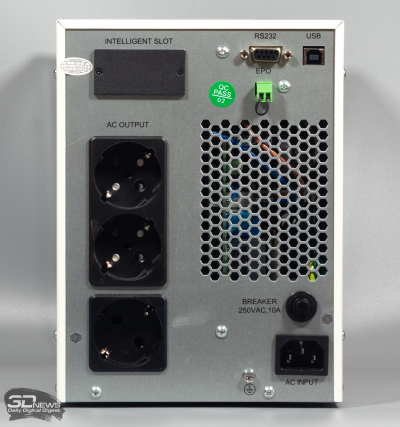 |
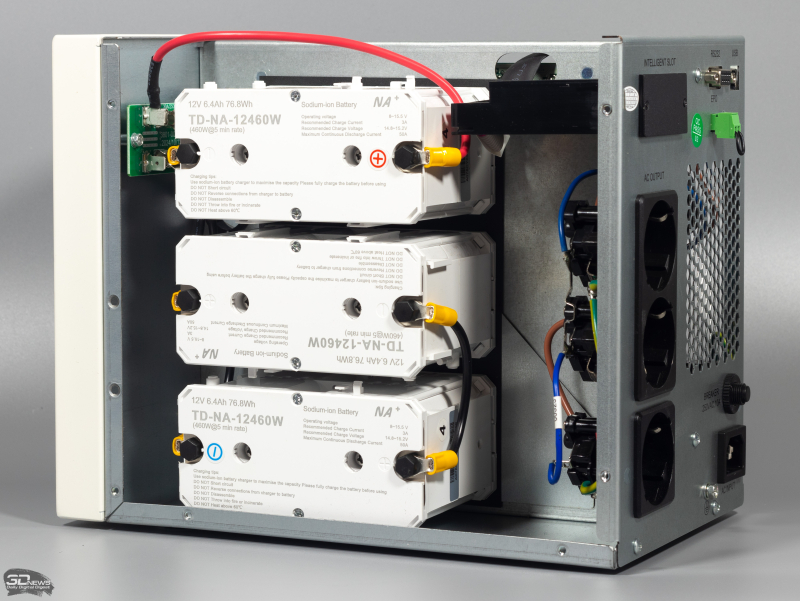
The power cord of the Ippon Na+ II TAE 1000 is detachable and protected by a 10 A circuit breaker. There are three European sockets at the output end with equal protection functions. Remote control interfaces include USB Type-B connectors, RS232, EPO (emergency power off) contacts, and “smart slots” for installing expansion cards (SNMP or dry contacts).
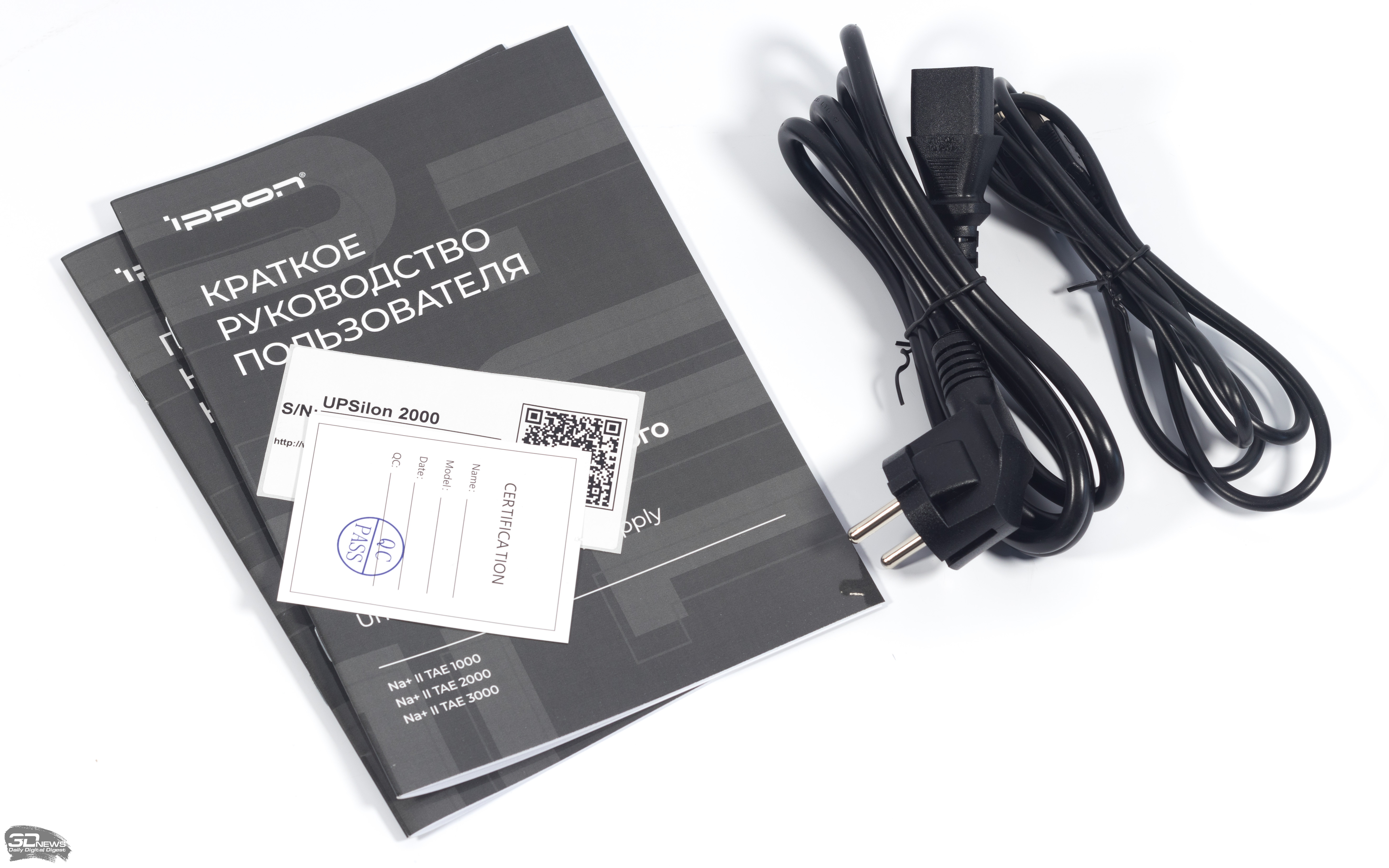
The UPS comes with power cord and USB cable with Type A and Type B connectors, as well as instructions in Russian and Kazakh.
⇡#internal structure
Each sodium-ion battery in the Ippon Na+ II TAE 1000 has a lower capacity (6.4 Ah) than the typical lead-acid batteries installed in an uninterruptible power supply, but there are three in total. The battery takes up half of the case and can be quickly replaced when needed.
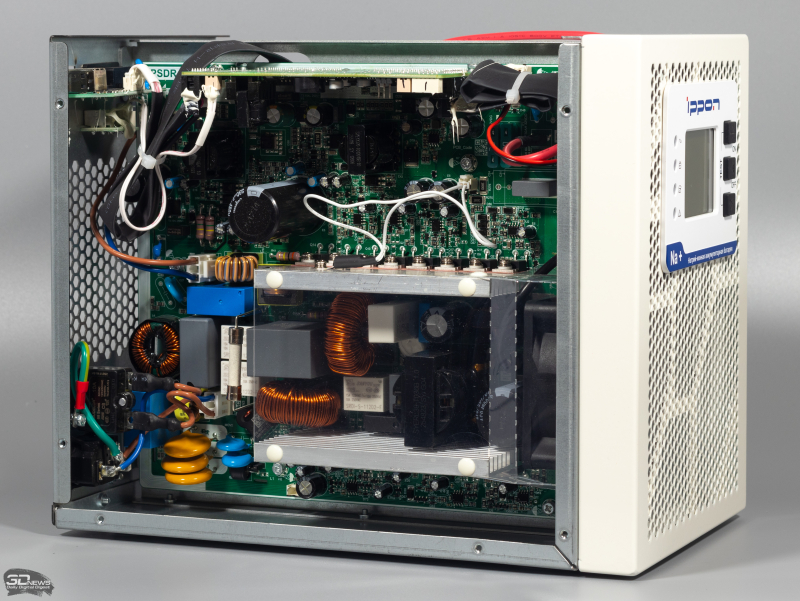
The other half of the case contains most of the UPS electronics, cooling fans, and radiators, with clear air ducts surrounding them. Additionally, you’ll notice that externally connectable circuit breakers are backed by fuses.
⇡#software
When connected via USB, the operating system does not recognize the device as a battery, so even basic functionality of remote UPS monitoring requires the installation of additional software. For use with the Na+ II TAE series, the manufacturer recommends the use of another (at least the fourth in the Ippon catalogue) software product called UPSilon 2000. This is a common and long-standing solution that requires a license and a sticker on the UPS with the necessary key.
The program demonstrates the main operating parameters of the device (input and output voltage, battery charge and load power) and allows you to record them. Functionality such as sending alerts and responding to emergencies has also been implemented.
⇡#Test results
In online mode, there’s basically nothing to test the Ippon Na+ II TAE 1000. All we can say is that the voltage waveform output by the UPS has an ideal sine wave shape even at high loads (800-850 W). More meaningful results were obtained by testing in Eco mode when the consumer was powered by bypass and the input voltage was within acceptable limits. Therefore, it turns out that double conversion is initiated when the UPS input voltage falls below 185 V or above 250 V, while 110 V is considered the emergency voltage to start autonomous operation. The transient process takes only 5.4 milliseconds.
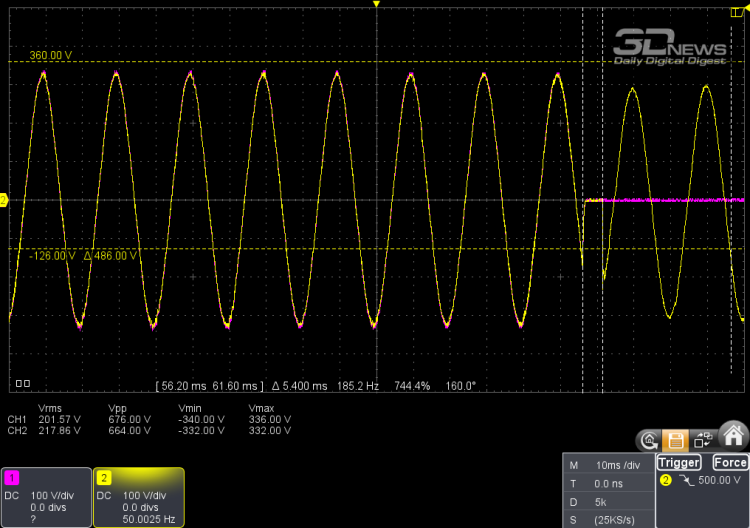
Under load, the aforementioned charge from the Ippon Na+ II TAE 1000 battery is enough to run for 6 minutes and 43 hours – which is enough to shut down the device properly and even delay the shutdown to give it a chance to wait out a brief power outage.
⇡#in conclusion
The Ippon Na+ II TAE 1000 is another UPS with an advanced sodium-ion battery, but unlike the home Na+ Frosty we recently reviewed, this is a no-nonsense model with an in-line topology designed to protect servers and workstations. There was no room for her in the bedroom due to the constant noise from the fan.
In addition to the advantages of the new battery chemistry, the review hero delivers full kilowatts of active power, long battery life and a quick transition to battery power in economy mode. The only glaring technical flaw with the device is that USB monitoring requires third-party software.
If you find an error, select it with your mouse and press CTRL+ENTER.