

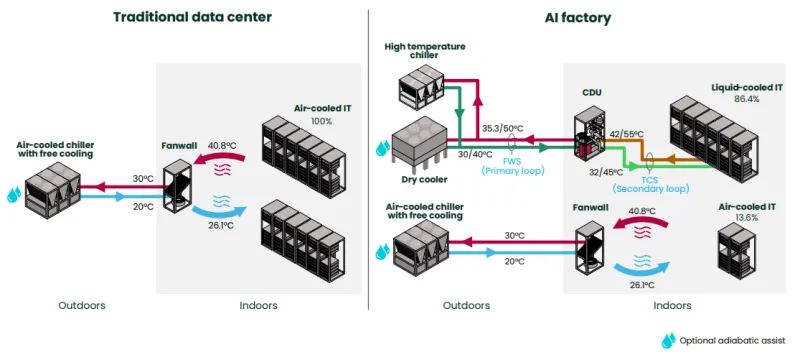
According to Schneider Electric’s analysis, the cooling system architecture has a decisive impact on the power and water consumption of the data center. The company emphasized that data center operators should pay special attention to such systems during the design phase, Report Register. Indeed, she might be interested in some of the conclusions.
Reporting Water usage at AI scale: Insights from a 100 MW comparative analysis The company’s experts simulated four data center options with different cooling systems, ranging from traditional air cooling to optimized liquid cooling. The paper concludes that switching from air to liquid systems will not only steadily improve energy efficiency but also potentially reduce water consumption in water-scarce regions. Additionally, the study simulated the impact of facility location on the efficiency of each cooling option. In particular, annual weather conditions in Paris (France) and Dallas (Texas, USA) are considered.
Schneider data display most water Switching to a liquid-to-liquid system with a coolant temperature of +45°C can reduce water consumption by at least half of the traditional air-cooled system in Dallas. The company emphasizes that location, operating temperature and cooling architecture largely determine a facility’s water needs, even without considering the industry’s transition to high-density AI systems. Water consumption depends largely on the heat removal equipment in the computer room. All other things being equal, a facility with a cooling tower requires 5 to 20 times the amount of water as a “dry” system.
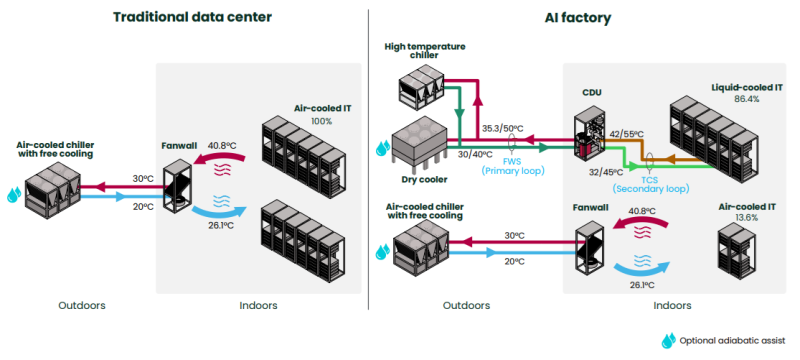
Image source: Schneider Electric
In the first considered scenario, the use of conventional air cooling was simulated. The second involves the use of liquid liquids with a coolant temperature of +32°C (an architecture typical of early AI data centers). In the third option, the same equipment is used, but the temperature is increased to +45°C. Finally, in the fourth option, less equipment is used, since the system was originally designed for coolant with a temperature of +45°C. This allows you to save equipment and reduce capital costs.
It is argued that higher temperature coolants can result in significant water savings, since in this case the use of “outdoor air” cooling can avoid the use of mechanical costs in a wider range of conditions. Experts recommend assessing water use early in the design process and considering alternative water sources to reduce pressure on community resources for local residents.
The problem is particularly acute in the United States, where data center water usage has increased over the past decade. three times. Artificial intelligence data centers in the United States consume water in hot weather, like new york completely. This is particularly important given the growing opposition from residents, activists and politicians to the construction of new data centres. Meanwhile, the British government has been accused of neglecting lack of water Promote the construction of more and more artificial intelligence data centers.
Schneider believes water efficiency should be evaluated comprehensively. PUE and WUE values, as well as local power and water costs, should be considered when choosing the best system. Of course, Schneider has his own commercial interests in these findings. 2024 her obtained Owns 75% of Motivair, a company specializing in liquid cooling systems. The remaining shares are planned to be purchased in 2028.
source: