


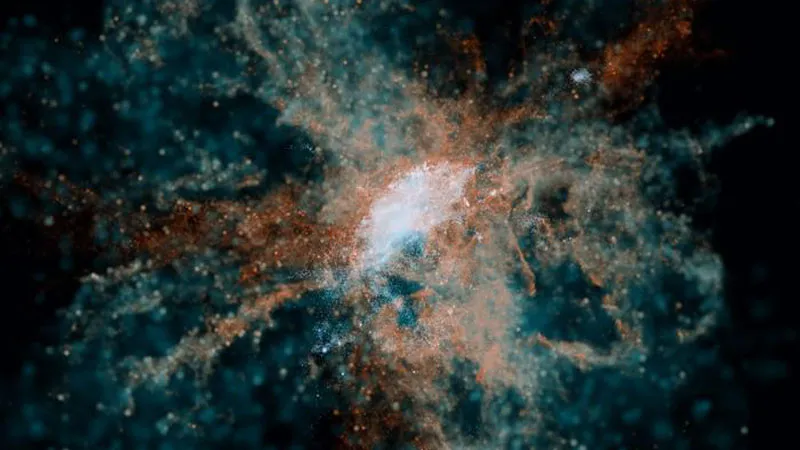
Before the advent of the James Webb Space Telescope, scientists thought the early universe contained no heavy elements and expected to see mainly hydrogen and helium. With Webb came the surprising discovery of many galaxies just a few hundred million years after the Big Bang. But during the same era elements heavier than hydrogen and helium appeared another discoverywhich shocked modern cosmology.
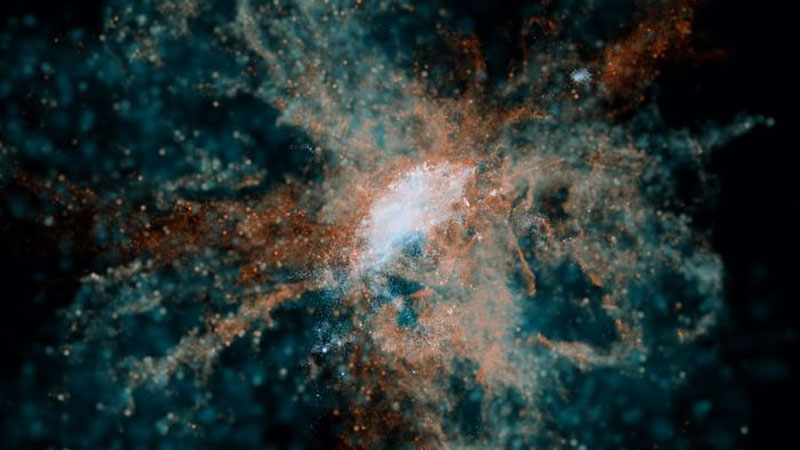
Image source: Zhu Yongda/University of Arizona
The observation was reported by a group of scientists at the University of Arizona. In a series of data collected during 30 hours of observations, Webb discovered three galaxies when the universe was about 500 million years old (redshift z = 7.2-9.3). The universe at this time was still in the process of reionization, and its matter was mainly composed of primordial hydrogen and helium. However, Webb’s spectroscopic data showed that gas containing elements synthesized within stars was already present around some of these galaxies. In particular, we are talking about oxygen and carbon, which are both heavy elements.
To detect the chemical composition, the researchers did not use radiation from the intergalactic gas itself, but instead used galaxies as a background source. The light they emit passes through the surrounding gas, where the atoms absorb radiation at characteristic wavelengths. The near-infrared spectrometer aboard Webb recorded absorption lines from neutral and ionized oxygen, carbon and silicon. Their movement relative to the speed of the galaxy system proved particularly important: the lines moved mainly to the blue side, which means that the gas rich in these elements is moving outward at about 50-250 km/s. In other words, heavy elements flew out of the galaxy and enriched the universe.
The resulting images suggest that a mechanism called the baryon cycle (the constant exchange of matter between a galaxy and its environment) was already operating in galaxies in the first few hundred million years after the Big Bang. The first generation of massive stars rapidly synthesized carbon, oxygen and other elements, and later stellar winds and supernova explosions could eject the concentrated gas outside the galaxy. At the same time, the chemical “fingerprints” of early galaxies are similar to those of mature galaxies, indicating the rapid formation of complete cycles of material recycling.
This result is also important for the search for hypothetical Population III stars (the first generation of stars formed almost from pure hydrogen and helium). If galaxies were actively spewing heavy elements into surrounding space 500 million years after the Big Bang, then there may be much less original primordial gas remaining than models assume. This doesn’t mean that Pop III stars have almost certainly disappeared by this time, but these observations significantly change the conditions for their search: even at very early stages in the universe’s history, chemical enrichment and redistribution of matter may have occurred very quickly, and the search for the universe’s elusive first stars will be much more difficult than imagined.
If you find an error, select it with your mouse and press CTRL+ENTER.