

In the past few years, some Chinese experts dreamed of developing their careers in Silicon Valley, but now in the field of artificial intelligence, the domestic labor market is becoming more and more attractive to them. Last year, China provided 41% of the world’s artificial intelligence researchers, compared with 34% in the United States.
Image source: Unsplash, Dominic Kurniawan Suryaputra
The research results say this Carnegie Chinabased on tracking the career activities of the world’s leading artificial intelligence experts. In comparison, in 2022, 46% of leading experts in the field were working in the United States, while only 27% were in China. Now the advantage is clearly on China’s side, and artificial intelligence technology is also developing rapidly. The sample included 10,280 researchers whose scientific publications were accepted for consideration at machine learning and neural computing conferences.
Chinese developers of artificial intelligence systems such as DeepSeek or Moonshot AI create attractive working conditions for professionals; salary levels at these companies are comparable to American companies. Moonshot AI itself was founded by Yang Zhilin, who returned to China to pursue a career in artificial intelligence after earning a degree in the United States.
China remains the main source of talent for the artificial intelligence industry. Last year, 57% of AI professionals earned a bachelor’s degree from a local university, an increase of 11 percentage points from 2022. At the same time, only 13% of Chinese artificial intelligence researchers tracked by the report’s authors were educated in the United States. If 57% of Chinese university graduates in this field stay and work in China by 2022, this proportion will increase to 69% last year. However, the study’s authors added that labor migration in this area may be affected in part by tightening conditions for obtaining work visas in the United States. Chinese authorities have also tightened penalties for unauthorized exports of key technologies. Many experts in China were simply “restricted from traveling abroad” for several years.

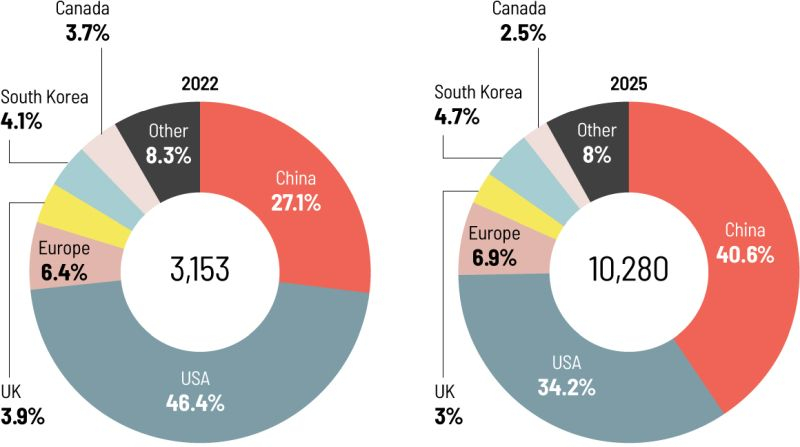
Image source: South China Morning Post
However, for Chinese graduates aiming to develop careers overseas, the United States remains the main attraction. The proportion of researchers coming to the United States from China increased by 4 percentage points last year. Even in the Chinese market, U.S. employers continue to attract experts.
If you find an error, select it with your mouse and press CTRL+ENTER.