


OpenAI introduces Dots, a new class of always-on artificial intelligence agents that can independently perform multi-step tasks, manage projects, use applications, write and test code, and continue working without human intervention. OpenAI says Dots can run around the clock and adapt to user preferences over time.

Image source: OpenAI
The main difference between Dots and regular ChatGPT is that agents have their own computing environment. Each Dot runs on a separate cloud computer, with its own browser and account to manage access and permissions. Users can open the virtual computer and see what Dot is doing.
By default, the cloud environment is isolated from the user’s computer. But if necessary, Dot can connect to your own computer and the agent can work directly on the user’s device.
The GPT-6 Astra model is used as the basis for Dots. OpenAI also integrates agents with its own plug-in ecosystem, enabling them to work with more than 4,000 applications. You can interact with Dot through ChatGPT, SMS, Slack and Microsoft Teams, and you can also contact customer service staff through voice. Maintain context across communication channels.
The main feature of Dots is the ability to independently continue what you started. Users don’t have to keep the chat open and control every step: an agent can take on a project, execute its various stages, track changes and contact the user only when a decision is needed from the user.
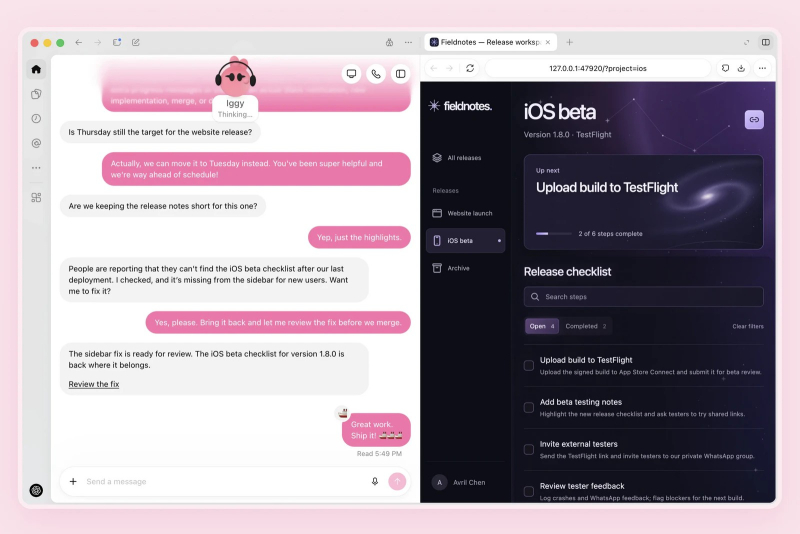
For example, an agent can monitor user feedback on an application, identify recurring issues, make corrections to the code, and prepare it for review by developers. In this case, the final decision on changes remains with the user.
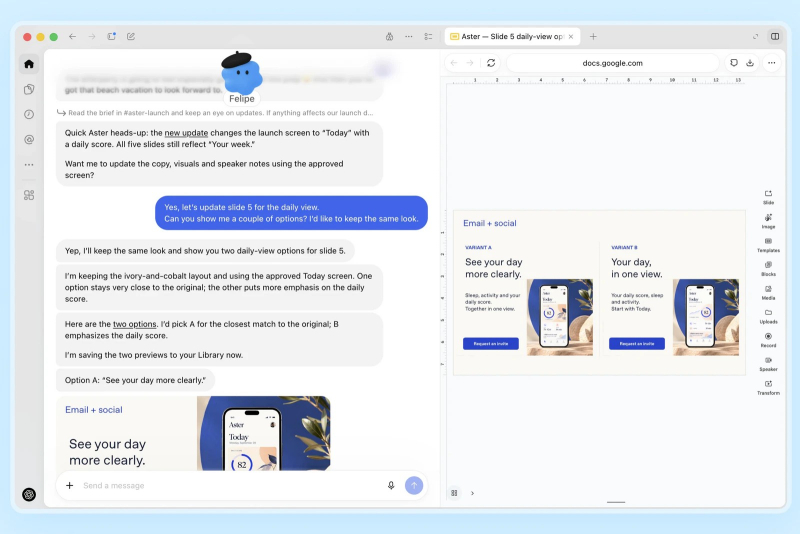
In another case, an agent oversees preparation for a product launch. If product features or requirements change, Dot can revise release plans, update documentation and collateral, and prepare changes for manual review. For research tasks, agents are able to repeat analyzes as new data becomes available, explore unexpected results, and update illustrations and conclusions.
Interestingly, Dots are designed not only to perform specific tasks but also to work proactively. OpenAI calls this “active exploration”: The agent can access connected applications in the background and look for ways to continue its current work. Currently, such backend tools have limited capabilities—for example, they cannot independently send messages, change the content of the application, or control the user’s browser and computer.
And in general, Dots’ autonomy is limited by a permissions system. Users decide which applications the agent will have access to and can set rules for each action: automatically allow, require confirmation, or completely block. Dots will also ask you to confirm actions that affect user accounts or may result in the transfer of information. OpenAI leaves some operations, such as changing passwords, to humans.
Dots also have a separate mechanism to prevent potentially dangerous behavior. If the agent detects a security threat, it can pause or stop the task entirely. OpenAI specifically emphasizes that Dots still make mistakes, so the results of work that affect important decisions or actions must be verified.
For business, OpenAI is preparing a specialized version of Dots. Here, the agent will receive a separate account, his own credentials, and the access to company systems required to perform specific roles. The company is already testing scenarios for procurement, invoice processing, email marketing, customer support and business contracting.
Upon release, Dots will be available to ChatGPT Pro and Business Premium users, with a beta version available to enterprise customers. There is no additional charge for the first Dot, and future OpenAI plans to charge separate monthly fees for adding new agents, increasing their speed, or increasing the amount of work they perform.
If you find an error, select it with your mouse and press CTRL+ENTER.