


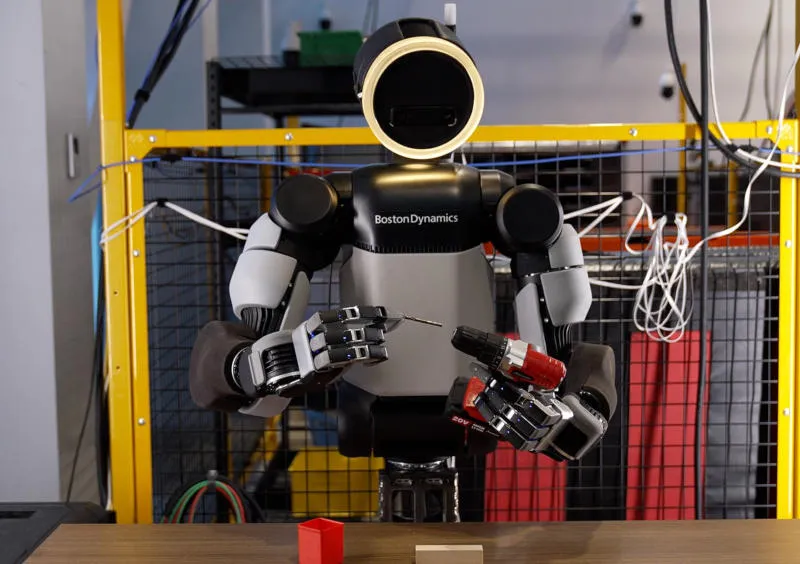
Boston Dynamics Tell About the new hand design received by the humanoid robot Atlas. The four-fingered hand retains sufficient strength and acquires the ability to effectively manipulate objects, just like a human – the robot is trained through his movements.
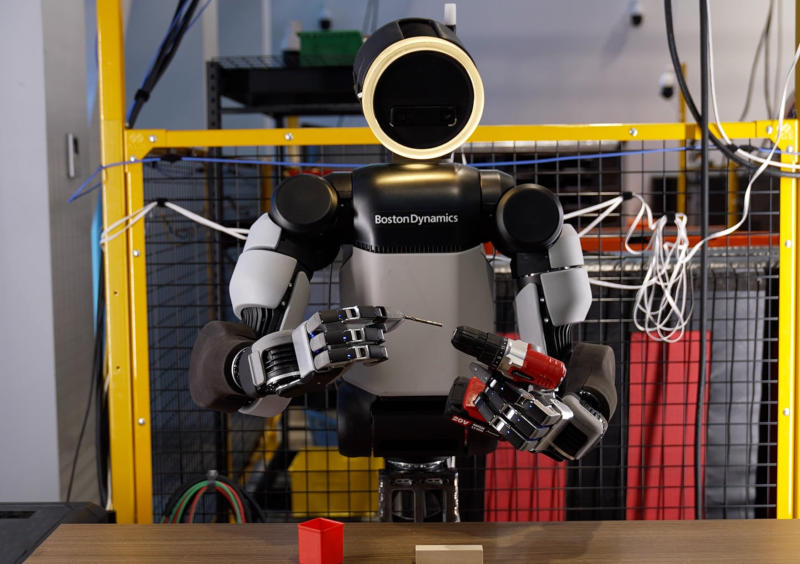
Image source: bostondynamics.com
In practice, designing a manipulator requires balancing the requirements of flexibility, strength, reliability, cost, maintainability, and sensitivity, even though these qualities may conflict with each other. In practice, it must be strong and durable enough to withstand real-life industrial and logistics environments; functional enough to be human-like; modeled and simulated for teaching purposes; and also suitable for mass production and cheap repair.
Taking into account the requirements raised, Boston Dynamics engineers developed a new model for the humanoid Atlas with 13 degrees of freedom. The 7-DOF hands of the previous generation Atlas were optimized for grabbing a variety of objects; the new ones let you fully manipulate them. The hand becomes four-fingered, retaining the opposable thumb. The drive in the finger is completely sealed – cables cannot pass through the connector.
Maintaining appropriate dimensions was important because Atlas had to work with objects and appear in spaces designed for humans – the robot’s novices are about the same size as human hands; at the same time, they retain the ability to hold and carry objects weighing up to 45 kilograms. Proprioception is also important – internal feedback helps the robot always know the position its hand is taking; in addition, the hand is equipped with a network of tactile pressure sensors covering the fingers and palm that can register the slightest contact.
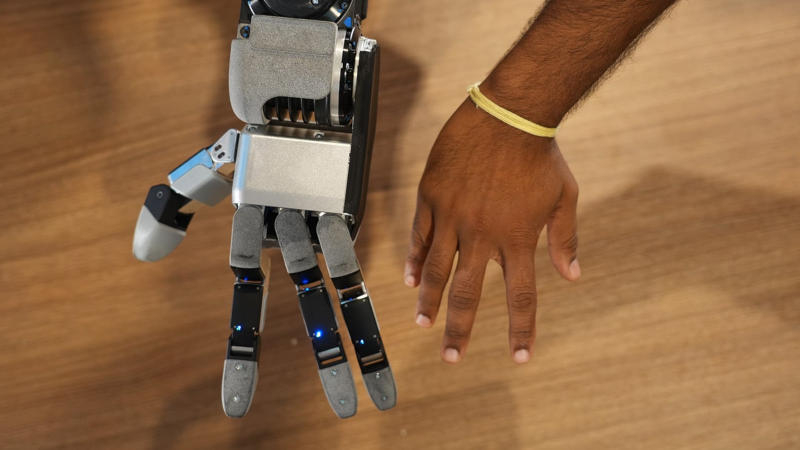
Engineers at Boston Dynamics settled on a four-finger robotic hand design after determining that a pinky finger offered no functional advantage—they even tried attaching their ring finger to their pinky finger for a day. Even with this design, the hand can be precisely held with a “pinch” (thumb and any other fingers), with three fingers in a row, and can also control tools: drills, screwdrivers, grinders and other equipment.
The robot learns actions based on human models: he can put on gloves, perform an action, and the system will repeat it. But that’s not enough, because the work of the hand is more than just a series of finger movements; The machine must instantly monitor its current position and process tactile feedback. Therefore, the best option seems to be to employ reinforcement learning mechanisms in simulations and then transfer the models to real robots. Engineers are already seeing the first successful results in transferring skills from simulation to the real world, and this direction will continue to develop further.
The hands must be dexterous, not so that the robot can perfectly imitate human movements, but so that it can continue to work effectively in unprepared environments. Requires dexterity when using tools, cord and handling containers. Boston Dynamics acknowledges that it’s impossible to create a one-size-fits-all hand; different scenarios require different mutually exclusive properties.
If you find an error, select it with your mouse and press CTRL+ENTER.