
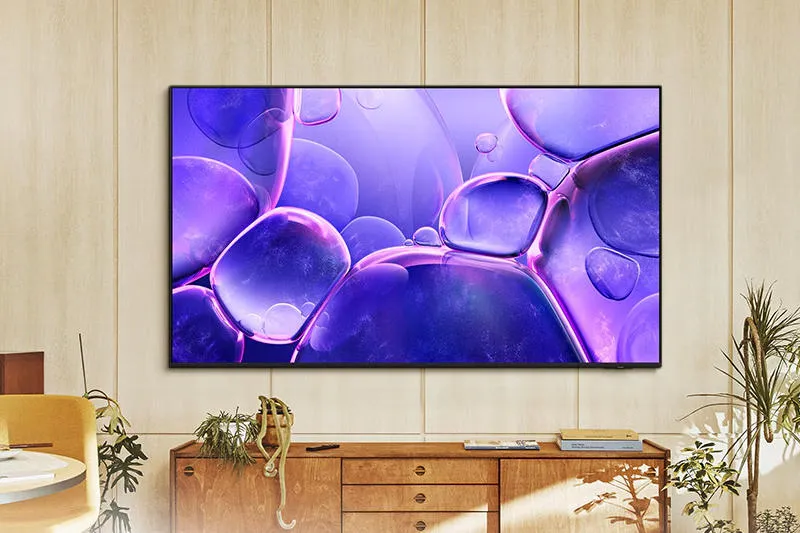
Chinese manufacturer TCL has filed a lawsuit against Samsung, accusing its Korean rival of unfairly promoting cheap LCD TVs with simple LED backlights as Mini LED models. It seems that if the screen does not have FALD backlight, the question of whether it can be called Mini LED will soon no longer be an empty talk.
Image source: samsung.com
TCL’s stance seems to make sense. Samsung’s M-series TVs range in price from $300 for the 43-inch model to $2,300 for the 100-inch model, raising questions about what exactly qualifies as Mini LED. The dispute exposed a problem faced by buyers: There is no universally accepted standard for Mini LED, and manufacturers have a lot of room to interpret the characteristics of the technology.
TCL said the Samsung M TVs do not have backlights that support full array local dimming (FALD), the most advanced backlight technology available for LCD panels. FALD lighting involves combining dozens to thousands of tiny LEDs into individual zones, each of which can be independently adjusted in brightness. This helps improve contrast and image quality for full HDR support.
However, on the page of Samsung M series TVs, the specifications are given honestly, indicating that the Supreme Mini LED Dimming technology used works at the software level and does not involve hardware full matrix backlighting. Meanwhile, Samsung is also using the term Supreme Mini LED Dimming for its Neo QLED TVs – TCL admits these models are true Mini LED TVs. And there’s no footnote about Neo QLED using software rather than hardware solutions.
Software brightness control involves analyzing each video frame, dividing it into regions and determining the brightness level of each region. Based on this information, the panel adjusts the brightness of the frame to increase perceived contrast. At the same time, unlike displays with FALD backlights, the actual brightness level remains uniform across the entire screen.
Panels with LED backlighting that support FALD technology should have a higher contrast ratio than similar screens without this feature. However, experts are convinced that if a monitor does not support FALD, it cannot be classified as Mini LED, if only because Mini LED technology emerged as an improved version of FALD. Samsung itself has partially confirmed this, saying on its website that Mini LED technology includes local dimming.
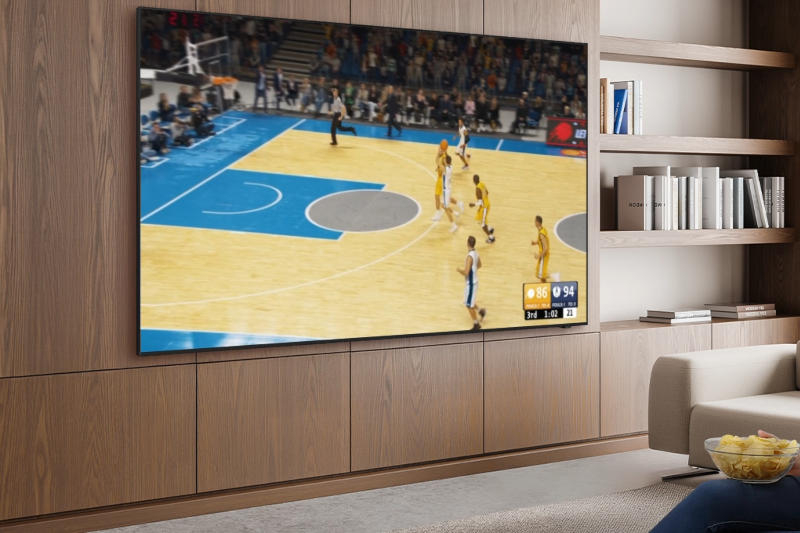
Another aspect is the size of the LED, which can correspond to the Mini LED level. There is no uniform standard: in some cases they are defined in the range 0.05-0.3 mm, in others 0.1-0.2 mm, 0.1-0.3 mm or “usually less than 200 µm (0.2 mm)”. TCL’s lawsuit covers a range of 0.1 to 0.3 millimeters, while the LEDs in Samsung’s M-series TVs are 0.5 millimeters – and no source classifies components of these sizes as Mini LEDs.
Additionally, Samsung M series models only use dozens of LEDs, while some Mini LED displays use thousands of LEDs. For cheap Samsung TVs, instead of forming a matrix on the panel, they are placed on two aluminum strips.
This affects the image quality of your TV. RTINGS notes that these panels have a lower contrast ratio (6440:1), which is why “dark scenes in dark rooms look washed out.” When displaying pictures in HDR “Content created at 600 or 1000 cd/m² brightness (most HDR content) is cut off sharply at the TV’s peak brightness levels. This helps the TV produce maximum brightness, but reduces gradient detail in frame highlights, causing bright details to blend into each other.”.
In comparison, the calibrated Samsung Neo QLED QN80H TV equipped with “honest” Mini LED displays a contrast ratio of 80,000:1 and correspondingly high picture quality. In turn, the budget model TCL QM6K achieved a contrast ratio of 118,059:1 after calibration, but, as the review author points out, halos were observed around bright objects and the TV failed to deliver impressive HDR images.
Therefore, even the presence of micro-LEDs and local dimming zones does not guarantee high image quality, and just like the Samsung M series models, their performance is not as good as more expensive models. The buyer suffered a loss as a result. The terms Mini LED and QLED are used everywhere these days, but they don’t always reflect the actual characteristics of the TV. Manufacturers may not reveal the size of the LED, the number of dimming zones, or exact contrast and brightness values. You can only trust the results of independent testing and price comparisons.
If you find an error, select it with your mouse and press CTRL+ENTER.