



Employees of the Spanish Museum of Computing presented the results of a project they had been working on for 18 months – a replica of the legendary Cray-1 supercomputer, built from 30 old Mac minis. The creation of an unusual exhibit was timed to coincide with the 50th anniversary of the commissioning of the legendary supercomputer and the 50th anniversary of the founding of Apple. The new supercomputer is more powerful than the original, although it is built from outdated systems.
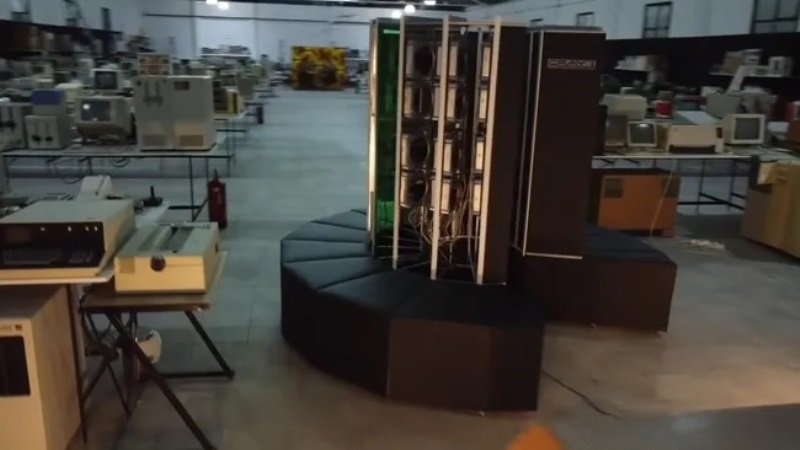
Image source: Museo de Historia de la Computación / YouTube
All Mac Minis involved in the project were released between 2012 and 2014: 25 computers based on dual-core Intel Core i5 chips and five based on quad-core Core i7 chips were used. In total, enthusiasts received a system with 70 cores, which showed a peak performance of 1.5 teraflops, which is approximately 9375 times more than the 160 megaflops of performance of the original Cray-1. During testing, one of the computers with a quad-core processor failed, causing overall performance to drop to 1.3 teraflops.
The original Cray-1 is considered the first commercially successful supercomputer, selling 80 units upon its debut in 1976. Scientific institutions have actively used it to process data sets, including for more accurate weather forecasting, calculations in the field of aerodynamics, nuclear physics and structural analysis.
The supercomputer was efficient in such calculations thanks to vector processing, which is something we take for granted these days. It was this approach that made the Cray-1 so powerful for its time, since many computers still executed one instruction at a time. At the same time, Cray-1 processed entire sets of numbers in parallel, saving enormous amounts of time.
The original Cray-1 used refrigerant pipes for cooling, which led to 20-ton refrigeration compressors located in a separate room. Since then, technology has come a long way, so the replica uses only passive cooling. The entire system operates very quietly; the Ethernet switches used in the project produce more noise. In the future, the authors of the project plan to replace them with silent ones.
To allow museum visitors to see the Cray-1 replica in action, a special retro-style control terminal was created. Something similar can be found in old films: a large metal table, in the center there is a keyboard, and several monitors are built into a panel running along the table. On the sides of the screens there are angled design elements that complete the characteristic silhouette of the control panel from the 70s of the last century.
On the screens you can see how the system copes with tasks of multiplying large matrices – this is exactly what the Cray-1 replica does especially well. Interestingly, the supercomputer can be run on macOS Mojave, as this operating system supports the Message Passing Interface, a message passing interface that allows instructions to be distributed across multiple Mac Minis for parallel computing.
The staff of the Spanish museum do not intend to limit themselves to this project. They want to launch a crowdfunding campaign to buy 70-80 more modern Mac Minis with the M4 chip. The goal of the new project is to get into the TOP 500 supercomputers rating.
If you notice an error, select it with the mouse and press CTRL+ENTER.


