



In 2027, the global laptop market will face weakening demand due to rising prices for RAM, processors and other components. In a worst-case scenario, device shipments could decline by close to 10% if manufacturers pass on most of the additional costs to buyers, analysts predict.
According to TrendForceglobal laptop shipments are initially expected to decline by several percent in 2027. However, rising costs of DRAM and processors may force manufacturers to raise retail prices, causing users to wait longer to replace devices. In this case, the annual drop in supplies could reach high single digits, that is, approaching 10%.
In 2026, the PC market was supported by improved processor availability, early purchases by component manufacturers and the postponement of some purchases. However, this does not mean a full recovery in demand: some users purchased laptops earlier than planned, so buyer activity may decrease in subsequent periods. An additional factor will be the gradual depletion of stocks of components purchased at lower prices.
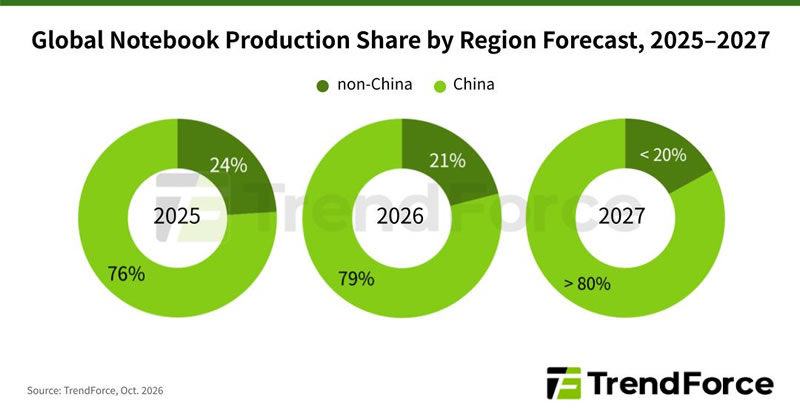
Image source: TrendForce
Analysts cite as an example mass-segment laptops with a recommended retail price manufacturer (MSRP) at $900. In the third quarter of 2026, the processor, DRAM and SSD storage accounted for about 68% of the cost of its components. Therefore, a further increase in the price of these components can significantly affect the cost of finished devices. Manufacturers will have to choose between raising prices, reducing their own profits and reducing laptop characteristics, such as the amount of RAM.
Changes may also affect the geography of production. The share of laptops manufactured outside China will decline from 24% in 2025 to 21% in 2026, and may drop below 20% in 2027. With rising costs for logistics, component procurement and supply chain management, manufacturers may return some capacity to China if pressure from tariffs does not increase. At the same time, the DRAM shortage may continue due to high demand from servers for AI, while the situation with NAND Flash may improve in the second half of 2027 due to the introduction of new production capacities.
Additional pressure on the industry comes from printed circuit boards (PCBs), multilayer ceramic capacitors (MLCCs), and power management ICs (PMICs). Their costs and delivery times are affected by the distribution of production capacity, raw material prices and geopolitical factors.
TrendForce believes that in 2027 the key issue will no longer be the availability of components, but rather the willingness of buyers to pay for more expensive devices. If manufacturers can partially offset rising costs and adjust laptop configurations, the decline in shipments will remain moderate. However, if additional costs are fully passed on to consumers, it could be significantly stronger in 2027.
If you notice an error, select it with the mouse and press CTRL+ENTER.


