


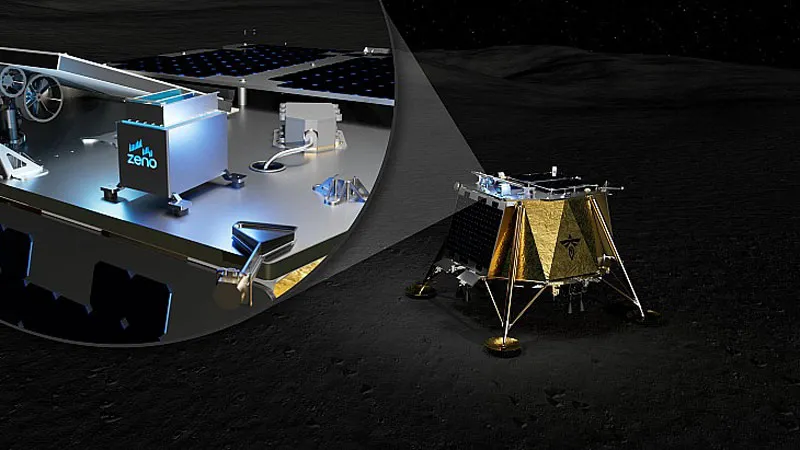
CompaniesFirefly Aerospace and Zeno Power Systems Prepare Demonstrating new technology that could help spacecraft survive the extreme conditions of a moonlit night. As part of the commercial agreement, the Blue Ghost lunar lander will deliver a radioisotope heating unit (RHU) powered by americium-241 to the lunar surface. As part of NASA’s current business plan, the mission is scheduled to launch no earlier than 2028.
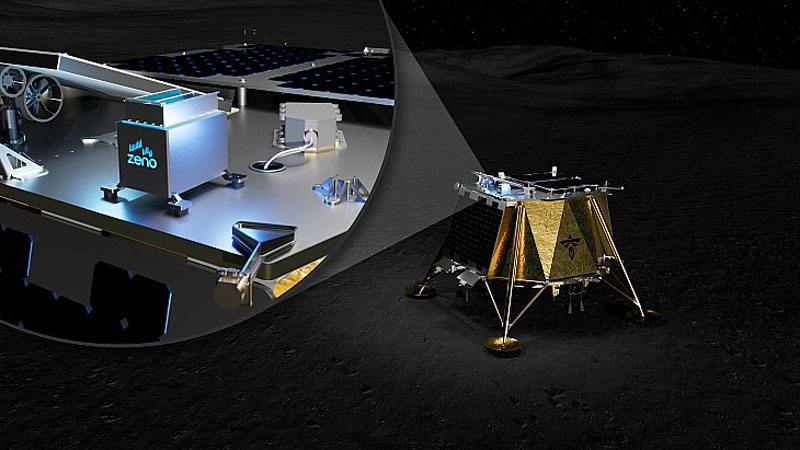
Image source: Firefly Aerospace
The main task of future experiments will be to test the possibility of long-term operation of new heating equipment during the lunar 14-day night, when the lunar surface cools rapidly due to the lack of an atmosphere capable of retaining heat. Near the equator, temperatures can drop to about -133 °C, and in permanently shadowed polar craters, temperatures are even lower. The Zeno radioisotope heater will generate approximately 5 watts of heat energy from the natural radioactive decay of americium-241, providing a constant heat source without the need for solar radiation.
The payload includes not only the thermal element itself, but also ancillary platforms with power, communications, control, data processing and thermal control systems. After landing, the “Blue Ghost” using solar panels will first perform NASA’s main science programs during the lunar daytime, and then the radioisotope device will continue to operate during the lunar nighttime to transmit equipment status data to the Earth.
The use of americium-241 is considered an alternative to traditional radioisotope systems based on plutonium-238, which has traditionally been used on spacecraft to maintain comfortable temperatures for the operation of onboard electronics, but has had limited availability. U.S. plutonium-238 production capacity closed in the 1980s, and since 1992 demand has been met largely through procurement contracts from Russia. That contract ended around 2008, and five years later the United States began manufacturing its own sources of plutonium-238, but it was still not enough for all uses.
As an alternative, Americium-241 looks more attractive. Its half-life is five times longer than that of plutonium-238. But more is needed to get the same heat energy and emit more radiation, which can be solved. But americium-241 is formed during the reprocessing of spent nuclear fuel and can be obtained from waste in virtually unlimited quantities. It is obtained in the United States and can be produced on a large scale. This would be an interesting solution for NASA’s future lunar and space programs.
If you find an error, select it with your mouse and press CTRL+ENTER.